March 30

What was advertised in a colonial American newspaper 250 years ago today?
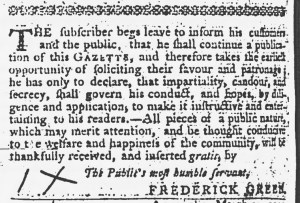
Maryland Gazette (March 30, 1775).

“He shall continue a publication of this GAZETTE.”

On March 30, 1775, the colophon for the Maryland Gazette stated, “ANNAPOLIS: Printed by FREDERICK GREEN,” for the first time.  In the previous issue, it read, “ANNAPOLIS: Printed by ANNE CATHARINE GREEN and SON.”  Anne Catharine Green had been publishing the newspaper since April 16, 1767, upon the death of her husband, Jonas.  She commenced a partnership with her son, William, in January 1768, but it ended with his death in August 1770.  In January 1772, she commenced another partnership, that one with another son, Frederick.  When she died on March 23, 1775, he became the sole publisher.

On that occasion, he inserted his own notice in the Maryland Gazette, placing it first among the advertisements in the March 30 edition.  Frederick “inform[ed] his customers and the public, that he shall continue a publication of this GAZETTE.”  He offered assurances of his editorial strategy, pledging that “impartiality, candour, and secrecy, shall govern his conduct.”  Through “diligence and application,” he intended to make the newspaper “instructive and entertaining to his readers.”  To that end, “All pieces of a public nature, which may merit attention, and be thought conducive to the welfare and happiness of the community, will be thankfully received, and inserted gratis.”  As had been the case when he worked alongside his mother, the printer needed to cultivate relationships with readers who would supply content to fill the pages of his newspaper.
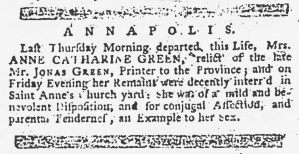
Maryland Gazette (March 30, 1775).

Elsewhere on the same page, Frederick ran a death notice in memory of his mother.  Thick black borders appeared above and below it, a common practice readily recognized as a sign of mourning.  “Last Thursday Morning,” the notice reported, “departed this Life, Mrs. ANNE CATHARINE GREEN, relict of the late Mr. JONAS GREEN, Printer to the Province.”  Her son remembered her “mild and benevolent Disposition,” declaring that “for conjugal Affection, and parental Tenderness” she was “an Example to her Sex.”  He did not elaborate on the service she provided to Annapolis and the rest of the colony.  Throughout most of her tenure as printer, the Maryland Gazette had been the only newspaper published in Maryland.  Anne Catharine Green was one of several women who ran printing offices in colonial America during the imperial crisis that culminated in a war for independence.  Along with Margaret Draper, Sarah Goddard, and Clementina Rind, she contributed to the dissemination of news and shaping of public opinion as momentous events occurred.

June 28

What was advertised in a colonial American newspaper 250 years ago this week?

Maryland Gazette (June 25, 1772).

“ADVERTISEMENTS, of moderate Length, are inserted the First Time, for 5s.”

Many colonial printers did not regularly publish how much they charged for newspaper subscriptions or advertising, while some included that information in the colophon at the bottom of the final page of each issue.  A few transformed their colophons into extensive advertisements for all sorts of goods and services available at their printing offices.

Such was the case for Anne Catherine Green and Son, printers of the Maryland Gazette.  They did not merely state that they printed their newspaper in Annapolis.  Instead, they declared that “all Persons may be supplied with this GAZETTE, at 12s. 6d. a Year” or twelve shilling and six pence annually.  Green and Son published advertisements “of a moderate Length” for five shillings “the First Time” and an additional shilling “for each Week’s Continuance.”  Like many other printers, they charged more for “Long Ones in Proportion to their Number of Lines.”  Some printers gave prices for only subscriptions or for only advertisements.  The more complete accounting from Green and Son demonstrates that a single advertisement that ran for a month generated almost as much revenue as a subscription for an entire year.

In addition to printing the Maryland Gazette, Green and Son also sold “most kinds of BLANKS” or printed forms for legal and financial transactions.  Throughout the colonies, printers hawked blanks.  Green and Son listed “COMMON and BAIL BONDS; TESTAMENTARY LETTERS of several Sorts, with their proper BONDS annexed; BILLS of EXCHANGE; [and] SHIPPING-BILLS.”  They appended “&c.” (an eighteenth-century abbreviation for et cetera) to indicate that they had on hand, “ready Printed,” an even greater variety of blanks to meet the needs of their customers.  In addition, they did “All Manner of PRINTING-WORK … in the neatest and most expeditious Manner.”  That included broadsides for posting around town, handbills for distributing on the streets, catalogs for auctions, and other advertising materials.

Each issue of the Maryland Gazette concluded with an extensive advertisement for goods and services available at the printing office.  Green and Son significantly expanded the colophon beyond giving the name of the printer and the place of publication, reminding readers that the printing office offered far more than just copies of the newspaper.

March 15

What was advertised in a colonial American newspaper 250 years ago this week?

Maryland Gazette (March 12, 1772).

“All Persons may be supplied with this GAZETTE, at 12s. 6d. a Year.”

Advertisements usually filled the final page of the Maryland Gazette in the early 1770s.  In addition, a colophon appeared at the bottom of the page.  Rather than merely announcing the names of the printers and place of publication, “ANNAPOLIS: Printed by ANNE CATHARINE GREEN and SON, at the PRINTING-OFFICE,” the lengthy colophon served as an advertisement for various goods and services.  Not all colonial printers used the colophon for such purposes, but a significant number did so.

Most commonly, printers promoted their newspapers – subscriptions, advertisements, or both – when they published extended colophons.  Green and Son informed prospective subscribers that they “may be supplied with this GAZETTE, at 12s. 6d. a Year.”  In addition, “ADVERTISEMENTS, of a moderate Length, are inserted the First Time, for 5s. and 1s. for each Week’s Continuance.”  Advertisers received a significant discount for running their notices more than once, but the higher fee for the initial insertion also covered setting type and bookkeeping.  Green and Son did not define what constituted a “moderate Length” for advertisements, but did state that they charged fees for “Long Ones in Proportion to their Number of Lines.”  Advertisements generated significant revenue for most colonial printers.

Green and Son also used the colophon to hawk blanks or printed forms for commercial and legal transactions.  They had in stock, “ready Printed, most kinds of BLANKS,” including “COMMON and BAIL BONDS; TESTAMENTARY LETTERS of all Sorts, with their proper BONDS annexed; and BILLS of EXCHANGE; SHIPPING-BILLS, &c. &c.”  Repeating the abbreviation for et cetera underscored the range of blanks available at the printing office.  Finally, Green and Son did job printing, including broadsides and handbills, when colonizers placed orders.  They declared, “All Manner of PRINTING-WORK performed in the neatest and most expeditious Manner,” emphasizing skill and efficiency.

Once readers perused the paid notices that ran in the Maryland Gazette they encountered a final advertisement at the bottom of the last page.  Green and Son transformed the colophon into a marketing mechanism that remained consistent from issue to issue even as the other contents changed.  They listed many of the goods and services available at printing offices throughout the colonies, while also specifying the subscription and advertising fees for their own newspaper.

January 18

What was advertised in a colonial American newspaper 250 years ago today?

Jan 18 - 1:18:1770 Maryland Gazette
Maryland Gazette (January 18, 1770).

“ADVERTISEMENTS, of a moderate Length, are inserted the First Time, for 5s.”

How much did it cost to place an advertisement in a colonial American newspaper? That question does not always yield ready answers. Most printers did not regularly publish their advertising rates. Those that did publish them usually did so in one of two places: the plan in the first issue of a new publication and the colophon that ran at the bottom of the final page of each issue. Some printers commenced publication of their newspapers with a plan or overview of their purpose and the kinds of information they intended to publish as well as details that included the quality of the paper and type and subscription and advertising rates. Other printers treated the colophon as a place for recording more than just their names and place of publication. They used the colophon as a mechanism for marketing the various operations at the printing office. There they sometimes indicated subscription fees, advertising rates, or both.

Such was the case in the Maryland Gazette published by Anne Catharine Green and William Green in Annapolis in 1770. The colophon listed the costs of both subscribing and advertising. The Greens declared that “all Persons may be supplied with this GAZETTE at 12s. 6d. a Year.” In addition, “ADVERTISEMENTS, of a moderate Length, are inserted the First Time, for 5s. and 1s. for each Week’s Continuance. Long ones in Proportion to their Number of Lines.” The Greens followed standard practices, yet also introduced one modification. Most printers who published their advertising rates had both an initial fee and then an additional fee for “each Week’s Continuance.” However, for most printers that initial fee included publishing the advertisement for several weeks, usually three or four, before incurring additional costs. The Greens did not offer any sort of package deal that included multiple insertions. This had the benefit of lowering the initial cost, but may have prevented prospective advertisers from feeling as though they got a bargain on the second and third insertions. Still, the fee structure suggests that the Greens charged four shillings for setting type and another shilling for the space the advertisement occupied the first time. After that, they charged only a shilling for each additional insertion, the type having already been set. Like other printers, they increased the rates for lengthy advertisements that took up more space. Prices for advertisements much larger than a “square” were assessed “in Proportion to their Number of Lines” rather than by the number of words.

That the Greens published the price of an annual subscription, twelve shillings and six pence, allows for comparison of the relative costs of subscribing and advertising. At five shillings for the first insertion, an advertisement cost 40% of a subscription. Advertisements that ran for multiple weeks steadily gained on the price of subscriptions, only needing to run for nine weeks for the former to exceed the latter. The financial viability of many colonial newspapers often depended much more on their ability to attract advertisers rather than subscribers.