March 7

What was advertised in a revolutionary American newspaper 250 years ago today?
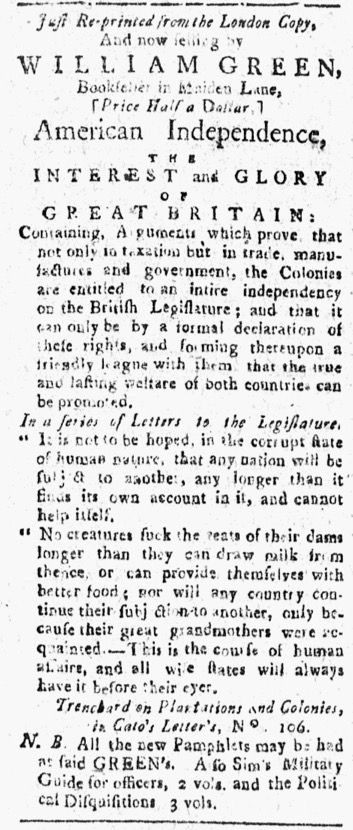
New-York Journal (March 7, 1776).

“THE NEW EDITION OF COMMON SENSE.”

“LARGE ADDITIONS TO COMMON SENSE.”

The March 7, 1776, edition of the New-York Journal included competing advertisements for Thomas Paine’s Common Sense and “LARGE ADDITIONS TO COMMON SENSE.”  Although John Anderson, the printer of the Constitutional Gazette, recently published a New York edition of Paine’s pamphlet, neither of these advertisements promoted pamphlets printed in that city.  Instead, both advertisements hawked pamphlets printed in Philadelphia and sent to New York.

New-York Journal (March 7, 1776).

Garrat Noel and Ebenezer Hazard stocked the “NEW EDITION OF COMMON SENSE; With Additions and Improvements in the Body of the WORK” published by William Bradford and Thomas Bradford, printers of the Pennsylvania Journal.  When Paine and Robert Bell, the publisher of the first edition of Common Sense, had a falling out, the author collaborated with the Bradfords on a “NEW EDITION” that featured new material, including “AN APPENDIX, And an ADDRESS to the People, called, QUAKERS.”  As the Bradfords prepared that edition for press, Bell published an unauthorized second edition and then supplemented it with yet another pamphlet of “LARGE ADDITIONS” that included “The American Patriot’s Prayer” and “American Independency defended, by Candidus.”  In their advertisements, the Bradfords warned that the pamphlet “consists of pieces taken out of News-Papers, and NOT written by the AUTHOR of Common Sense.”  To spite Paine and the Bradfords, Bell then pirated “An Appendix to Common Sense; together with an Address to the People called Quakers, on their Testimony concerning Kings and Government, and the present Commotions in America” and packaged it with the “LARGE ADDITIONS.”

The advertisements in the New-York Journal reveal that Noel and Hazard stocked the Bradfords’ edition of Common Sense at the Constitutional Post Office and that William Green, a bookseller and bookbinder in Maiden Lane, carried Bell’s “LARGE ADDITIONS.”  Noel and Hazard’s advertisement included the warning about items from newspapers passed off as Paine’s work.  Green previously placed the first advertisement for Common Sense that appeared in any newspaper beyond Philadelphia, identifying himself as Bell’s local agent for distributing the pamphlet.  That he now advertised the “LARGE ADDITIONS” demonstrated that Bell continued supplying him with pamphlets to peddle in New York.  Even as printers in New York and other towns produced local editions of Common Sense, printers in Philadelphia tried to expand their share of the market for the popular pamphlet by sending copies to local agents to advertise and sell.

February 18

What was advertised in a revolutionary American newspaper 250 years ago this week?

New-York Journal (February 15, 1776).

“A NEW and CORRECT EDITION … of that justly esteemed PAMPHLET, called COMMON SENSE.”

A month after Robert Bell published the first edition of Thomas Paine’s Common Sense in Philadelphia on January 9, 1776, readers of the New-York Journal certainly knew about the pamphlet, even if they had not read it or heard much about its contents.  Just reading the newspaper would have been enough to get a sense of the pamphlet’s popularity.  After all, the February 15 edition of the New-York Journal carried four advertisements for Common Sense!

Some of them would have looked familiar to regular readers of that newspaper.  William Green, a bookbinder in Maiden Lane and Bell’s agent in New York, once again advertised the unauthorized “Second Edition of COMMON SENSE” that Bell published in Philadelphia.  It was the third consecutive week his notice ran in the New-York Journal.  Also appearing for the third time, another advertisement informed readers that William Bradford and Thomas Bradford would soon publish a “NEW EDITION, (with LARGE and INTERESTING ADDITIONS …) OF COMMON SENSE,” an edition undertaken “by appointment of the Author.”  After a falling out with Bell, Paine approached the printers of the Pennsylvania Journal to publish a new edition.  The Bradfords set about advertising that expanded edition in both Philadelphia and New York.

A variation of one of the other advertisements ran in the previous issue of the New-York Journal.  In it, John Anderson, the printer of the Constitutional Gazette, announced publication of a local edition of “that justly esteemed PAMPHLET, called COMMON SENSE.”  The previous version ended with the title of the pamphlet.  The new one included two elements often included in other advertisements for Common Sense: the section headings that outlined the contents and an epigraph from “Liberty,” a poem by James Thomson.  The addition material in Anderson’s advertisement may have helped draw attention to it …

… but the final advertisement dwarfed all the others.  For the first time, Bell advertised directly in the New-York Journal rather than indirectly through Green.  In doing so, he transferred to New York the feud that he and Paine had waged in advertisements in the Pennsylvania Evening Post and other newspapers published in Philadelphia.  Compared to the Bradfords’ new edition “In the PRESS, and will be published as soon as possible,” Bell’s unauthorized second edition was “Out of the Press” and on sale.  His notice included the section headers and epigraph by Thomson as well as an address “To the PUBLIC” that first appeared in the Pennsylvania Evening Post on January 27 and an even longer diatribe “To Mr. ANONYMOUS” that first appeared in the Pennsylvania Evening Post on February 1.  While the Bradfords’ advertisement hinted at discord between Bell and Paine, this advertisement put the argument on full display for readers in New York.  Perhaps that helped generate interest in the pamphlet.  For readers who had not yet perused Common Sense themselves, those four advertisements may have encouraged them to acquire a copy to find out more about all the hullabaloo.

February 14

What was advertised in a revolutionary American newspaper 250 years ago today?

Constitutional Gazette (February 14, 1776).

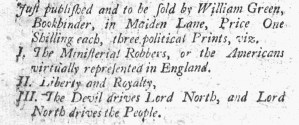
The Devil drives Lord North, and Lord North drives the People.”

In the February 14, 1776, edition of the Constitutional Gazette, William Green, a bookbinder, advertised “three political Prints” for sale for one shilling each at his shop in Maiden Lane in New York.  He listed the titles, but he did not describe them to prospective customers.  Perhaps he did not wish to pay for the additional space in the newspaper.  Perhaps he thought the titles provided sufficient description.  Perhaps he considered the titles evocative enough to spark curiosity among readers, prompting them to visit his shop to discover for themselves what exactly each print depicted.  After all, titles like “The Ministerial Robbers, or the Americans virtually represented in England” and “The Devil drives Lord North, and Lord North drives the People” simultaneously told a story and expressed support for the American cause.  Notably, the purveyor of these “political Prints” was the first person to advertise Thomas Paine’s Common Sense outside of Philadelphia, doing so just eleven days after Robert Bell, the publisher of the first edition, announced its publication.

Readers may have been familiar with some of the political cartoons that Green advertised.  In the fall of 1775, William Woodhouse, John Norman, and Robert Bell placed an advertisement in the Pennsylvania Journal to promote “The MINISTERIAL ROBBERS; or AMERICANS VIRTUALLY Represented in ENGLAND,” a “SATYRICAL PRINT” that “LATELY ARRIVED FROM LONDON.”  Green may have sold copies from London or an American edition of the print.

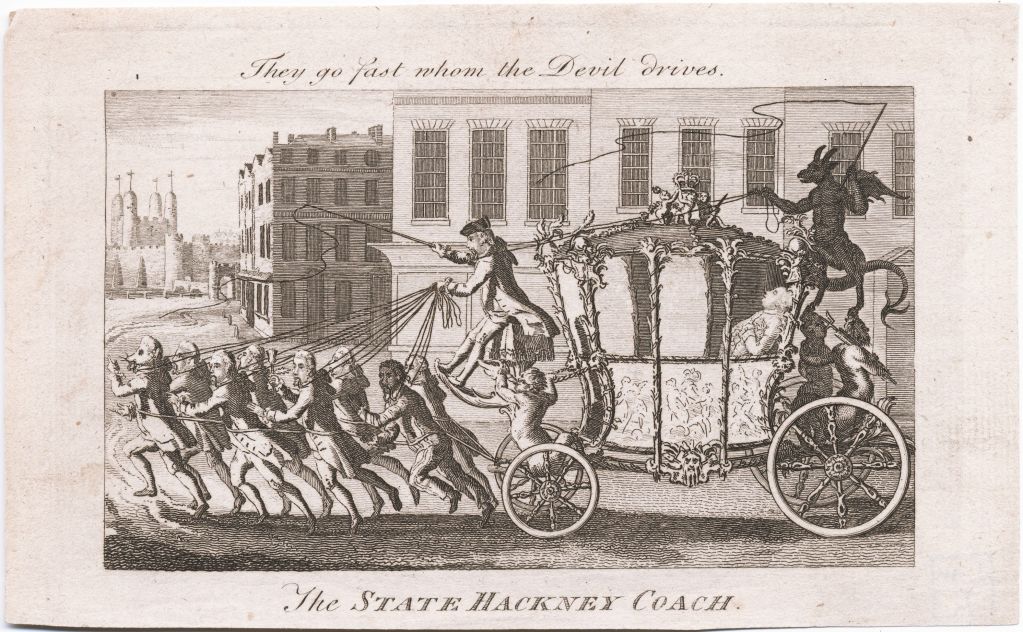
Another of those political cartoons, “The Devil drives Lord North, and Lord North drives the People,” originated in London as “The State Hackney Coach,” a plate that adorned the London Magazine for December 1772.  The print depicted a coach pulled by eight men rather than horses with Lord North, the prime minister, driving them.  Most of those men did not have distinguishing features; they represented any of the members of Parliament and other officials who allowed the prime minister to dominate them.  The first figure had a face that looked more like a rat than a man, additional commentary on the character of those members of Parliament.  Henry Fox, one of North’s proteges, and Jeremiah Dyson, Lord of the Treasury, were recognizable.  Although North drove the men with a whip, a devil perched on the back of the coach had his own whip that he used to steer North’s course.  A caption above the image declared, “They go fast whom the Devil drives.”  Inside the carriage, George III slept, apparently oblivious to any problems.

Green almost certainly displayed these political cartoons in his shop.  Customers who came to purchase Common Sensewould have seen images that worked in tandem with Paine’s attitudes toward monarchy and calls to declare independence.  They may even have decided to purchase both a print and a pamphlet, expressing their own political principles through the choices they made in the marketplace.

“The State Hackney Coach,” a print that adorned the London Magazine (December 1772). Courtesy Lewis Walpole Library, Yale University.

January 22

What was advertised in a revolutionary American newspaper 250 years ago today?

New-York Gazette and Weekly Mercury (January 22, 1776).

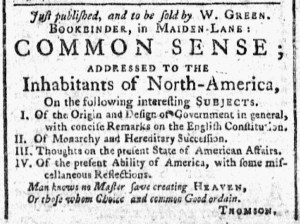
To be sold by W. GREEN … COMMON SENSE.”

Just days after an advertisement for Thomas Paine’s Common Sense made its first appearance in a newspaper beyond those published in Philadelphia, a second advertisement appeared in yet another newspaper.  The Constitutional Gazettecarried that first advertisement on January 20, 1776.  A variation ran in the New-York Gazette and Weekly Mercury on January 22.

Both advertisements included the title of the political pamphlet, “COMMON SENSE,” though the version in the Constitutional Gazette indicated that it was “ADDRESS TO THE INHABITANTS OF AMERICA” while the one in the New-York Gazette and Weekly Mercury instead stated that it was “ADDRESSED TO THE Inhabitants of North-America.”  Both listed the “interesting SUBJECTS” contained within the pamphlet, offering four section headings that included “Of the Origin and Design of Government in general, with concise Remarks on the English Constitution” and “Thoughts on the present State of American Affairs.”  Both concluded with an epigraph from James Thomson’s poem, “Liberty” (1734): “Man knows no Master save creating HEAVEN, / Or those whom Choice and common Good ordain.”  Those lines previewed the arguments readers would encounter in the pamphlet.  These advertisements in newspapers printed in New York replicated those previously published in newspapers in Philadelphia.

The new advertisement in the New-York Gazette and Weekly Mercury did have one significant difference from the earlier advertisements.  It did not include the name of the publisher of the first edition, Robert Bell.  The introduction to the version in the Constitutional Gazette did mention the prominent printer and bookseller, advising readers that “ROBERT BELL, in Third-Street, Philadelphia,” sold the pamphlet and then also listing William Green, a “Bookseller, in Maiden Lane, New-York,” as a local purveyor of Common Sense.  The version in the New-York Gazette and Weekly Mercury, however, eliminated Bell and named Green as the sole vendor of the pamphlet: “Just published, and to be sold by W. GREEN.  BOOKBINDER, in MAIDEN-LANE.”  Eighteenth-century readers knew to separate the phrases “Just published” and “to be sold by.”  Only the latter referred to Green’s role in the production and distribution of the pamphlet.  The phrase “Just published” merely meant “now available.”  Green did not print Common Sense, but when he submitted copy for his advertisement to the New-York Gazette and Weekly Mercury’s printing office he privileged his role in making the incendiary new pamphlet available in that city.  As the pamphlet gained popularity, John Anderson, the printer of the Constitutional Gazette, published and advertised a local edition (and a second local edition), but for a short time Green was the only retailer in New York hawking the pamphlet in the public prints.  His marketing efforts contributed to the stir caused by Paine’s appeal to declare independence rather than continue to seek a redress of grievances within the imperial system.

January 20

What was advertised in a revolutionary American newspaper 250 years ago today?

Constitutional Gazette (January 20, 1776).

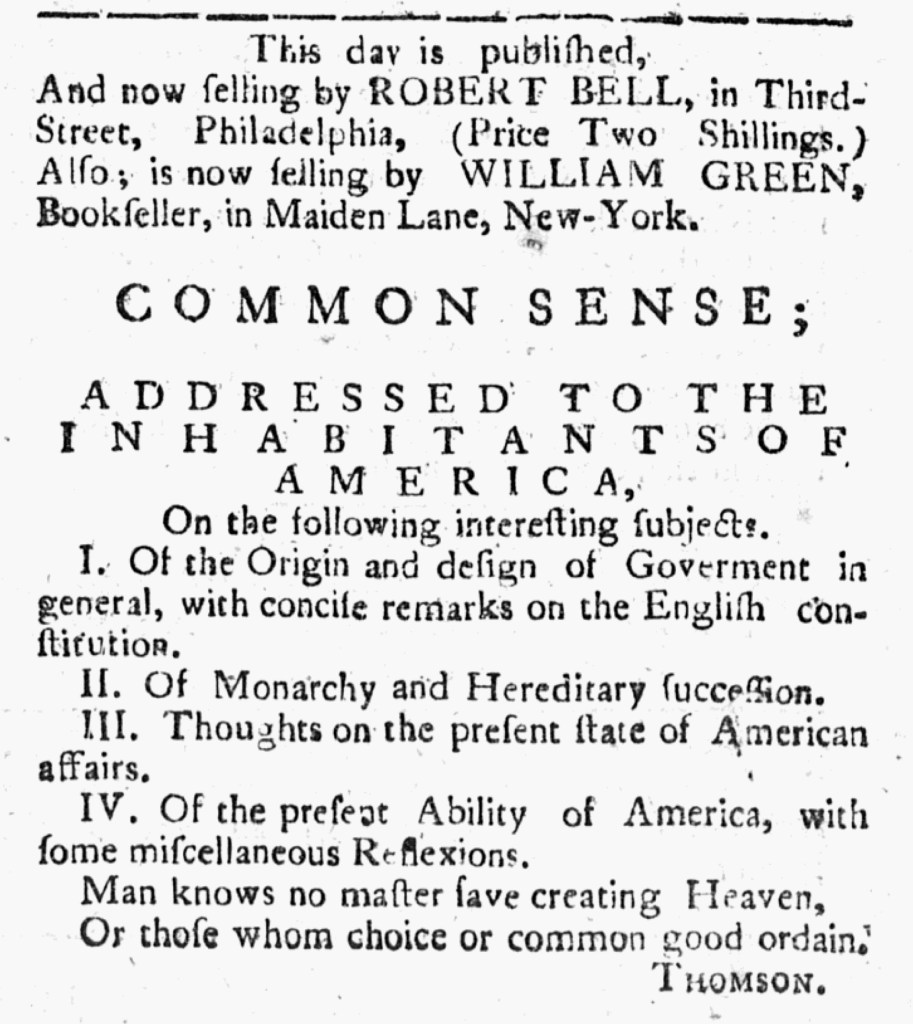
“Now selling by WILLIAM GREEN, Bookseller, in Maiden Lane, New-York.  COMMON SENSE.”

Just eleven days after the first newspaper advertisement for Thomas Paine’s Common Sense appeared in the January 9, 1776, edition of the Pennsylvania Evening Post, the first advertisement for the inflammatory political pamphlet ran in a newspaper outside of Philadelphia.  Within a week, Robert Bell, the publisher of the first edition, inserted advertisements in all six newspapers printed in Philadelphia, including Henrich Millers Pennsylvanischer Staatsbote.  One of the most savvy and influential American printers and booksellers of the eighteenth century, Bell quickly dispatched copies of the pamphlet to New York.  On January 20, the Constitutional Gazette carried an advertisement that nearly replicated those in Philadelphia’s newspapers.

That notice announced the publication of the pamphlet and stated that it was “now selling by ROBERT BELL, in Third-Street, Philadelphia” for two shillings per copy.  Yet prospective customers did not need to send to Philadelphia to acquire copies because the pamphlet was “now selling by WILLIAM GREEN, Bookseller, in Maiden Lane, New-York.”  Like the other advertisements, the notice in the Constitutional Gazette did not identify Paine as the author.  It gave the title of the work, “COMMON SENSE; ADDRESSED TO THE INHABITANTS OF AMERICA,” and listed the various headings for the sections of the pamphlet.  Readers may have already heard about a new pamphlet that took Philadelphia by storm and some of the arguments for declaring independence that it contained, yet such an outline likely told them more than they already knew and whetted their appetites for more.  What did the pamphlet say about “Monarchy and Hereditary succession”?  What kinds of “Thoughts on the present state of American affairs” did it contain?  What did the author think of “the present Ability of America” in its contest against Great Britain?  Even before they saw anything in print, most residents of New York probably first learned about Common Sense via word of mouth.  The advertisement in the Constitutional Gazette offered readers an opportunity to move beyond excited conversations about what they heard the pamphlet said about monarchy, government, and the prospects for declaring independence to obtaining their own copies and reading the treatise for themselves.  It did not take long for advertisements for Common Sense to move beyond Philadelphia’s newspapers to the Constitutional Gazette in New York and other newspapers in other cities and towns.

January 18

What was advertised in a colonial American newspaper 250 years ago today?

Jan 18 - 1:18:1770 Maryland Gazette
Maryland Gazette (January 18, 1770).

“ADVERTISEMENTS, of a moderate Length, are inserted the First Time, for 5s.”

How much did it cost to place an advertisement in a colonial American newspaper? That question does not always yield ready answers. Most printers did not regularly publish their advertising rates. Those that did publish them usually did so in one of two places: the plan in the first issue of a new publication and the colophon that ran at the bottom of the final page of each issue. Some printers commenced publication of their newspapers with a plan or overview of their purpose and the kinds of information they intended to publish as well as details that included the quality of the paper and type and subscription and advertising rates. Other printers treated the colophon as a place for recording more than just their names and place of publication. They used the colophon as a mechanism for marketing the various operations at the printing office. There they sometimes indicated subscription fees, advertising rates, or both.

Such was the case in the Maryland Gazette published by Anne Catharine Green and William Green in Annapolis in 1770. The colophon listed the costs of both subscribing and advertising. The Greens declared that “all Persons may be supplied with this GAZETTE at 12s. 6d. a Year.” In addition, “ADVERTISEMENTS, of a moderate Length, are inserted the First Time, for 5s. and 1s. for each Week’s Continuance. Long ones in Proportion to their Number of Lines.” The Greens followed standard practices, yet also introduced one modification. Most printers who published their advertising rates had both an initial fee and then an additional fee for “each Week’s Continuance.” However, for most printers that initial fee included publishing the advertisement for several weeks, usually three or four, before incurring additional costs. The Greens did not offer any sort of package deal that included multiple insertions. This had the benefit of lowering the initial cost, but may have prevented prospective advertisers from feeling as though they got a bargain on the second and third insertions. Still, the fee structure suggests that the Greens charged four shillings for setting type and another shilling for the space the advertisement occupied the first time. After that, they charged only a shilling for each additional insertion, the type having already been set. Like other printers, they increased the rates for lengthy advertisements that took up more space. Prices for advertisements much larger than a “square” were assessed “in Proportion to their Number of Lines” rather than by the number of words.

That the Greens published the price of an annual subscription, twelve shillings and six pence, allows for comparison of the relative costs of subscribing and advertising. At five shillings for the first insertion, an advertisement cost 40% of a subscription. Advertisements that ran for multiple weeks steadily gained on the price of subscriptions, only needing to run for nine weeks for the former to exceed the latter. The financial viability of many colonial newspapers often depended much more on their ability to attract advertisers rather than subscribers.