March 4

What was advertised in a colonial American newspaper 250 years ago today?

Pennsylvania Evening Post (March 4, 1775).

“WATCH MAIN SPRINGS MADE in Philadelphia.”

The headline proclaimed, “WATCH MAIN SPRINGS.”  Matthia Eyre, “SPRING MAKER from London,” hoped that would draw attention to his advertisement in the March 4, 1775, edition of the Pennsylvania Evening Post.  He informed readers, especially “Watchmakers in this and the neighbouring Provinces,” that he sold spring he produced in the colonies at the house on Third Street in Philadelphia.  In addition, watchmaker John Wood also stocked Eyre’s watch springs at his shop on Front Street.

Eyre asserted that “Watchmakers and others may be supplied with any Quantity of Springs much cheaper than can be afforded when imported from England.”  The price in combination with the “good Quality of the Springs” prompted the “Manufacturer” to suggest that he merited the “Encouragement” of watchmakers who needed parts.  Eyre likely composed his advertisement with confidence that both prospective customers and the public would consider his appeals in the context of current events, including the nonimportation agreement currently in place to protest the Coercive Acts.

The First Continental Congress devised the Continental Association in the fall of 1774.  The first article of that pact prohibited importing “any such Goods, Wares, or Merchandise, as shall have been exported from Great Britain.”  The eighth article, in turn, called for “encourag[ing] Frugality, Economy, and Industry; and promot[ing] Agriculture, Arts, and the Manufactures of this Country.”  Eyre offered an alternative to the watch springs that colonizers were no longer supposed to import, making it easier for them to abide by the Continental Association.  They could do so without sacrificing the quality of the parts they used in their work.  In addition, they had a duty to support a local “Manufacturer” in those troubling times.

Yet those “Watchmakers in this and the neighbouring Provinces” were not the only colonizers who read Eyre’s advertisement.  The spring maker enhanced his reputation in his community while simultaneously providing an example of American industriousness that answered the challenges of that tense political moment.  Readers could hardly peruse Eyre’s notice without having the Continental Association in mind.  He signaled to them that he answered the call, one of many artisans prepared to serve the American cause through his efforts in his workshop.
June 11

What was advertised in a colonial American newspaper 250 years ago today?

Maryland Journal (June 11, 1774).

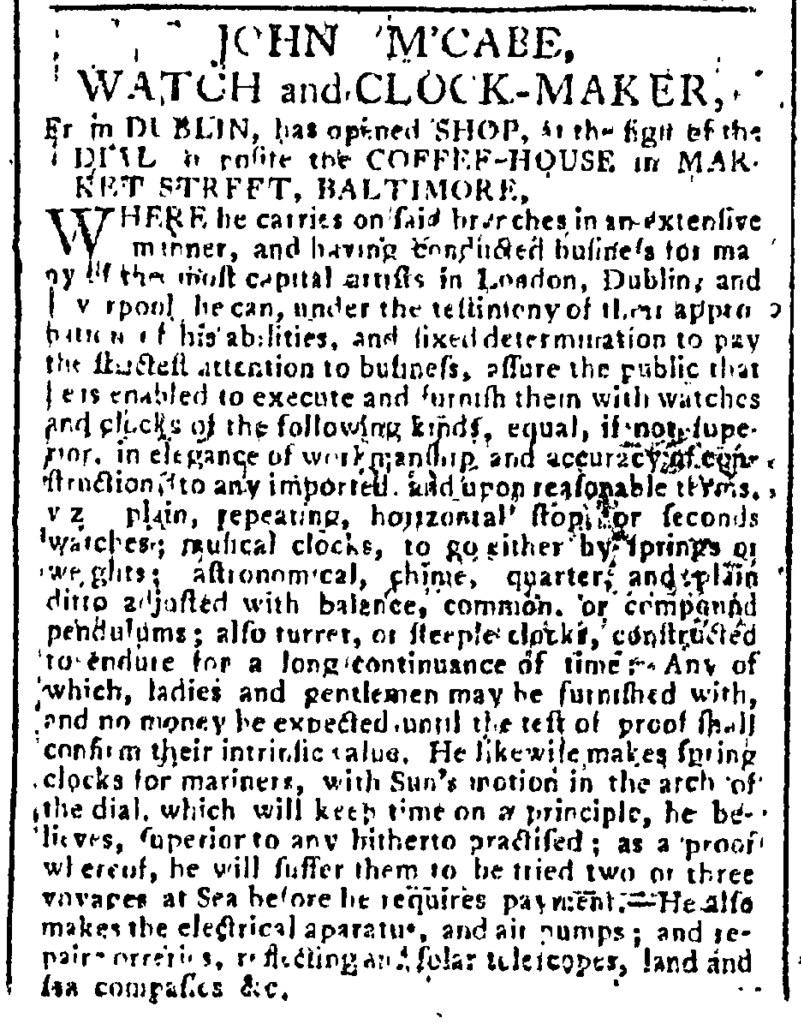
“No money be expected until the test of proof shall confirm their intrinsic value.”

When he set up shop “at the sign of the DIAL” in Baltimore, John McCabe, a “WATCH and CLOCK-MAKER, From DUBLIN,” deployed a marketing strategy commonly undertaken by artisans who migrated across the Atlantic to the colonies.  In an advertisement in the June 11, 1774, edition of the Maryland Journal, he sought to establish his reputation in a town that did not have firsthand knowledge of his skill.  Instead, he relied on an overview of his experience, asserting that he had “conducted business for many of the most capital artists in London, Dublin, and Liverpool.”  Having worked in the most exclusive shops in urban centers, especially the cosmopolitan center of the empire, gave the newcomer a certain cachet, enhanced even more by the “testimony of their approbation of his abilities” that he claimed he could produce.

Yet McCabe did not rest on such laurels that were not immediately apparent to readers.  Instead, he simultaneously declared that his “fixed determination to pay the strictest attention to business.”  Underscoring his industriousness also came from the playbook developed by other artisans, a familiar refrain in their advertisements.  Prospective customers who might have been skeptical of McCabe’s credentials could judge for themselves whether he made clocks and watches “equal, if not superior, in elegance of workmanship and accuracy of construction to any imported.”  They could acquire such timepieces “upon reasonable terms,” getting the same style and quality as watches and clocks from London without paying exorbitant prices.

Even though the initial portions of his advertisement resembled notices placed by other artisans, McCabe, he did include an offer not made nearly as often: allowing a trial period for customers to decide if they wished to purchase or return watches and clocks from his shop.  The enterprising artisan declared that “ladies and gentlemen may be furnished” with any of the variety of clocks and watches listed in his advertisement and “no money be expected until the test of proof shall confirm their intrinsic value.”  McCabe did not explicitly state that customers could return items they found lacking, so confident was he that they would indeed be satisfied with his wares during the trial.  He extended a similar offer for “spring clocks for mariners … which keep time on a principle, he believes, superior to any hitherto practised.”  Customers could make that determination for themselves: “he will suffer them to be tried two or three voyages at Sea before he requires payment.”  Such arrangements would have required some negotiation about the amount of time and the length of those voyages, but allowing for such trials before collecting money from customers did not put McCabe at a disadvantage in the eighteenth-century commercial culture of extending extensive credit to consumers.  Prospective customers likely expected credit, so McCabe gained by transforming the time that would elapse between purchase and payment into a trial, giving those customers the impression that they received an additional benefit from doing business with him.  For some, that may have been the more effective marketing strategy than any claims about his experience working in the best shops in London, Dublin, and Liverpool.

August 11

What was advertised in a colonial American newspaper 250 years ago today?

Pennsylvania Gazette (August 11, 1773).

“Weaver’s Reeds or Shuttles.”

Eighteenth-century readers would have recognized the image that adorned George Lechler’s advertisement in the August 11, 1773, edition of the Pennsylvania Gazette, even though it does not possess the same familiarity for modern readers.  Lechler described himself as a “WEAVER AND REED-MAKER.”  The image that ran across the top of the notice, a long narrow rectangle divided by vertical lines at close intervals, depicted a reed.  As described by the Oxford English Dictionary, a reed is “part of a loom consisting of a set of evenly spaced wires known as dents (originally slender pieces of reed or cane) fastened between two parallel horizontal bars used for separating, or determining the spacing between, the warp threads, and for beating the weft into place.”  A reed also aids in guiding a shuttle across the loom.  Though the woodcut likely looks like a geometric design to most readers today, colonizers easily recognized a piece of equipment used when weaving.

That image helped draw attention to the lively copy that constituted the remainder of the advertisement.  Lechler expressed some exasperation that he “F[OU]ND myself once more under the necessity to acquaint the Public where in Philadelphia I live, since there are persons who say that I am removed.”  Such stories, he asserted, were “entirely false, as I live in the same house where I have lived these 12 years past, and shall continue in it till I move into eternity.”  Lechler had no intention, now or ever, of moving to another location.  Furthermore, following his death, “there will be another Lechler, who will continue to live there, as the house is my own, and he will make work as good as his father.”  The weaver demonstrated pride in owning his house and workshop, as sign of success, as well as pride in his own abilities and pride in the skills of his son who would continue the family business.  Yet he did not consider it necessary to go into greater detail about the “Weaver’s Reeds or Shuttles” that he made, stating that “it is not necessary for me to praise my work, for the work itself will praise the master.”  Customers who needed reeds and shuttles, Lechler declared, “may depend on getting them as good of me, as in any part of the world,” whether imported or made in the colonies.

The weaver had “a parcel of good Reeds ready made …for sale” at his house on Market Street, “the third door above the sign of the Three Kings.”  He intended for the image of the reed and the slightly cantankerous advertisement to entice weavers to acquire equipment from him at the usual place rather than trust in idle gossip (or perhaps even deliberate attempts to undermine his share of the market) that he had moved to another location.  He also encouraged the public to think of his workshop as a family business that would continue after his death, promoting customer loyalty among those satisfied with the reeds they purchased from him.

February 22

What was advertised in a colonial American newspaper 250 years ago today?

Providence Gazette (February 22, 1772).

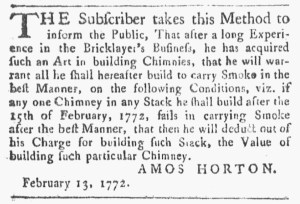
“He has acquired such an Art in building Chimnies, that he will warrant all he sall hereafter build to carry Smoke in the best Manner.”

Artisans of all sorts often promoted their years of experience when they placed advertisements in American newspapers in the eighteenth century.  Such was the case for Amos Horton, a bricklayer in Providence.  In an advertisement that first ran in the February 15, 1772, edition of the Providence Gazette, Horton invoked his “long Experience in the Bricklayer’s Business.”  That “long Experience” prompted him to incorporate an additional marketing strategy into his notice.  Horton offered a guarantee.

The bricklayer proclaimed that he “has acquired such an Art in building Chimnies, that he will warrant all he shall hereafter build to carry Smoke in the best Manner.”  The guarantee, however, came with conditions.  Horton specified that “if any one Chimney in any Stack he shall build after the 15th of February, 1772, fails in carrying Smoke after the best Manner, that then he will deduct out of his Charge for building such Stack, the Value of building such particular Chimney.”  What constituted “carrying Smoke after the best Manner” remained a matter of interpretation, but offering a guarantee of any sort may have helped Horton garner attention.  It likely made prospective clients favorably inclined toward his work before hiring him while also providing reassurances that the bricklayer would address concerns if his chimneys did not meet with their satisfaction.

Furthermore, Horton put his reputation on the line.  After making such a proclamation, published in the public prints on several occasions, he was obligated to honor it.  Not doing so had the potential to damage his reputation and prevent additional clients from hiring him than if he never issued any sort of guarantee at all.  Word-of-mouth critiques of the bricklayer and his chimneys had the potential to outweigh any promises he made in notices that ran in the Providence Gazette.  Adhering to the promise he published in his advertisement became part of his record of customer service.