
What was advertised in a revolutionary American newspaper 250 years ago today?
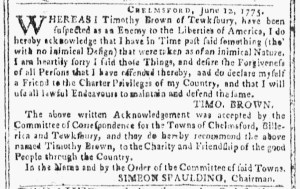
“I … declare myself a Friend to the Charter Privileges of my Country.”
Timothy Brown of Tewksbury, Massachusetts, wanted to return to the good graces of his community in the summer of 1775. He had fallen out of favor because he had not always supported the American cause with as much fervor as his neighbors wished, so he realized that he needed to apologize and pledge to do better. To that end, he not only submitted a “written Acknowledgment” to the Committee of Correspondence for the towns of Chelmsford, Billerica, and Tewksbury but also benefitted from the publication of their response in the New-England Chronicle for readers far and wide to see.
“WHEREAS I … have been suspected as an Enemy to the Liberties of America,” Brown confessed, “I do hereby acknowledge that I have in Time past said something (tho’ with no inimical Design) that were taken as of an inimical Nature.” Like others who had signed an address to Governor Thomas Hutchinson when he departed for England, Brown simultaneously admitted what he had done and attempted to distance himself from it. He had not intended his words, he claimed, in the way that they had been interpreted, though he understood how whatever he had said had been received. “I am heartily sorry I said those Things,” Brown lamented, “and desire the Forgiveness of all Persons that I have offended thereby.” Furthermore, he declared himself “a Friend to the Charter Privileges of my Country” and pledged that he would “use all lawful Endeavours to maintain and defend the same.”
Brown presented that statement in writing to the Committee of Correspondence for Chelmsford, Billerica, and Tewksbury. In turn, the committee recommended him “to the Charity and Friendship of the good People through the Country.” Simeon Spaulding, the chairman, published Brown’s acknowledgment of his error and the committee’s response in the New-England Chronicle “In the Name and by the Order of the Committee of said Towns.” It appeared next to the second insertion of the advertisement that cleared Ebenezer Bradish of attempting “to do any Injury to his Country,” part of a trend of using newspaper advertisements to designate which colonizers once suspected of sympathizing with Tories now expressed support for the Patriot cause. That the advertisement concerning Brown was inserted in the New-England Chronicle “by the Order of the Committee” suggests that Brown was not the only one to benefit from its publication. The committee paid for an advertisement to make a public display of Brown falling in line, an example for others who had not yet done so and a testament to the unity they hoped to achieve among colonizers as the imperial crisis became a war of resistance in the spring and summer of 1775.