What was advertised in a revolutionary American newspaper 250 years ago today?
“My old sign of Dr. Lucas, which hangs opposite my Liberty Pole.”
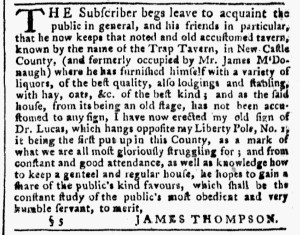
When James Thompson began operating “that noted and old accustomed tavern, known by the name of the Trap Tavern,” in New Castle County, Delaware, in the summer of 1776, he placed an advertisement in Dunlap’s Pennsylvania Packet in hopes of attracting customers among “the public in general, and his friends in particular.” Some prospective patrons may have remembered that the tavern was “formerly occupied by Mr. James McDonaugh,” yet Thompson insisted that he now provided the kind of hospitality they sought. He had, for instance, “furnished himself with a variety of liquors, of the best quality.” He also provided superior “lodgings and stabling, with hay, oats, &c. of the best kind.” He asserted that he possessed the “knowledge how to keep a genteel and regular house” and pledged “constant and good attendance in doing so.
Such appeals regularly appeared in newspaper advertisements for inns and taverns. Thompson made another pitch to prospective customers, invoking his own patriotism as a reason to visit his tavern. Readers could gather with others who supported the American cause. Thompson noted that the tavern “has not been accustomed to any sign” that marked its location. Now that he ran the place, Thompson “erected my old sign of Dr. Lucas, which hangs opposite my Liberty Pole.” The tavernkeeper deployed multiple symbols familiar to eighteenth-century readers. “Dr. Lucas” referred to Dr. Charles Lucas (1713-1771), an Irish physician and Member of Parliament for Dublin whose positions made him a favorite among American Patriots during the imperial crisis. The Sons of Liberty sometimes included Lucas alongside John Wilkes and Edmund Burke when making toasts at public events. Even though Lucas is not well known today, Thompson believed that using his image as a device to identify his tavern would resonate with prospective customers. He had apparently used his “old sign of Dr. Lucas” to mark another enterprise with results that made him believe in its effectiveness now that he displayed it again. The tavernkeeper also gave his liberty pole a name, “No. 1,” claiming that it was “the first put up in this County, as a mark of what we are all most gloriously struggling for.” Thompson intended for the spirit of revolution to inspire readers to eat, drink, and sleep at his tavern at the sign of Dr. Lucas and across from the county’s first liberty pole.