What was advertised in a colonial newspaper 250 years ago today?
Connecticut Courant (May 19, 1766).
“Sundry Sett of the largest and best Size of POTT ASH Kittles and Coolers.”
By 1760, “potash was an important farm and home industry. … It was worth silver in the foreign markets, where the textile industry desired tons and tons of it to make the scouring and bleaching agents they needed. … There were entrepreneurial storekeepers accepting ashes in payment for their goods, and operating an ashery in conjunction with their stores,” according to Ralmon Jon Black, author of Colonial Asheries: Potash, an Eighteenth-Century Industry.
Black contends that nearly every family that settled the New England frontier in the second half of the eighteenth century participated in the potash industry to some extent, “even if only to save the ashes from the fireplace to pay their taxes.” He depicts an economy in which bartering was a standard practice and potash sometimes substituted for currency.
This advertisement helps to illustrate those circumstances. John-Pantry Jones, Oliver Pomroy, and Benjamin Henshaw sold sets of potash kettles (thick-walled iron pots used in the small-scale manufacture of potash) and coolers. They accepted cash or bartered for “Pot-Ash, or Country Produce.” Henshaw also sold a variety of imported goods. He may or may not have operated an ashery of his own as part of his commercial venture, but he certainly incorporated potash production into his business enterprise.
What was advertised in a colonial newspaper 250 years ago this week?
New-Hampshire Gazette (February 28, 1766).
“Will give Cash for Forty HEIFERS or young COWS.”
Jonathan Moulton’s advertisement in the New-Hampshire Gazette gives insight into a society where bartering was accepted in lieu of cash or credit at times. Although Moulton’s advertisement does state he will give cash payment in exchange for cows, he initially asks for “ABOUT Eighty Tons of good Salt and English HAY, for Boards or Staves.” The decision to offer a trade in replacement of cash allowed Moulton to target a wide range of people that may not have had consistent access to cash.
In order to be successful in the colonies, entrepreneurs needed to be flexible and work with their fellow colonists in the developing economy. Moulton’s decision to accept boards or staves instead of cash and then later to pay cash for young cows likely made his advertisement applicable and appealing to more people.
The second half of Moulton’s advertisement is directed towards people with livestock, giving him a targeted audience, one that did not always have large sums of cash readily available. The opportunity for people to choose either to trade or to use local currency was appealing to many colonists.
**********
ADDITIONAL COMMENTARY: Carl Robert Keyes
In the wake of Currency Acts passed by Parliament in 1751 and 1764, colonists feared “the likelihood of a diminished supply of local currency and a return to a heavier reliance on the more burdensome, less flexible alternatives: barter, commodity money (e.g., tobacco or sugar), and foreign gold or silver coin.”[1] Trevor has chosen an advertisement that suggests how some colonists incorporated both currency and barter into their business practices, resorting to one or the other depending on the circumstances. Given the relatively short supply of currency, Moulton’s offer to pay cash for heifers and young cows may indeed have been all the more attractive to colonists looking to sell some of their livestock.
New-Hampshire Gazette (February 7, 1766).
Does this advertisement sound familiar? It should, even if it does not visually look familiar, because a portion of it was previously featured on the Adverts 250 Project. This advertisement was printed in two separate pieces in the February 7, 1766, issue of the New-Hampshire Gazette. The first half appeared at the bottom of the first page, running across both columns. The second half appeared at the bottom of the final page, also running across both columns.
New-Hampshire Gazette (February 7, 1766).
When Trevor and I discussed the advertisements he wished to feature this week, I approved this one because, technically, it is a different advertisement than the previous one. It includes new material and the type for the entire advertisement was reset for this variant. Besides, as I have previously explained, our methodology (requiring us to consult the most recently published newspaper in the colonies) disproportionately privileges the New-Hampshire Gazette. The paucity of advertisements for consumer goods and services in that publication, compared to others from the period, can be frustrating. The guest curators and I have learned to make do with the slim pickings in the New-Hampshire Gazette.
Why did the printer reset the type and combine two advertisements into one? Friday’s extended commentary will explain how I solved that mystery when I examined the original copies at the American Antiquarian Society.
**********
[1] John J, McCusker and Russell L. Menard, The Economy of British America, 1607-1789 (Chapel Hill: University of North Carolina Press for the Institute of Early American History and Culture, 1985), 337.
What was advertised in a colonial newspaper 250 years ago this week?
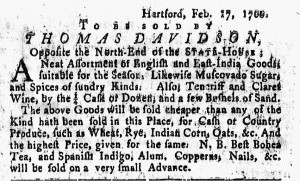
Connecticut Courant (February 17, 1766).
“The above Goods will be sold … for Cash or Country Produce.”
It is interesting that Davidson starts his advertisement assuring his potential customers that the “neat assortment of English and East-India Goods [were] suitable for the season.” He is letting them know that the products he was currently carrying could be used immediately and did not need to be stored until their use was required.
Davidson also mentioned that if people did not have cash on hand he would be more than happy to barter. He even went beyond mentioning his openness to bartering; he listed specific items that he would accept in lieu of cash. He would have accepted country produce and a list of other products that costumers from the town would likely have gotten from another source or grown themselves.
By accepting items other than cash in exchange for goods, he interested a larger audience because hard currency was not as common at this time. Davidson appealed to a larger constituency than if he had advertised cash only.
**********
ADDITIONAL COMMENTARY: Carl Robert Keyes
Mary notes that Davidson described his stock of “A Neat Assortment of English and East-India Goods” as “suitable for the Season.” This was one of many appeals the shopkeeper incorporated into his advertisement, along with mentioning price, quality, and the possibility of bartering. This advertisement also includes several stock phrases, including “Neat Assortment” and “suitable for the Season,” among its attempts to woo potential customers.
Davidson inserted one element that did not always appear in eighteenth-century advertisements: the date. While it was not exceptional for an advertiser to include a date, it was not the standard practice either. In this case, the date of the advertisement matched the date of the issue in which it appeared. (The type would have been set and the newspaper printed before February 17, so most likely Davidson intentionally specified that the date of his commercial notice would bear the same date as the issue in which it appeared.) Davidson, like other newspaper readers of the period, would have realized that sometimes an advertisement might be repeated for weeks or even months. Including the date in his advertisement buttressed his claim that his “Assortment of English and East-India Goods” was indeed “suitable for the Season,” or at least allowed readers and potential customers to better assess that claim.
What was advertised in a colonial newspaper 250 years ago today?
New-Hampshire Gazette (February 7, 1766).
“To be sold about 80 tons of good salt and English hay, for boards or staves.”
During Colonial times, items were often bartered, rather than sold. In this case, salt and hay are being offered in exchange for boards or staves, which were materials that might be used for carpentry projects, such as putting up buildings. In modern times, we would call a ‘stave’ a post, or a piece of wood used to make a wooden barrel and most individuals in the lumber industry today would not know what you meant if you asked them for a stave.
In this advertisement, it seems that the project that a person is trying to collect materials for might be one that will take place over a period of time, as it says that the individual seeking these materials has between now (which, remember, is February 1766) and ‘next’ July 1 for people to respond.
A final thing that catches my eye with this advertisement, is the mentioning of Jonathon Moulton of Hampton. Each time I see a name in an old newspaper, I have to see if there’s a trail that will lead me to understand what the mentioned individual was after and what information is available about their life and death. This will be a recurring theme within my posts this week. I often find individuals to be an intriguing area of history. I feel that in some cases, some historians favor learning about events, while others favor learning about individuals.
In researching Moulton, I was delighted to find a plethora of information available about him from a Hampton library website page. Johnathon Moulton was born on July 21, 1726, and is the descendant of some of the first settlers of Hampton, a group that came to the Colonies from Norfolk, England. Moulton died on September 18, 1787. To learn more about Moulton of Hampton, check out this link.
**********
ADDITIONAL COMMENTARY: Carl Robert Keyes
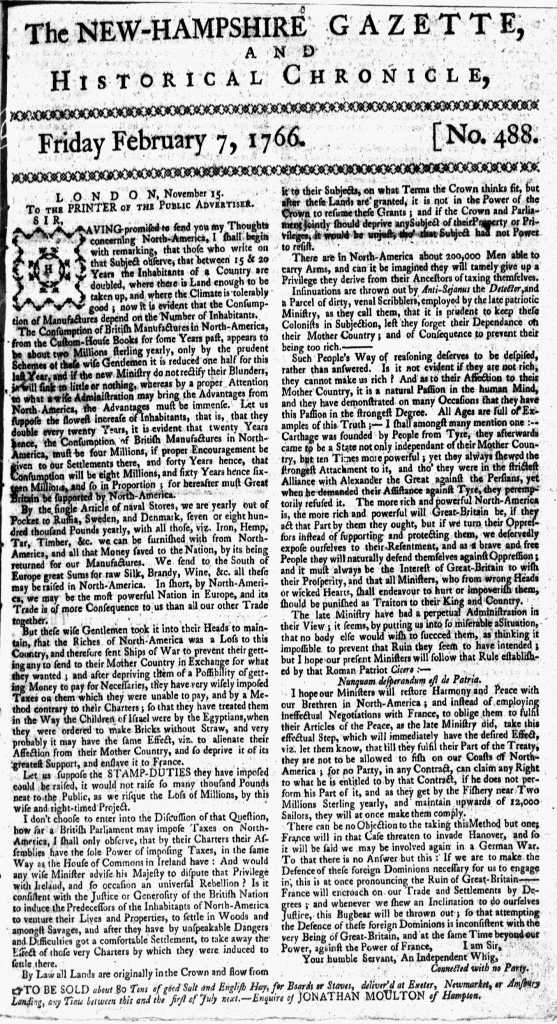
First Page of New-Hampshire Gazette (February 7, 1766).
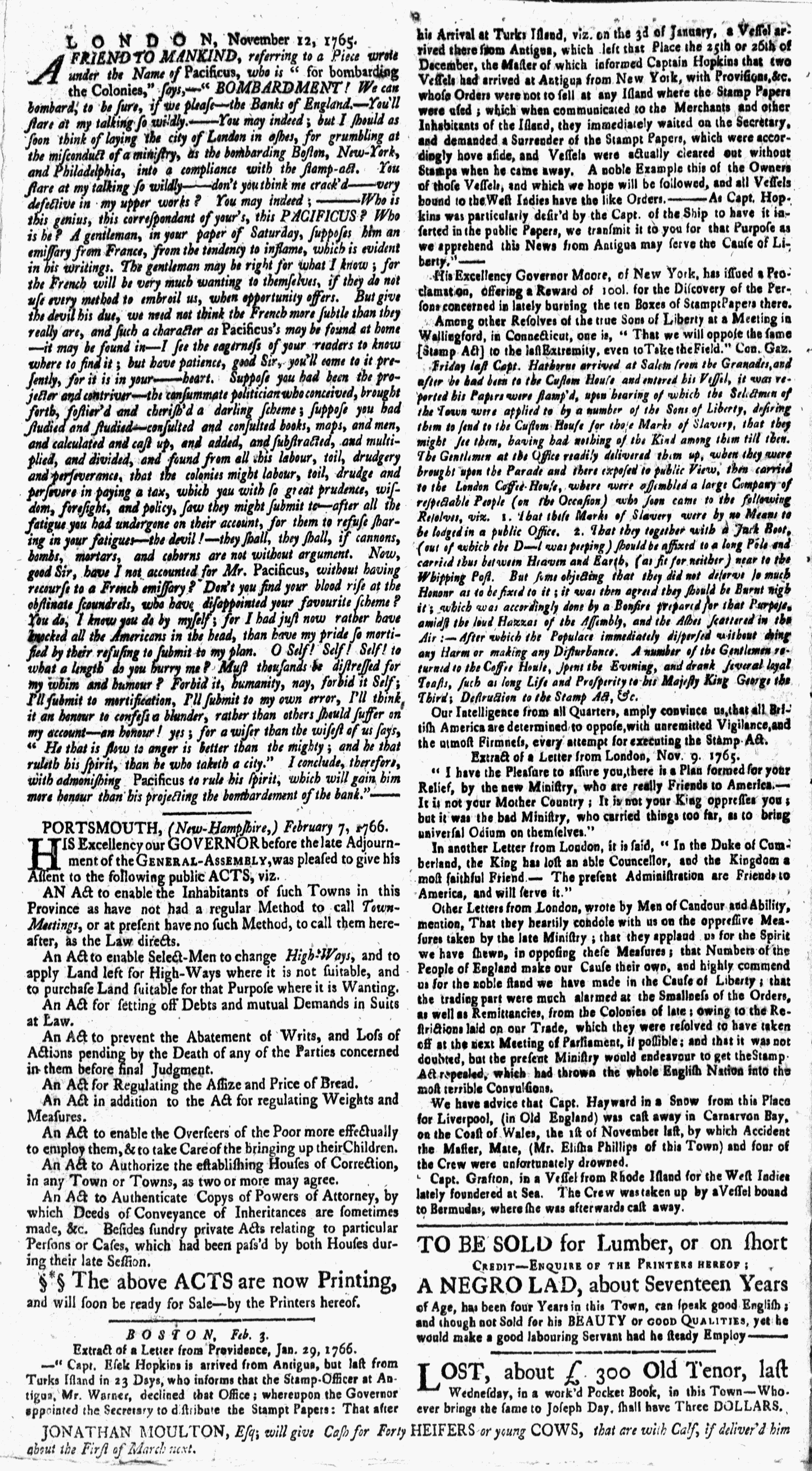
While Kathryn focuses on evidence of bartering in colonial advertisements and a more extensive biography of this particular advertiser, I am interested in the format of this advertisement and the layout of the rest of the issue. I sometimes insert an entire page of a newspaper to provide both visual and textual context, but today I think it would be helpful to see the entire issue of the New-Hampshire Gazette that included this advertisement.
The advertisement that Kathryn selected appeared at the bottom of the first page. It extends across both columns. This is unusual, but not completely uncommon. Printers sometimes used this method to fill space or perhaps to insert advertisements received just before going to press. Compare this advertisement to yesterday’s featured advertisement for a lottery, which appeared at the end of the final column of the final page. The page – and the issue – were set perfectly thanks to its inclusion.
In contrast, this issue includes several advertisements laid out in unusual ways. Short advertisements from Jonathan Moulton run across both columns at the bottom of both the first and final pages. These two pages would have been printed on the same side of the broadsheet before it was folded in half to make a four-page newspaper. It is likely that both were added after the remainder of the issue had been set. In making each page the same length, the advertisements provided balance on the first and last pages (which others would have seen next to each other when looking at a subscriber reading the second and third pages). This suggests conscientiousness about the appearance of the newspaper on the part of the printer.
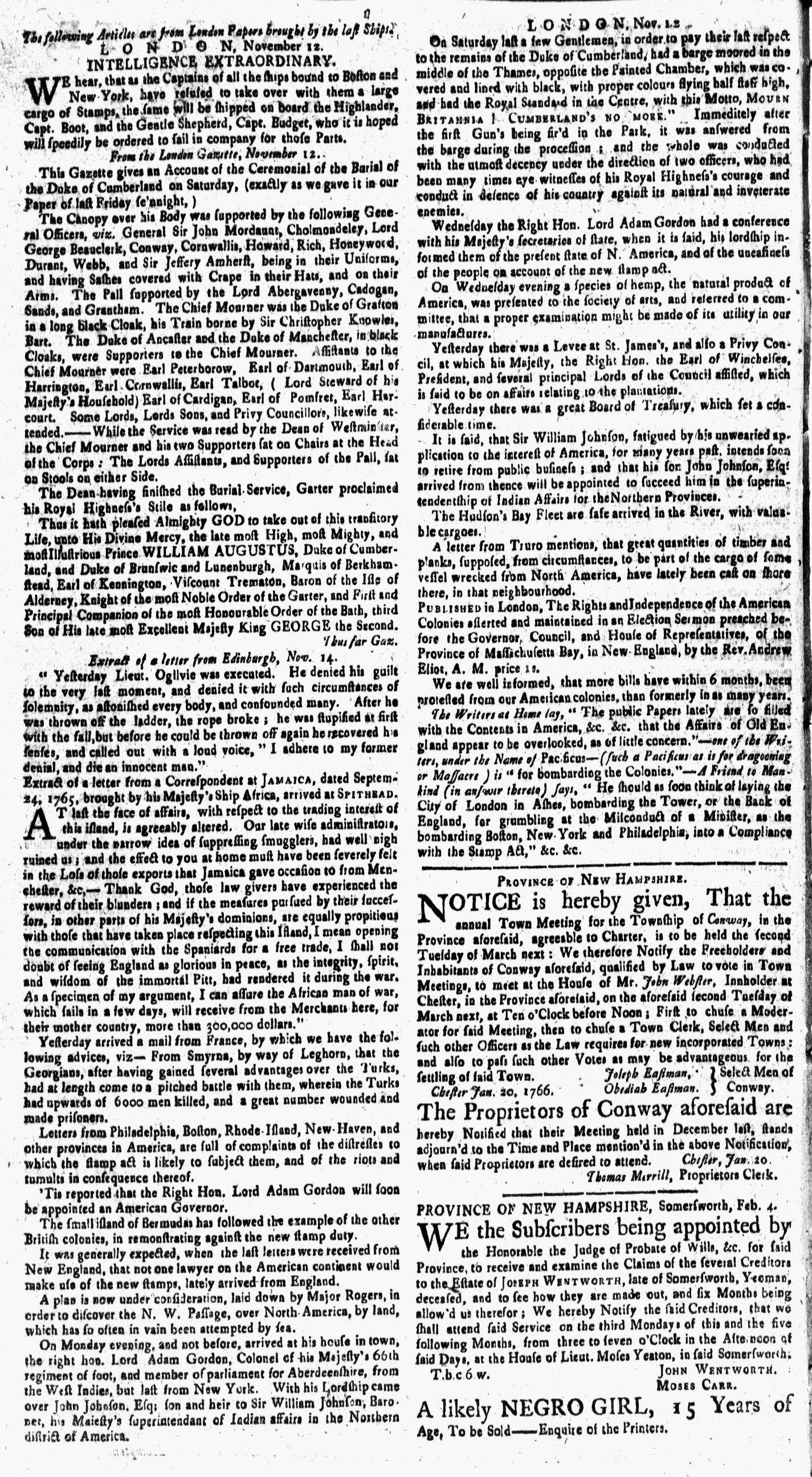
Second Page of New-Hampshire Gazette (February 7, 1766).
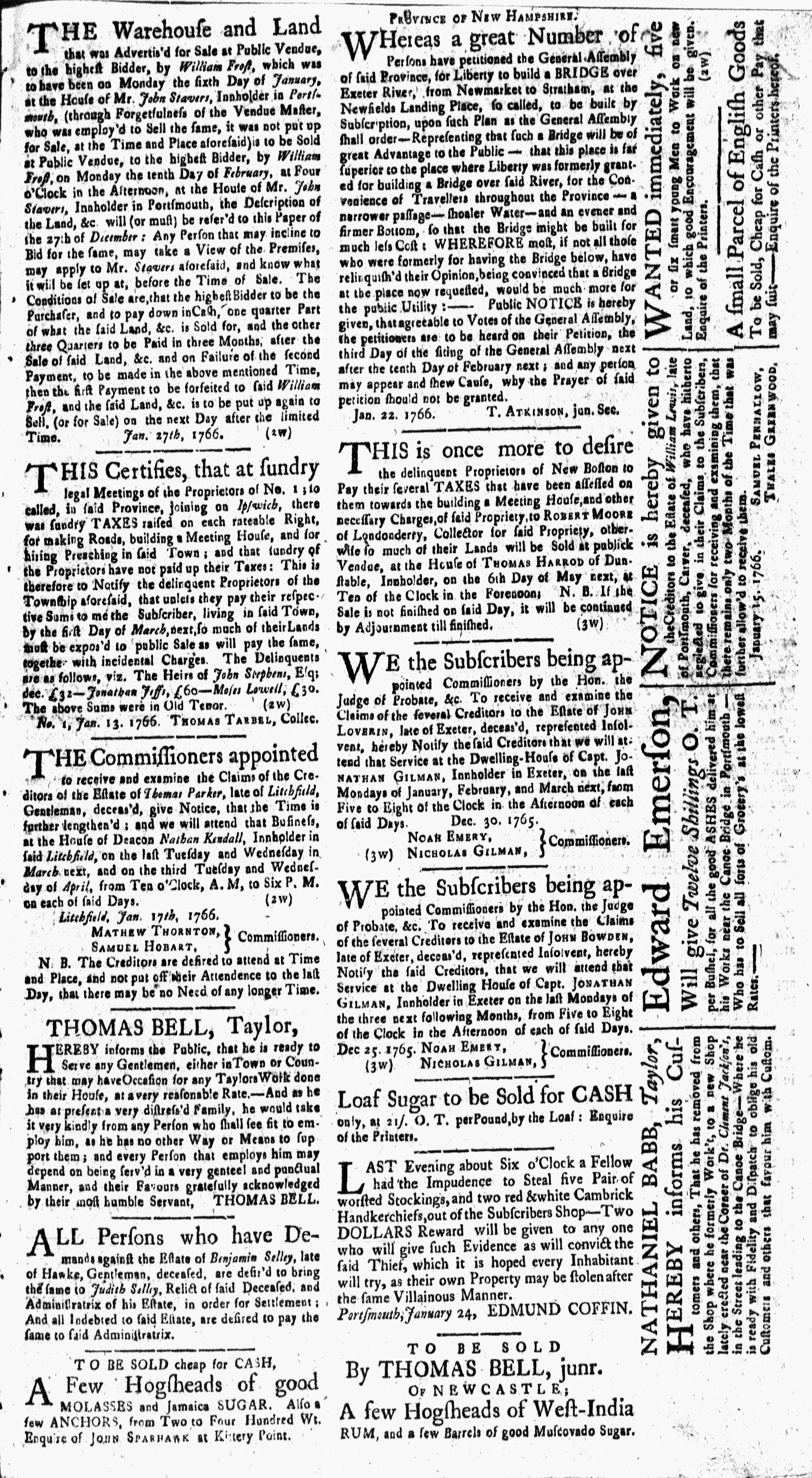
The advertisements on the third page, however, were laid out in an extremely unusual manner. That page features two columns of advertisements, as expected, along with four additional advertisements rotated ninety degrees clockwise to form a third column. This would be very visually striking. It might draw attention to the advertisements. Perhaps this was the printer’s intention, but I hesitate to make this claim without evidence that other similar experiments appeared in the New-Hampshire Gazette over the next several weeks or months. Something else may have explained this decision, such as advertisers clamoring to have commercial notices for which they had already paid appear in print. After all, the New-Hampshire Gazette had recently printed relatively few advertisements in favor of covering the Stamp Act crisis throughout the colonies. The printer may have been attempting to insert advertisements usually any layout necessary to do so.
This is an instance in which digitized sources reveal some questions that cannot be answered without consulting the original sources in an archive. I’d like to know about the amount of space covered in print on the second and third pages relative to each other, but both appear exactly the same size on my computer screen, making it impossible to make such an assessment. Indeed, I assumed above that Jonathan Moulton’s advertisements mirroring each other on the first and fourth pages caused the text on both to cover the same amount of space. This seems like a reasonable conclusion, but it must be tested by consulting an original (rather than photographed, microfilmed, or digitized) issue of the February 7, 1766, New-Hampshire Gazette.
Third Page of New-Hampshire Gazette (February 7, 1766).
**********
Fourth Page of New-Hampshire Gazette (February 7, 1766).