
What was advertised in a colonial American newspaper 250 years ago today?
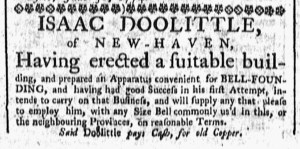
“ISAAC DOOLITTLE, of NEW-HAVEN … prepared an Apparatus convenient for BELL-FOUNDING.”
On August 12, 1774, “ISAAC DOOLITTLE, of NEW-HAVEN,” placed an advertisement in the Connecticut Gazette, published in New London, to alert readers that he could cast “any Size Bell commonly us’d in this, or the neighbouring Provinces.” The entrepreneur explained that he had “erected a suitable building, and prepared an Apparatus convenient for BELL-FOUNDING.” Furthermore, he “had good Success in his first Attempt,” prompting him to follow that trade and seek customers. Realizing that the market in and near New Haven would not support his business, he embarked on an advertising campaign in multiple newspapers published in Connecticut. Along with his notice in the Connecticut Gazette, he simultaneously inserted an advertisement in the Connecticut Journal and New-Haven Post-Boy. It featured almost identical copy, though Doolittle did not consider it necessary to advise readers of the newspaper that served his town that he was “of NEW-HAVEN.”
Not surprisingly, he did so once again in his advertisement in the August 16 edition of the Connecticut Courant, directing prospective customers in Hartford and nearby towns to send orders and other correspondence to him in New Haven. He did not, however, run his advertisement in the Norwich Packet, the last of the four newspapers printed in Connecticut at the time. It was also the newest, having commenced publication less than a year earlier. Perhaps that influenced Doolittle’s decision not to invest in advertising in yet another newspaper. He may have been unfamiliar with the Norwich Packet or doubtful that its circulation would justify the cost of advertising. He was not the only advertiser who opted for notices in the Connecticut Courant, the Connecticut Gazette, and the Connecticut Journal, but not the Norwich Packet during that newspaper’s first year. Even one advertiser new to Norwich passed over the Norwich Packet in favor of placing his notice in the well-established Connecticut Gazette, though he may have depended on word-of-mouth to reach prospective customers in his new location. The colophon for the Norwich Packet advised that the printers “thankfully received” both subscriptions and advertisements “for this Paper,” but that was not sufficient to convince some prospective advertisers in other towns to extend their marketing campaigns to include the colony’s newest newspaper.