August 5

What was advertised in a colonial American newspaper 250 years ago today?

South-Carolina and American General Gazette (August 5, 1774).

“*Extract from Dr. RUSH’s Oration.”

Robert Wells had sufficient content to fill a four-page supplement (though printed on a smaller sheet) as well as the standard four-page issue when he took the August 5, 1774, edition of the South-Carolina and American General Gazetteto press.  With so much space to fill, he devoted the entire final page of the standard issue to a book catalog, listing dozens and dozens of titles in four columns.  His inventory represented an array of subjects, though he did not classify or categorize his offerings under headings like other booksellers sometimes did.  Instead, he left it to readers to discover the variety as they perused the catalog.  Among the many titles, he hawked “THE VISIONS of THOMAS SAY of the City of Philadelphia, which he saw in a Trance.”  Wells was either unaware that Say had disavowed that publication in an advertisement in the Pennsylvania Gazette several months earlier or he disregarded it in favor of generating revenue from selling the curious work.

The printer and bookseller also stocked “AN ORATION delivered … before the American Philosophical Society at Philadelphia, containing an Enquiry into the NATURAL HISTORY of MEDICINE among the INDIANS in NORTH-AMERICA … By BENJAMIN RUSH, M.D. Professor of Chemistry in the College of Philadelphia*.”  The asterisk directed readers to an “*Extract from Dr. RUSH’s Oration” that filled the bottom third of the column.  Despite the title, the excerpt (starting on page 67) warned against “luxury and effeminacy” among colonizers, stating that the damage was not so extensive that it could not be remedied.  He offered a series of recommendations, including improved education for children and temperance for adults, while some of them reflected the imperial crisis.  Politics and medicine intertwined when Rush commented on “the ravages which Tea is making upon the health and populousness of our country.  Had I a double portion of all that eloquence which has been employed in describing the political evils which lately accompanied this East-India herb, it would be too little to set forth the numerous and complicated diseases which it has introduced among us.”  The doctor described tea as a hydra, asserting that colonizers needed the strength of Hercules “to vanquish monsters.”  Parliament, the East India Company, and colonizers’ own desire for tea were presumably among the many heads of that monstrous hydra.  The excerpt concluded with an argument that “America is a theatre where human nature will probably receive her last and principal literary, civil and military honours.”

Wells almost certainly selected passages intended to pique the curiosity of readers and leave them wanting more.  They could examine Rush’s entire argument and learn what his comments about education, temperance, and tea had to do with “MEDICINE among the INDIANS” by purchasing the book.  Just as modern publishers provide excerpts to entice prospective customers, Wells published an “Extract” to help boost sales.

South-Carolina and American General Gazette (August 5, 1774).

April 27

What was advertised in a colonial American newspaper 250 years ago today?

Pennsylvania Gazette (April 27, 1774).

“These Baths and Waters … have been for some Years deservedly in the highest Repute.”

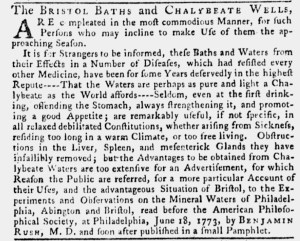
As spring gave way to summer in 1774, the proprietors of the “BRISTOL BATHS and CHALYBEATE WELLS” ran an advertisement in the Pennsylvania Gazette to advise residents of Philadelphia and other towns that they provided services “in the most commodious Manner, for such Persons who may incline to make Use of them [during] the approaching Season.”  For any “Strangers” who were not familiar with “these Baths and Waters,” the proprietors proclaimed that they “have been for some Years deservedly in the highest Repute” for their “Effects in a Number of Diseases, which had resisted every other Medicine.”  The chalybeate (or iron-infused) waters had a restorative effect that made visiting the spa an occasion for recuperation as well as relaxation.  The proprietors provided several examples of maladies that the bathing in and drinking the chalybeate waters alleviated.  They asserted that the waters strengthened the stomach, “promoting a good Appetite,” and rejuvenated “relaxed debilitated Constitutions, whether arising from Sickness, residing too long in a warm Climate, or too free living.”  In addition, the iron-infused waters “have infallibly removed” “Obstructions in the Liver, Spleen, and mesenterick Glands.”

Pennsylvania Gazette (April 27, 1774).

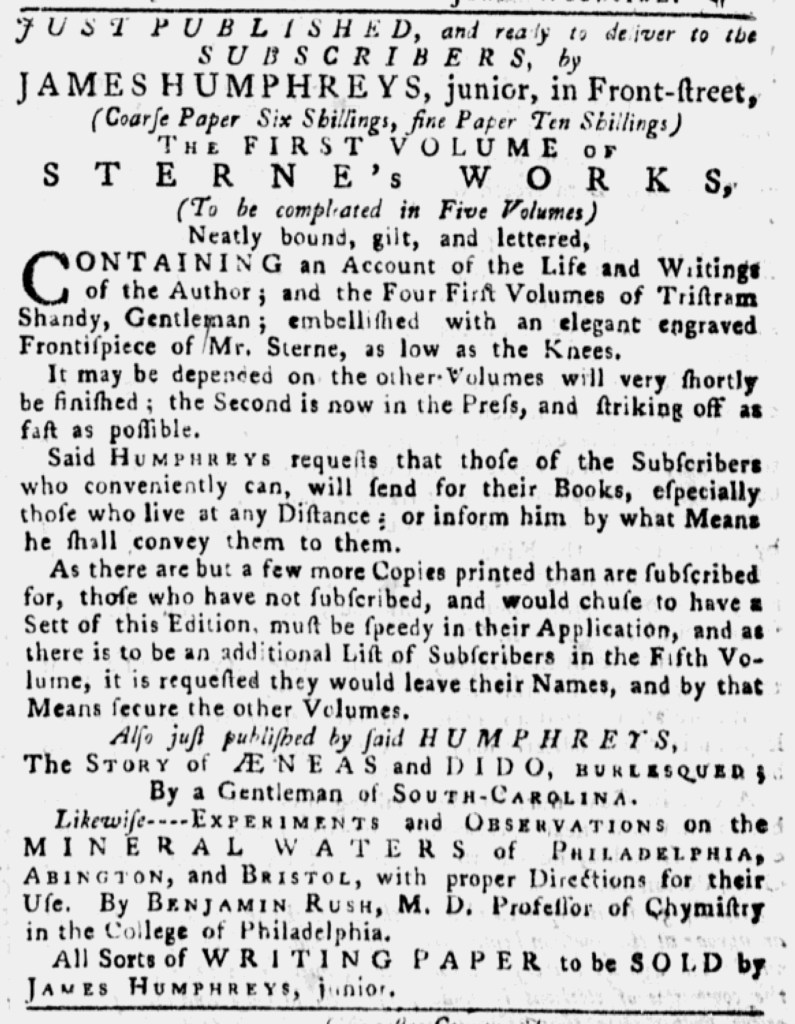
Yet the proprietors did not ask prospective patrons simply to take their word about the effects of the baths and wells in Bristol.  Instead, they declared that the “Advantages to be obtained from Chalybeate Waters are too extensive for an Advertisement, for which Reason the Public are referred” to a pamphlet “by BENJAMIN RUSH, M.D.”  The prominent physician had read a paper, “Experiments and Observations on the Mineral Waters of Philadelphia, Abington, and Bristol,” to the American Philosophical Society on June 18, 1773, and then published it.  The proprietors of the Bristol Baths, Rush gave a more particular Account of their Uses, and the advantageous Situation of Bristol.”  Historian Vaughan Scribner explains that Rush “nurtured colonists’ expanding interest in the science and commercialization of mineral springs.”  The doctor provided a “general location and description of each spring,” described experiments with “mix[ing] more than twenty-one different substances with the mineral waters,” noted several diseases the waters cured (along with only a couple of exceptions), and “contended that the springs could hardly be rivaled for their health and commercial values.”[1]  In the April 27 edition of the Pennsylvania Gazette, printer James Humphreys, Jr., conveniently placed an advertisement on the opposite side of the page as the notice about the Bristol Baths and Chalybeate Wells.  Most of it concerned an update for subscribers to “STERNE’s WORKS,” but the printer appended a note that he sold “EXPERIMENTS and OBSERVATIONS on the MINERAL WATERS … By BENJAMIN RUSH, M.D. Professors of Chymistry in the College of Philadelphia.”  Perhaps that was a happy coincidence for the proprietors of the Bristol Baths and Chalybeate Waters, but maybe they had coordinated with Humphreys to have their advertisements run at the same time.  Either way, they did not direct the public to an obscure pamphlet.  Instead, anyone interested in learning more could easily acquire Rush’s tract.

**********

[1] Vaughn Scribner, “‘The happy effects of these waters’: Colonial American Miner Spas and the British Civilizing Mission,” Early American Studies: An Interdisciplinary Journal 14, no. 3 (Summer 2016): 437, https://doi.org/10.1353/eam.2016.0020.