What was advertised in a colonial American newspaper 250 years ago this week?

“The largest & compleatest Collection of Books, that ever was sold at this Office.”
A note at the end of auctioneer Robert Gould’s advertisement in the February 3, 1774, edition of the Massachusetts Gazette and Boston Weekly News-Letter seemed incongruous with the content of the rest of the notice. Gould announced that he would auction a “Variety of genteel House-Furniture” the next morning “At TEN o’Clock.” He listed many of the items going up for bids, including “Mahogany dining Tea & Bureau Tables,” “Looking-Glasses,” and “a few Sets genteel Pictures.” In addition, the sale would include “a great Variety of English GOODS.”
The note that followed his signature, however, stated, “No Catalogues will be published, and as this is by far the largest & compleatest Collection of Books, that ever was sold at this Office, therefore they will be exposed to View on Saturday and Monday next.” That reference made little sense since the auction of the furniture, housewares, and other goods was scheduled for the next day, a Friday. In addition, a coy aside directed readers, “Pray Remember the Sale begins half past 9 Precisely,” a different time than the auction discussed earlier in the advertisement would begin.
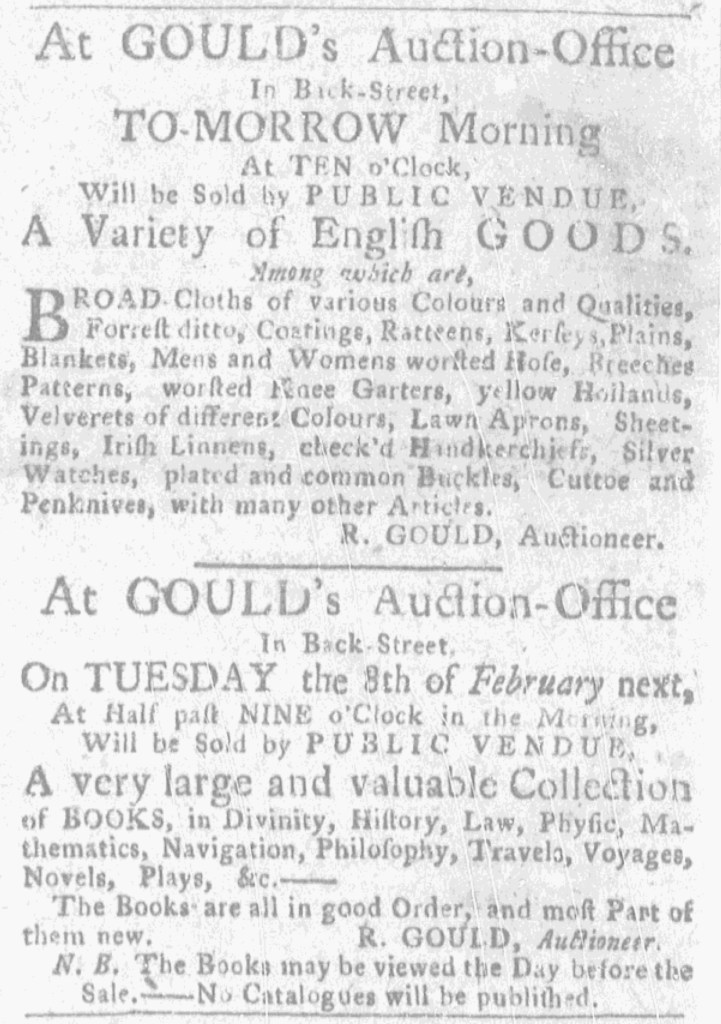
It appears that these inconsistencies resulted from a miscommunication between the auctioneer and the printing office or an error in the printing office. In the previous issue of the Massachusetts Gazette and Boston Weekly News-Letter, Gould ran an advertisement in two parts, both of which could have appeared separately. The first part included an introduction identical to the one in the notice published on February 3. The compositor likely did not even reset type for the introduction, instead updating the headline from “A Variety of English GOODS” to “A Variety of genteel House-Furniture” and inserting a new list of items for sale. The second part described an auction for a “very large and valuable Collection of BOOKS” that would take place “On TUESDAY the 8th of February next, At Half past NINE o’Clock in the Morning.” Gould explained that the books “are all in good Order, and most Part of them new.” In addition, he appended a nota bene advising that the books “may be viewed the Day before the Sale.—No Catalogues will be published.”
Gould probably attempted to update both parts of the advertisement, providing new information about the weekly sale at his auction office and an update about an upcoming special auction for books, but some confusion ensued. Gould may not have been clear about how much of the previous advertisement should carry over to the new one. Alternately, the compositor may not have paid sufficient attention to the instructions submitted to the printing office. Either way, the strange note at the end of the advertisement could have piqued interest among readers. After all, proclaiming the sale featured “by far the largest and compleatest Collection of Books, that was ever sold at this Office” was intended to attract attention. To learn more, they only had to contact Gould or take note of advertisements he already published in the Boston-Gazette and the Massachusetts Gazette and Boston Weekly News-Letter.