October 29

What was advertised in a colonial American newspaper 250 years ago today?
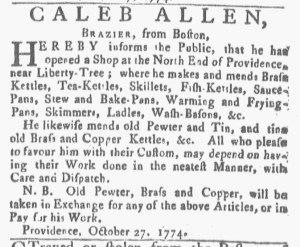
Providence Gazette (October 29, 1774).

“BRAZIER, from Boston …  has opened a Shop at the North of Providence, near Liberty-Tree.”

When Caleb Allen, a “BRAZIER, from Boston,” opened a shop in Providence in the fall of 1774, he took to the pages of the local newspaper to advise the public of his new endeavor.  He announced that he “makes and mends Brass Kettles, Tea-Kettles, Skillets,” and other items and “mends old Pewter and Tin.”  Like many other artisans, he pledged that his customers “may depend on having their Work done in the neatest Manner, with Care and Dispatch.”  Braziers and other artisans often assured the public about their skill and the quality of their work.

In giving his location, Allen stated that customers could find his shop “at the North End of Providence, near Liberty-Tree.”  In so doing, he may have signaled his political views.  At the very least, he seemingly indicated that he was friendly to the patriot cause rather than holding it in disdain.  After all, he could have chosen from among many ways to give his location, including just “at the North End of Providence” without mentioning the Liberty Tree.  He could have given the name of the street, noted his shop’s proximity to a prominent resident or business, or invoked another familiar landmark.  Yet the newcomer from Boston specifically associated the Liberty Tree with his business.

Allen did not mention how recently he arrived in Providence.  He had not advertised in the Providence Gazette prior to October 29, 1774.  Perhaps he left Boston after the Boston Port Act went into effect, blockading the harbor until the residents of the town paid for the tea destroyed during the Boston Tea Party.  That legislation, along with the other Coercive Acts, disrupted commerce and everyday life in Boston.  The same issue of the Providence Gazette that carried Allen’s advertisement also featured an update from Boston that “transports, with troops, &c. on board, arrived here from New-York.”  Anticipating that things would get even more difficult in that city, the “BRAZIER, from Boston” may have determined to depart and seek his fortunes elsewhere.  In that case, the Liberty Tree in Providence would have had particular significance for him when he set up shop near it.

September 21

What was advertised in a colonial American newspaper 250 years ago today?

Boston-Gazette (September 21, 1772).

“The great Encouragement he has had beyond Expectation from his former Advertisements.”

John Thompson described himself to current and prospective customers as a “Tinman and Brazier from LONDON.”  In an advertisement in the September 21, 1772, edition of the Boston-Gazette, he declared that he “Makes various Articles in Tin and Copper too tedious to enumerate.”  Other artisans and purveyors of goods published lengthy lists of their merchandise to entice consumers, but Thompson opted instead to focus on a few select items.  He proclaimed that he made “all Sorts of Polish’d Tin Ware like Silver, never before manufactured in Boston,” underscoring the value of purchasing from an artisan “from LONDON.”  In addition, he carried “all Sorts of Come Tin Ware” as well as “Brass and Copper Vessels Tin’d with pure Grain Tin in the London Fashion.”

In his effort to secure his reputation and attract even more customers, Thompson expressed his gratitude to existing customers.  Doing so suggested to prospective customers that he already established a clientele at his shop.  He stated that he “is much oblig’d to all his Customers in General, and to the good People of Boston in Particular, for the great Encouragement he has had beyond Expectation from his former Advertisements.”  Furthermore, his previous success “imboldens him again to advertise, hoping for a Continuance of Favours” from customers in Boston.  Thompson offered rare commentary from an advertiser on the effectiveness of advertising in colonial America.  He asserted that his advertising had indeed produced positive results even “beyond Expectation.”  That certainly supported his allusions to an existing clientele, but that does not necessarily mean that it was mere puffery.  After all, Thompson chose to place a new advertisement following his “former Advertisements.”  He apparently believed that his earlier advertising had been successful, even if he exaggerated its effects in his new notice, or at least considered one more advertisement worth the investment.  Some advertisers testified to the effectiveness of advertising by repeatedly placing notices in the public prints.  Relatively few, however, made such explicit comments on the effectiveness of their marketing.