February 20

GUEST CURATOR:  Gabriela Vargas

What was advertised in a colonial American newspaper 250 years ago today?
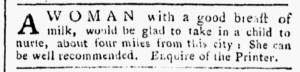
Dunlap’s Pennsylvania Packet (February 20, 1775).

“A WOMAN with a good breast of milk, would be glad to take in a child to nurse.”

On February 20, 1775, an anonymous woman placed an advertisement offering her services as a wet nurse in Dunlap’s Pennsylvania Packet. In colonial and revolutionary America, women advertised their services as wet nurses while families often placed advertisements seeking wet nurses. Mothers who could not supply their own breast milk due to health issues acquired wet nurses. Families who lost mothers during childbirth also needed wet nurses. This was a common practice in the eighteenth century.

According to Janet Golden, some English physicians advised against wet nurses because they might be “sick or ill-tempered.”[1]  William Buchan, for instance, advised looking for a “healthy woman, … one with an abundant supply of milk, healthy children, clean habits and a sound temperament.”[2] Those physicians looked down on women not breastfeeding their own children but doing it for others. In general, wet nursing caused an increase in infant mortality rate. Golden states, “Nearly every European commentator knew that wet nursing increased infant mortality. Wet-nursed infants were more likely to die than were infants suckled by their mothers, and the wet nursing system itself contributed to infant mortality by inducing poor women to abandon their own offspring in order to find employment suckling the children of others.”[3]

For women who were hired as wet nurses in colonial America, their earnings belonged to their husbands by law.[4] Wet nursing was not always a paid arrangement. Instead, neighbors sometimes helped their communities by nursing the babies of mothers who could not breastfeed due to postpartum ailments.[5] Some families felt more comfortable with a neighbor rather than a stranger. Mothers or their families would often look for neighbors or friends to breastfeed their babies, but that was not always possible. That created a market for other women to offer their services, which they would advertise in early American newspapers.

**********

ADDITIONAL COMMENTARY:  Carl Robert Keyes

Even though the prescriptive literature authored by English physicians sometimes cautioned against entrusting infants to wet nurses, colonizers sometimes heeded those concerns and other times developed their own practices embedded in local circumstances in the eighteenth century.  As Gabriela indicates, neighbors participated in communal wet nursing as one way of contributing to their communities.

Some also went against the prescriptive literature that condemned wealthy women for hiring wet nurses instead of fulfilling what the physicians considered their maternal obligations.  Sending infants to foster with wet nurses in the countryside became a popular practice among many affluent families in Boston and other cities.  “Some urban families,” Golden explains,” assumed that the city was an unhealthy environment, rife with both epidemic and endemic diseases.  The countryside, many believed, provided a more salubrious setting, especially in the early months of life.”[6]  Note that the anonymous “WOMAN with a good breast of milk” in the advertisement Gabriela selected emphasized that she resided about four miles from Philadelphia, near the busy port yet removed from the largest city in the colonies.  Other women took a similar approach.  According to Golden, “advertisements placed by women looking for babies to wet nurse reported their distance from the city.”[7]

In four short lines, the woman who placed today’s featured advertisement addressed several common concerns.  She commented on her own health and the nourishment she could provide for an infant, asserting that she had a “good breast of milk.”  Yet she did not ask prospective clients to take her word for it.  Instead, she stated that she “can be well recommended,” presumably both for her character and for her health.  At the same time, she testified to the healthiness of the environment where she provided her services, highlighting that she resided outside the city.  The anonymous woman intended for each of those appeals to resonate with mothers and their families.

**********

[1] Janet Golden, A Social History of Wet Nursing in America: From Breast to Bottle (New York: Cambridge University Press, 1996), 15.

[2] Golden, Social History of Wet Nursing, 16.

[3] Golden, Social History of Wet Nursing, 14.

[4] Golden, Social History of Wet Nursing, 17.

[5] Golden, Social History of Wet Nursing, 20.

[6] Golden, Social History of Wet Nursing, 22.

[7] Golden, Social History of Wet Nursing, 22.

October 17

GUEST CURATOR: Lindsay Hajjar

Who was the subject of an advertisement in a colonial American newspaper 250 years ago today?

oct-17-10171766-new-london-gazette
New-London Gazette (October 17, 1766).

“ALSO, An able body’d hearty Wench 16 Years old (with a sucking Child.”

This advertisement started with the sale of a twenty-nine-year old slave, described as “strong and healthy.” The seller then indicated where he was born and that he has skills in farming. Next, he stated he was selling a “Wench” who was sixteen years old. By calling her a wench he degraded her status as a woman even further. In this case, a female slave was held at even lower regard than a male slave, perhaps because of the fact that when she had a child it took away from her ability to do work. The girl being sold was “able-bodied” and could “do all Sorts of House Work,” but was being sold because of “her breeding.” The words “breeding” and “wench” show the seller’s opinion about women, especially enslaved women, as well as an assumption that because she was a women and a slave she should be good at housework because that was what she was born to do.

In “Work, Pregnancy, and Infant Mortality among Southern Slaves,” John Campbell talks about how in the South slave owners placed value not on the gender of slaves but rather their age and physical condition. Campbell also points out that both male and female slaves were “harvesting equal proportions of cotton,” showing that in the South it did not matter to the slave owners the gender of the slave as long as they were capable of doing the work.[1] However, this advertisement was printed in the northern colony of Connecticut during an earlier period; the seller’s tone was different. It changed, becoming more aggressive and angry when going from depicting the man to the girl being sold. It is as if the seller was annoyed that she had a child that was now going to be a burden on him and he had to sell them because the child would be a distraction to her. He was not willing to make the long-term investment in the child, showing that Northern slave owners in the colonial period were not as ambivalent about their slaves’ genders as Southern slave owners were in the nineteenth century. In his advertisement the seller said the young woman came “with a sucking child.” He seemed upset with the fact that she had a child and that the child was nothing but an inconvenience, because the child was still breastfeeding. Female slaves could be looked at as beneficial because they had the ability to produce more slaves for their owners but that could also be a shortcoming because when they were pregnant and while the child was dependent mothers were not able to work to the same capacity.

**********

ADDITIONAL COMMENTARY: Carl Robert Keyes

I appreciate how Lindsay compares the sentiments expressed in today’s advertisement to the attitudes adopted by slaveholders in another region during another period, underscoring that there was not a monolithic experience of slavery in America. Instead, different people (both enslaved and free) faced very different circumstances depending on the period and place in which they lived.

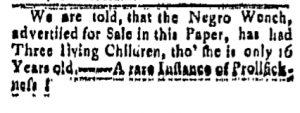
oct-17-10171766-puff-piece-new-london-gazette
New-London Gazette (October 17, 1766).

Another notice that appeared on the same page of the New-London Gazette further complicates today’s advertisement. “We are told,” an anonymous narrator (perhaps the printer) proclaimed, “that the Negro Wench advertised for Sale in this Paper, has had Three living Children, tho’ she is only 16 Years old. — A rare Instance of Prollfickness!” (Presumably the last word was supposed to be “prolificness.”) As Lindsay noted, the seller wished to be rid of this young woman solely because of her “breeding” and the inconveniences that it caused. The other notice, however, seemed to celebrate the young enslaved woman’s ability to produce children, promoting her fecundity as a selling point for potential buyers.

Who was responsible for the announcement that the sixteen-year-old “hearty Wench” already had three children? Was this an advertisement – a puff piece – placed by the current owner of the young woman in hopes of generating interest and making a sale? Or did the printer insert it of his own volition, as a point of interest he hoped would inform and entertain readers? The placement on the page makes it difficult to reach any particular conclusion. The notice appeared among the advertisements included in that issue of the New-London Gazette, but it appears at the bottom of the column immediately to the left of the column in which the advertisement for the “hearty Wench” was printed. It may have been positioned to prime readers to consider purchasing the young woman, but it also could have been intended as amusing filler when news and advertising did not completely fill the column. Either way, it now provides disheartening evidence concerning the levels of degradation one enslaved woman experienced at the hands of her captor and his community.

When Lindsay first presented this advertisement for my approval, I thought I might contemplate whether it suggested a family was being separated. When I examined it in the context of the rest of the issue, however, I discovered a much more revolting situation.

**********

[1] John Campbell, “Work, Pregnancy, and Infant Mortality among Southern Slaves,” Journal of Interdisciplinary History 14, no. 4 (Spring 1984): 797.