February 20

GUEST CURATOR:  Gabriela Vargas

What was advertised in a colonial American newspaper 250 years ago today?
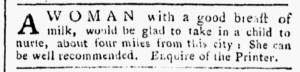
Dunlap’s Pennsylvania Packet (February 20, 1775).

“A WOMAN with a good breast of milk, would be glad to take in a child to nurse.”

On February 20, 1775, an anonymous woman placed an advertisement offering her services as a wet nurse in Dunlap’s Pennsylvania Packet. In colonial and revolutionary America, women advertised their services as wet nurses while families often placed advertisements seeking wet nurses. Mothers who could not supply their own breast milk due to health issues acquired wet nurses. Families who lost mothers during childbirth also needed wet nurses. This was a common practice in the eighteenth century.

According to Janet Golden, some English physicians advised against wet nurses because they might be “sick or ill-tempered.”[1]  William Buchan, for instance, advised looking for a “healthy woman, … one with an abundant supply of milk, healthy children, clean habits and a sound temperament.”[2] Those physicians looked down on women not breastfeeding their own children but doing it for others. In general, wet nursing caused an increase in infant mortality rate. Golden states, “Nearly every European commentator knew that wet nursing increased infant mortality. Wet-nursed infants were more likely to die than were infants suckled by their mothers, and the wet nursing system itself contributed to infant mortality by inducing poor women to abandon their own offspring in order to find employment suckling the children of others.”[3]

For women who were hired as wet nurses in colonial America, their earnings belonged to their husbands by law.[4] Wet nursing was not always a paid arrangement. Instead, neighbors sometimes helped their communities by nursing the babies of mothers who could not breastfeed due to postpartum ailments.[5] Some families felt more comfortable with a neighbor rather than a stranger. Mothers or their families would often look for neighbors or friends to breastfeed their babies, but that was not always possible. That created a market for other women to offer their services, which they would advertise in early American newspapers.

**********

ADDITIONAL COMMENTARY:  Carl Robert Keyes

Even though the prescriptive literature authored by English physicians sometimes cautioned against entrusting infants to wet nurses, colonizers sometimes heeded those concerns and other times developed their own practices embedded in local circumstances in the eighteenth century.  As Gabriela indicates, neighbors participated in communal wet nursing as one way of contributing to their communities.

Some also went against the prescriptive literature that condemned wealthy women for hiring wet nurses instead of fulfilling what the physicians considered their maternal obligations.  Sending infants to foster with wet nurses in the countryside became a popular practice among many affluent families in Boston and other cities.  “Some urban families,” Golden explains,” assumed that the city was an unhealthy environment, rife with both epidemic and endemic diseases.  The countryside, many believed, provided a more salubrious setting, especially in the early months of life.”[6]  Note that the anonymous “WOMAN with a good breast of milk” in the advertisement Gabriela selected emphasized that she resided about four miles from Philadelphia, near the busy port yet removed from the largest city in the colonies.  Other women took a similar approach.  According to Golden, “advertisements placed by women looking for babies to wet nurse reported their distance from the city.”[7]

In four short lines, the woman who placed today’s featured advertisement addressed several common concerns.  She commented on her own health and the nourishment she could provide for an infant, asserting that she had a “good breast of milk.”  Yet she did not ask prospective clients to take her word for it.  Instead, she stated that she “can be well recommended,” presumably both for her character and for her health.  At the same time, she testified to the healthiness of the environment where she provided her services, highlighting that she resided outside the city.  The anonymous woman intended for each of those appeals to resonate with mothers and their families.

**********

[1] Janet Golden, A Social History of Wet Nursing in America: From Breast to Bottle (New York: Cambridge University Press, 1996), 15.

[2] Golden, Social History of Wet Nursing, 16.

[3] Golden, Social History of Wet Nursing, 14.

[4] Golden, Social History of Wet Nursing, 17.

[5] Golden, Social History of Wet Nursing, 20.

[6] Golden, Social History of Wet Nursing, 22.

[7] Golden, Social History of Wet Nursing, 22.

October 15

What was advertised in a colonial American newspaper 250 years ago today?

Massachusetts Gazette and Boston Weekly News-Letter (October 15, 1772).

“WANTED immediately, a Wet-Nurse.”

Richard Draper had too much content to publish all of it in the October 15, 1772, edition of the Massachusetts Gazette and Boston Weekly News-Letter.  He remedied the situation, in part, by printing and distributing a supplement on a smaller sheet.  That supplement included additional news, but no advertising.  Even with the supplement, Draper did not have enough space for all the news and advertising received in the printing office.  A note at the bottom of the final column on the third page instructed readers to “See SUPPLEMENT” and advised that “Other Articles and Advertisements must be defer’d.”

Why insert such a note on the third page instead of placing it at the end of the final column on the last page?  The process of printing newspapers on a manually-operated press provides an explanation.  Like most other newspapers from the era of the American Revolution, a standard issue of the Massachusetts Gazette and Boston Weekly News-Letter consisted of four pages created by printing two pages on each side of a broadsheet and folding it in half.  Printers usually set the type and printed the first and fourth pages on one side of the sheet.  After it dried, they printed the second and third pages on the other side.  That resulted in the latest news often appearing inside the newspaper rather than on the front page.  That also meant that the last portion of the newspaper arranged by the compositor was the third page, not the final page.  That being the case, announcements about supplements and omitted materials usually appeared on the third page.

Draper did manage to include one additional advertisement in the standard issue for October 15 rather than deferring it for a week.  The urgency of the notice may have convinced him to make a special effort to include it.  “WANTED immediately,” the advertisement proclaimed, “a Wet-Nurse, with a young Breast of Milk, that can be well Recommended, to suckle a Child in a Family: Enquire of the Printer.”  That notice ran in the right margin of the third page, almost the entire length of an extensive advertisement that listed merchandise stocked by John Barrett and Sons at their store “near the MILL-BRIDGE” in Boston.  With some creative graphic design, Draper squeezed an advertisement seeking a wet nurse, a notice that likely arrived late to the printing office, into that issue.  In so doing, he adapted to the technology of the printing press while providing a special service to that advertiser.

August 21

What was advertised in a colonial American newspaper 250 years ago today?

Aug 21 - 8:21:1770 Massachusetts Spy
Massachusetts Spy (August 21, 1770).

“A General Assortment of GROCERIES.”

Isaiah Thomas launched the Massachusetts Spy on July 17, 1770, with an issue that included the “PROPOSALS for printing by Subscription, A New PAPER of INTELLIGENCE” as well as several news items.  The “PROPOSALS” served as an advertisement for the newspaper, the only advertisement that appeared in “NUMB. I,” that first issue.  Thomas stated that he would publish the next issue two weeks later (but three times a week after that) and invited subscribers and advertisers to contact him.  Three weeks elapsed before the printer distributed the next edition, but after that he kept to the schedule he outlined in the “PROPOSALS.”

The first several issues, however, did not include advertisements.  Thomas and the Massachusetts Spy competed with four other newspapers published in Boston, all of them established years earlier and familiar to the readers in the city and its hinterlands.  Prospective advertisers quite likely did not wish to invest in placing notices in the Massachusetts Spy until they saw what kind of reception it received among the public and got a better sense of its circulation.  It was not until “NUMB. 8,” the eighth issue, that advertisements other than the “PROPOSALS” ran in the Massachusetts Spy.  More than a month after Thomas solicited advertisements in the first issue, four of them ran on August 21, 1770.  Alexander Chamberlain, Jr., advertised groceries and housewares, while two citrus sellers at “the sign of the Dish of Lemons, in Marlborough-street” and “the Sign of the Basket of Lemons … in Middle-Street” competed for customers.  An anonymous “WET NURSE” offered her services, instructing prospective clients to “Enquire at the New Printing-Office, in Union-Street.”  Like other printers, Thomas disseminated additional information to readers who followed up on advertisements that ran in his newspaper.

In the colophon on the final page, Thomas reminded readers that he accepted “Subscriptions, Articles of Intelligence, and Advertisements, &c. for this Paper.”  Having finally published these advertisements, he likely hoped that they would encourage more colonists to insert their own notices in his newspaper.  After all, advertising represented an important revenue stream for any printer.  Paid notices often made the difference between newspapers successfully turning a profit or not having sufficient resources to continue publication.