April 12

What was advertised in a colonial American newspaper 250 years ago today?

Supplement to the New-York Gazette and Weekly Mercury (April 12, 1773).

“He intreats those who are so obliging as to intend advertising in the first Number of the New-York Gazetteer, to favour him with their Advertisements as soon as convenient.”

As he prepared to launch his New-York Gazetteer, James Rivington placed a notice in the April 12, 1773, edition of the New-York Gazette and Weekly Mercury to announce that he published and distributed “AN ADDRESS TO THE SUBSCRIBERS” for his newspaper.  He worried, however, that not every subscriber actually received their copy.  He arranged for each of them to “have the Address left at their Houses,” but discovered that “thro’ Inadvertency, [some] may have been hitherto neglected.”  To remedy the situation, he offered that they “may be furnished sans Expence with as many Copies of it as may be required for themselves or for their Friends” upon sending a request to the printing office.

Why might subscribers have been interested in obtaining multiple free copies of this address and sharing them with others?  It was not an extended subscription proposal.  Instead, Rivington explained that it “contains the Speeches in Parliament, subsequent to that from the Throne at the opening of the present Session,” made by nearly twenty politicians and other dignitaries, including “the truly eloquent Mr. Edmund Burke, Agent for our Colony.”  Those speeches elaborated on “the most important Subjects, in which the Inhabitants of this Continent are very materially interested.”  Rivington devised a premium or gift that he gave to subscribers before the first issue of his newspaper went to press.  He likely hoped that any of the additional copies that subscribers ordered to share with their friends might also induce others to subscribe as well.

The printer had another purpose, however, in placing this notice in the New-York Gazette and Weekly Mercury.  Between his offer to distribute additional copies of the “ADDRESS TO THE SUBSCRIBERS” and his explanation of the contents, he made a pitch to prospective advertisers.  Rivington “intreats those who are so obliging as to intend advertising in the first Number of the New-York Gazetteer, to favour him with their Advertisements as soon as convenient.”  He explained that advertisements “will be inserted on the usual terms,” though he did not specify the rates, and promised that the newspaper “will have a very extensive Circulation.”  Colonizers familiar with the full name of the newspaper, Rivington’s New-York Gazetteer; or the Connecticut, New-Jersey, Hudson’s-River, and Quebec Weekly Advertiser, already anticipated that would be the case.  Furthermore, Rivington previously disseminated subscription proposals in New York, Pennsylvania, and New England.  Merchants, shopkeepers, artisans, and others could depend on prospective customers near and far glimpsing their advertisements as they perused Rivington’s newspaper.

This notice appeared in the New-York Gazette and Weekly Mercury ten days before Rivington published the first issue of his new newspaper on April 22, 1773.  He presented a gift to his subscribers and offered additional free copies of speeches delivered in Parliament in hopes of inciting more interest among prospective subscribers.  At the same time, he positioned a call for advertisers in the middle of his description of the premium his subscribers and their friends received.  When the first issue went to press, advertising filled five of the twelve columns.  Through his various efforts, Rivington convinced advertisers to take a chance on placing notices in his new publication.
December 22

What was advertised in a colonial American newspaper 250 years ago today?

Dec 22 - 12:22:1767 South-Carolina Gazette and Country Journal
South-Carolina Gazette and Country Journal (December 22, 1767).

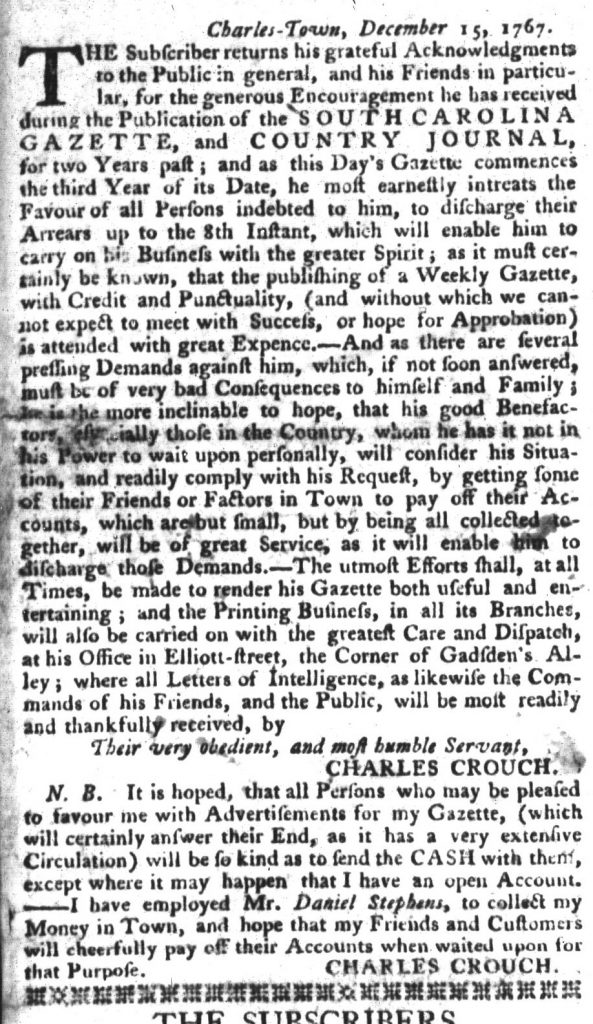
“He most earnestly intreats the Favour of all Persons indebted to him, to discharge their Arrears.”

Charles Crouch, the printer of the South-Carolina Gazette and Country Journal, marked the completion of the second year of publication with an advertisement that called on subscribers and other “Persons indebted to him” to settle accounts so he, in turn, could pay down his own debts. His notice first appeared in the December 15, 1767, issue. It ran for four weeks, appearing immediately below the masthead as the first item in the first column on the first page in the final three issues of 1767 and the first issue of 1768. Crouch invoked his privilege as the printer to determine his advertisement’s placement on the page, choosing the spot likely to garner the most notice by those he wished to see his message and follow through on his request for payment.

The printer resorted to several tactics to encourage his debtors to “discharge their Arrears.” He emphasized that he assumed “great Expence” in publishing such a “useful and entertaining” newspaper “with Credit and Punctuality.” He offered a service to the public, and did so with competence, but that potentially put “himself and Family” at risk of “very bad Consequences” if those who owed him money did not pay as soon as possible. He also sought to downplay the amount of any particular debt, asserting that if many made small payments that the total would be sufficient for him “to discharge those Demands” against him. Considering these various appeals together, Crouch implicitly argued that the value of his newspaper amounted to much more than the small costs subscribers, advertisers, and others incurred when they did business with him.

Crouch also addressed advertisers in particular, attaching a nota bene about inserting advertisements in subsequent issues of his newspaper. First, he underscored their efficacy, assuring those who contemplated placing notices that advertising in his gazette “will certainly answer their End, as it has a very extensive Circulation.” The South-Carolina Gazette and Country Journal was one of three newspapers published in Charleston at the time, so Crouch needed to convince advertisers to select his newspaper instead of, or along with, the others. He also made a request for new advertisers to “be so kind as to send the CASH” when they submitted their copy, though this was not necessary if he already happened to have “an open Account.”

The continuation of advertising, along with the inclusion of other “useful and entertaining” content, depended in part on an advertisement published by the printer of the South-Carolina Gazette and Country Journal. Even as he instructed potential advertisers that inserting notices in his gazette “will certainly answer their End,” Crouch depended on that being the case for his own advertisement, trusting that it would induce his debtors to settle their accounts.

January 22

What was advertised in a colonial American newspaper 250 years ago today?

jan-22-1221767-pennsylvania-gazette
Pennsylvania Gazette (January 22, 1767).

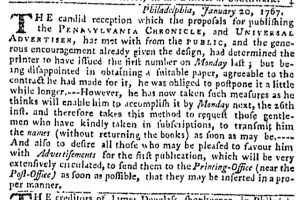
“All those who may be pleased to favour him with Advertisements for the first publication … to send them to the Printing-Office.”

William Goddard published proposals for a new newspaper, the Pennsylvania Chronicle, and Universal Advertiser, in Philadelphia’s other newspapers for several weeks in late December 1766 and early January 1767. He pledged “to give his readers a weekly relation of the most remarkable and important occurrences, foreign and domestic, collected from the best magazines and papers in Europe and America, as well as from other sources, having a particular regard to such matters as shall most intimately relate to the welfare of the Colonies.”[1]

In addition, he offered space for advertisements, though the Pennsylvania Gazette and the Pennsylvania Journal already featured extensive advertising, sometimes extending to half-sheet supplements devoted exclusively to commercial and other notices. “The Rates of the paper and advertisements,” Goddard promised, “shall be the same … with those heretofore and now printed in this city.—All advertisements shall be punctually inserted, in order as they come in, and be neither delayed or displaced, but shall appear in a fair and conspicuous manner.”

Readers of the newspapers already printed in Philadelphia encountered Goddard’s proposal, dated December 23, 1766, for nearly a month before he published an update that he expected to commence publication of the Pennsylvania Chronicle on January 26. In that shorter notice, he requested that “all those who may be pleased to favour him with Advertisements for the first publication, which will be very extensively circulated, to send them to the Printing-Office … as soon as possible.”

Goddard had experience with publishing newspapers, having previously printed the Providence Gazette for several years. He knew that profits from such an endeavor usually did not arrive from subscriptions but rather from the additional revenues generated by selling advertising space. He also knew that advertisements drew readers. As attractive as those “most remarkable and important occurrences, foreign and domestic” may have been to prospective subscribers, colonists also desired the news and marketing appeals delivered via advertisements. Assorted legal notices kept citizens informed. Notices about runaway servants, slaves, and wives kept residents cautious of strangers they encountered. Notices promoting consumer goods and services kept potential customers aware of current fashions and the availability of products that were part of the ongoing consumer revolution.

Goddard’s proposal also revealed how advertisers could expect the notices they purchased to be handled by the printer: no privileges or preferences when it came to when or how they were inserted in the Pennsylvania Chronicle. Although Goddard’s promise about the timing for printing advertisements may have been accurate, the requirements for laying out columns and pages within any issue almost certainly prohibited publishing advertisements in the same order that they arrived in the printing office. In his advertisement to solicit advertisements, Goddard engaged in his own sleight of hand that savvy consumers expected from any sort of marketing.

**********

[1] For Goddard’s original proposal, see Pennsylvania Gazette (January 8, 1767).