August 1

What was advertised in a colonial American newspaper 250 years ago this week?
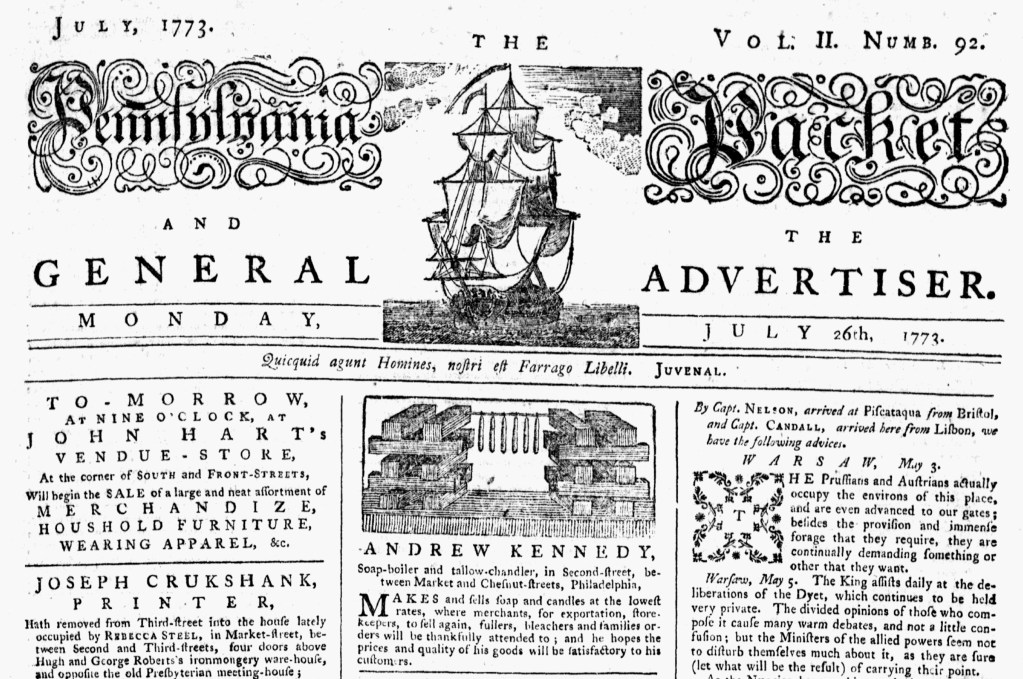
Pennsylvania Packet (July 26, 1773).

“MAKES and sells soap and candles … for exportation.”

The front page of the July 26, 1773, edition of the Pennsylvania Packet and General Advertiser featured two images.  As usual, a woodcut depicting a ship at sea appeared in the masthead.  The newspaper took its name from the packet ships that crisscrossed the Atlantic, transporting passengers and freight.  Significantly, packet ships also carried information, whether written in letters, printed in newspapers, or shared by captains, other officers, and crew.  The Pennsylvania Packet, like a packet ship, disseminated news to every destination it reached.  Whether accounts of current events, rosters of vessels arriving and departing from customs houses, prices current for commodities, or advertisements, the contents of the Pennsylvania Packet facilitated commerce in Philadelphia, its figurative home port, and readers wherever they happened to peruse the newspaper.

Andrew Kennedy certainly hoped that the Pennsylvania Packet and General Advertiser would facilitate his own commercial interests.  The “soap-boiler and tallow-chandler” ran a shop in Philadelphia, though he aimed to serve consumers far beyond that bustling port.  Like packet ships and newspapers, he envisioned the soap and candles that he made and sold “at the lowest rates” reaching faraway places.  He offered them to “merchants, for exportation,” and to “storekeepers, to sell again,” presenting those options for buying by volume first before mentioning “families orders.”  Like many other artisans and shopkeepers who advertised in colonial newspapers, he promoted the “prices and quality of his goods” and concluded with overtures about customer satisfaction.  Kennedy commenced his advertisement with an image that readers immediately recognized, stacks of blocks on the right and left to support a string dangling six freshly-dipped candles.  Without even skimming the rest of the advertisement, readers knew that Kennedy sold candles.

Only two other images appeared in that issue of the Pennsylvania Packet, both of them woodcuts of indentured servants who ran away from their masters.  John Dunlap, the printer, provided those stock images to the advertisers, but Kennedy commissioned a woodcut for his own exclusive use.  That image likely helped attract attention to the appeals to price and quality that he intended to resonate with merchants, shopkeepers, and other prospective customers.
May 7

What was advertised in a colonial American newspaper 250 years ago this week?

May 7 - 5:4:1769 Virginia Gazette Purdie and Dixon
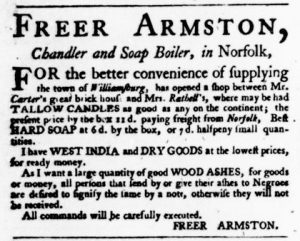
Virginia Gazette [Purdie and Dixon] (May 4, 1769).
“Best HARD SOAP at 6d. by the box.”

In the spring of 1769, Freer Armston,, a chandler and soap boiler in Norfolk, Virginia, attempted to enlarge his market by expanding his operations into Williamsburg. He placed an advertisement in Purdie and Dixon’s Virginia Gazette to inform prospective customers that he had opened a new shop where he sold “TALLOW CANDLES as good as any on the continent.” With such a bold statement, Armston favorably compared his wares to any others that consumers could acquire.

To make his candles even more attractive, he took the unusual step of naming their price in his advertisement: “by the box 11 d. paying freight from Norfolk.” Advertisers rarely listed prices in eighteenth-century newspapers, though many often made general appeals to low or reasonable prices. Readers likely knew what to expect to pay for a box of tallow candles from other chandlers and shopkeepers in Williamsburg. As a newcomer, Armston attempted to stimulate interest in his merchandise by allowing prospective customers to assess on their own whether he offered a deal. He did the same for his “Best HARD SOAP at 6d. by the box, or 7d. halfpenny [sic] small quantities.” He was not as verbose about the quality of his soap, simply describing it as “Best,” and instead emphasized the price and potential savings by buying in bulk. Customers saved twenty percent when they purchased an entire box of hard soap.

Armston also sought to establish that he was a careful and responsible entrepreneur. In addition to selling candles and soap, he asked readers to provide him with supplies, especially “good WOOD ASHES” used in the production of soap, for which he offered “goods or money.” He was vigilant when it came to accepting ashes from Black men and women, assuming that some did not acquire them by legitimate means. Armston instructed that “all persons that send by or give their ashes to Negroes” must also send a note specifying that they had done so or else he would not accept them. The chandler and soap boiler was not about to give “goods or money” to Black people who could not demonstrate how they came into possession of ashes they delivered to his shop. In addition to offering quality goods at low prices, Armston depicted himself as a good neighbor who attended to maintaining proper order in his business dealings.

July 31

What was advertised in a colonial American newspaper 250 years ago today?

Jul 31 - 7:31:1767 New-London Gazette
New-London Gazette (July 31, 1767).

“Intending to carry on my former Business …”

Charles Jeffery had been away from New London for a while, having left “to settle sundry Accounts of long standing,” but, “having almost compleated the same,” he was back and ready to resume the business he had allowed to lapse during his absence. To make sure that “all good old Customers” knew of his return, he placed an advertisement in the New-London Gazette.

Jeffery reminded readers of the various branches of the business he formerly pursued: “Butchery,—Baking Loaf and Ship Bread,—Butter Bisket, Tallow-Chandling;—Also brewing SHIP BEER, &c. &c. &c.” He did not elaborate on the goods he offered for sale, neglecting to make any of the common appeals to price or quality. He did, however, make a nod toward the sort of customer service that readers could expect; they could “depend on being used in the neatest and best manner, by their humble Servant.” He aimed this promise directly at “all good old Customers.”

Despite the hiatus in his business, Jeffery anticipated that readers of the New-London Gazette were sufficiently familiar with him and the commodities he sold that he did not need to do much by way of attempting to convince them to resume trading with him. In that regard, his advertisement resorted more to announcing his enterprise instead of marketing it. He did not even seem particularly interested in attracting new customers but rather desired to revive relationships with former associates, those “good old Customers” who made purchases from him in the past.

Jeffery may have felt little need to engage in much marketing, perhaps assuming that he had already achieved prominence and a positive reputation among residents of New London and its hinterland. In addition, he likely faced less competition than his counterparts in larger port cities, like Boston, Charleston, New York, and Philadelphia. Had he temporarily suspended business in any of those locales, he may very well have posted a rather different sort of advertisement when he sought to return to the marketplace.