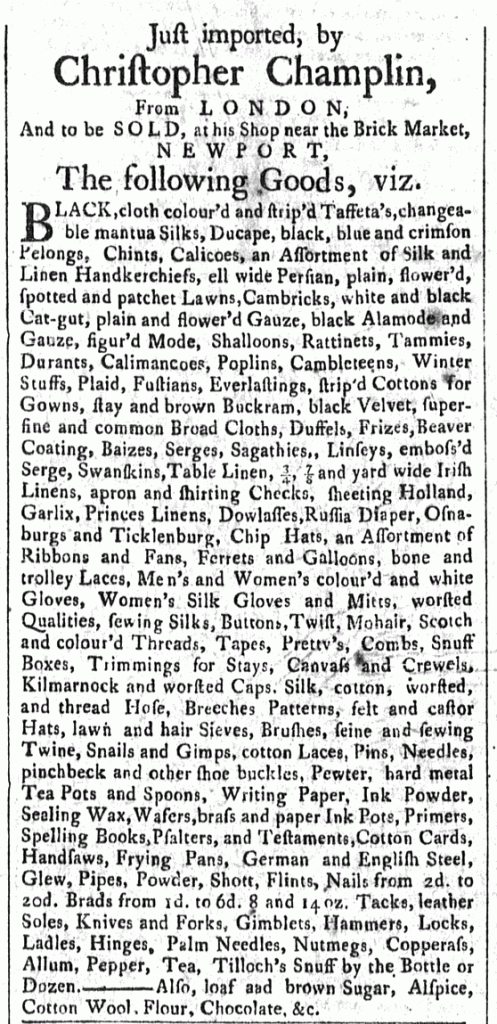
What was advertised in a colonial American newspaper 250 years ago today?

“Fresh Imported … direct from LONDON … English & India GOODS.”
The crisis over tea hit the boiling point as Christopher Champlin inserted a new advertisement in the May 16, 1774, edition of the Newport Mercury. Relying on standard language that appeared in notices placed by merchants and shopkeepers, he informed readers in Rhode Island that he stocked a “general assortment of English & India GOODS, Suitable for the Season, Which he continues to sell, by WHOLESALE and RETAIL.” His merchandise was “Fresh Imported” on two ships “direct from LONDON.” In a final appeal, Champlin asserted that he sold his wares “As low, for cash, as at any store or shop in the colony.” Considering the news that ran immediately to the left of his advertisement, Champlin’s marketing strategy may not have been resonated differently than he originally intended.
Word of the Boston Port Act had arrived in Newport. A news update with a headline that proclaimed, “JOIN or DIE!!” described the “act of parliament for blockading the harbour of Boston, in order to reduce its spirited inhabitants to the most servile and mean compliance ever attempted to be imposed on a free people” as leading to a fate “worse than death—SLAVERY.” The editor had the news from “a gentleman” who recently arrived in Newport from Boston.” That source stated that “a number of the first merchants in London had wrote the manufacturers in inland towns of England, not to send them any more goods, and had wrote to the merchants in Boston, that the surest way to settle the present difference, between the two countries, is to stop all trade immediately, and advised a strict union between all the colonies in this measure.” Whether merchants in London had actually done any of that or it was wishful thinking on the part of patriots who sought allies on the other side of the Atlantic, colonizers had experience with nonimportant agreements (or boycotts) as political leverage in response to the Stamp Act and the Townshend Acts. The update reminded readers “that hydra the Stamp Act … was destroyed by our firmness and union.”
By the end of October, the First Continental Congress adopted the Continental Association, a trade boycott intended to pressure Parliament into repealing the Boston Port Act and the rest of the Coercive Acts passed in retaliation for the Boston Tea Party as well as address other grievances. For the moment, however, no boycott was in place when Champlin published his advertisement promoting his “Fresh Imported” goods. The news that accompanied that notice perhaps caused some consumers to reconsider what they might purchase, but it might also have served to encourage sales among colonizers who suspected that it was only a matter of time before another boycott went into effect. They could buy what they wished with a clear conscience and without others censuring them for doing so. Whatever they chose to do in May 1774, consumers in Rhode Island made decisions in the context of news arriving from Boston, London, and other places.