May 8

What was advertised in a colonial American newspaper 250 years ago this week?

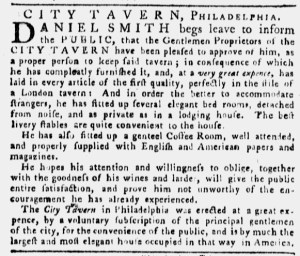
Supplement to the Massachusetts Gazette and Boston Weekly News-Letter (May 5, 1774).

“City Tavern, Philadelphia.”

When the City Tavern opened in Philadelphia, Daniel Smith inserted advertisements in the Pennsylvania Gazette and the Pennsylvania Packet in February 1774.  The opening had been much anticipated in that city, following the efforts of some of the most prominent residents to erect the building via subscription.  In 1772, Samuel Powel entrusted the land to seven wealthy colonizers.  In turn, those “Gentlemen Proprietors” oversaw a “voluntary subscription of the principal gentlemen of the city” to raise funds to build the tavern and then selected Smith to lease and operate the City Tavern.

About three months after his advertisement ran in Philadelphia’s newspaper, it appeared in the Supplement to the Massachusetts Gazette and Boston Weekly News-Letter on May 5.  It featured identical copy and, except for the headline, identical format in terms of capitalization and italics.  Smith may have written it out exactly, but just as likely he clipped the advertisement from his local newspaper and sent it to Richard Draper’s printing office in Boston.  Alternately, he could have sent instructions to reprint the notice from a newspaper that Draper received via his exchange networks with other printers, but Smith would not have been certain that Draper received the issues that originally carried his advertisement.  Given that the tavernkeeper proclaimed that he “fitted up a genteel Coffee Room, … properly supplied with English and American papers and magazines,” he likely corresponded directly with Draper, ordering a newspaper subscription and arranging to run his advertisement in the public prints in Boston.

That advertisement provided a brief history of the City Tavern that would have been familiar to many residents of Philadelphia yet new to readers in Boston.  Smith hoped to impress prospective visitors to his city with the “largest and most elegant house occupied in that way [as a tavern, coffeehouse, and inn], in America.”  He emphasized his own “very great expence” in furnishing it with “every article of the first quality, in the stile of a London tavern.”  Indeed, when John Adams traveled to Philadelphia to attend the First Continental Congress several months later, he described it as “the most genteel [tavern] in America.”[1]  That was the reputation Smith hoped to cultivate, not only in his city but throughout the colonies.  He positioned the City Tavern as a destination itself, not just a place to eat, drink, and lodge while visiting Philadelphia.

**********

[1] See entry for August 29, 1774, in John Adams diary 21, 15 August – 3 September 1774 [electronic edition]. Adams Family Papers: An Electronic Archive. Massachusetts Historical Society. http://www.masshist.org/digitaladams/
February 16

What was advertised in a colonial American newspaper 250 years ago today?

Pennsylvania Gazette (February 16, 1774).

“Perfectly in the stile of a London tavern.”

In February 1774, Daniel Smith took to the pages of the Pennsylvania Gazette and the Pennsylvania Packet to promote his latest enterprise, the City Tavern in Philadelphia.  Residents of the urban port had witnessed the building and marketing of the tavern.  As Smith explained, the building “was erected at a great expence, by a voluntary subscription of the principal gentlemen of the city.”  He billed it as “the largest and most elegant house in that way,” meaning a tavern and inn, “in America.”  The previous summer, the proprietors ran an advertisement seeking a tavernkeeper with “an active, obliging disposition” to rent the building, still under construction with completion expected by September, and operate it “for the convenience and credit of the city.”  Those “Gentlemen Proprietors” wanted the largest and most cosmopolitan city in the colonies to have a tavern that rivaled any found in London.

Smith asserted that he achieved that goal, doing so “at a very great expence.”  He proclaimed that he furnished the building and stocked the storerooms with every necessity.  He “laid in every article of the first quality, perfectly in the stile of a London tavern,” just as envisioned by the affluent subscribers who made the City Tavern one of their projects for improving the bustling urban port and enhancing the city’s reputation throughout the British Atlantic world.  The amenities included a “genteel Coffee Room” where merchants and others could socialize and conduct business.  He “supplied English and American papers and magazines” for their entertainment, but also so they could track the shipping news, prices current, and current events that had an impact on their businesses.  Perhaps his subscriptions included the new Royal American Magazine, the only magazine published in the colonies at the time, demonstrating to his patrons the efforts he made to provide the latest and most interesting publications.  For “strangers” or visitors to the city, Smith “fitted up several elegant bed rooms, detached from noise,” and the “best livery stables,” located “quite convenient to the house.”  Smith expected that all those features, along with “the goodness of his wines and larder,” would “give the public entire satisfaction.”

The City Tavern quickly became a popular meeting place, especially as the imperial crisis intensified.  In addition to merchants and the local gentry frequenting the establishment as part of their everyday routines, concerned citizens met there to debate and discuss politics.  In May 1774, just three months after Smith ran his advertisement, more than two hundred of them gathered at the City Tavern to determine how to respond to messages from Boston in the wake of the Boston Port Act that closed the port until the colonizers paid for the tea destroyed during the Boston Tea Party.  When the First Continental Congress met in Philadelphia in September and October 1774, many influential leaders from throughout the colonies dined and drank at the City Tavern.  John Adams praised it as “the most genteel [tavern] in America.”[1]

**********

[1] See entry for August 29, 1774, in John Adams diary 21, 15 August – 3 September 1774 [electronic edition]. Adams Family Papers: An Electronic Archive. Massachusetts Historical Society. http://www.masshist.org/digitaladams/

July 7

What was advertised in a colonial American newspaper 250 years ago today?

Pennsylvania Packet (July 7, 1773).

“To be lett, THE CITY TAVERN.”

The City Tavern became a landmark in Philadelphia during the era of the American Revolution, but in 1773 it was a new structure that awaited a tenant to oversee its operations.  An advertisement in the July 7 edition of the Pennsylvania Journal described the location “in one of the principal Streets, near the Center of the Town” and described the grand edifice, including the spacious rooms and the lofty ceilings.  Over time, the City Tavern rivaled the London Coffee House as a meeting place for merchants to socialize and conduct business.  Members of the Continental Congress dined at the City Tavern, as did delegates to the Constitutional Convention.  Notable men and women, including George and Martha Washington and John and Abigail Adams, stayed at the City Tavern.  Residents of Philadelphia and visitors to the city alike gathered, dined, and danced at the City Tavern both during the American Revolution and during the decade that Philadelphia served as the capital of the new nation.

What were the origins of such a storied venue?  Why was the “most convenient and elegant structure of its kind in America” in need of a host to run the establishment in the summer of 1773?  Some of the most elite residents of Philadelphia, the largest and most prosperous city in the colonies, determined that their growing metropolis needed “a genteel club the equal of any in England” to serve as “the center of business by day and entertainment at night.”  As the advertisement in the Pennsylvania Journal explained, “the Proprietors have built this tavern without any view of profit, but merely for the convenience and credit of the city.”  The prestige associated with the city having such an establishment was profit enough.  Samuel Powel, a prominent merchant and politician, donated the land.  Seven trustees set about raising funds by subscription, convincing fifty-three subscribers to contribute at least twenty-five pounds each.  In total, they raised more than three thousand pounds for the building.

Once construction was complete, the proprietors needed someone with an “active, obliging disposition” who would certainly “find it in his interest” to oversee operations at the new City Tavern.  They hoped to engage a tenant who would open the tavern to patrons in September.  The proprietors selected Daniel Smith.  In an advertisement in the February 14, 1774, edition of the Pennsylvania Packet, Smith promoted the “genteel Coffee Room … properly supplied with English and American papers and magazines,” the “goodness of his wines and larder,” “several elegant bed rooms, detached from noise,” and the “best livery stables.”  He set about delivering on the “stile of a London tavern” as intended by the proprietors and subscribers who first envisioned the City Tavern as a marker of Philadelphia’s cultural status.

April 14

GUEST CURATOR: Matthew Ringstaff

What was advertised in a colonial American newspaper 250 years ago today?

New-Hampshire Gazette (April 14, 1769).

“Public Vendue … at Capt. Jacob Tilton’s Tavern.”

This advertisement from the New-Hampshire Gazette on April 14, 1769, sparked my interest because of what was being sold and where the sale took place: “TO BE SOLD … at Capt. Jacob Tilton’s Tavern … SUNDRY HOUSEHOLD FURNITURE.” The location of this “Public Vendue” or auction, Tilton’s Tavern, seemed unusual. How often does a bar have an auction for household furniture? In the twenty-first century when a bar holds some type of event it is often a car or motorcycle show, but not a furniture auction. According to Leigh Zepernick, a collections intern at the Old State House in Boston, “It is difficult to overstate the importance of taverns in 18th century life. In addition to providing food, drink, and lodging, they were venues for town meetings, legal proceedings, and business transactions. Taverns were a place to debate politics, play games such as cards or dice, and catch up with the latest news and gossip. They were the hub of social life, and in Boston in particular, they were ubiquitous. In 1765, there was one tavern for every 79 adult men.”

**********

ADDITIONAL COMMENTARY: Carl Robert Keyes

Edward Moyston’s trade card for the City Tavern (1789). Courtesy Historical Society of Pennsylvania (Society Miscellaneous Collection).

As Matt notes, a lot more than eating and drinking took place at taverns in eighteenth-century America. Two decades after the New-Hampshire Gazette ran the advertisement about an auction at Tilton’s Tavern in Portsmouth, Edward Moyston distributed a trade card for the City Tavern in Philadelphia. His marketing made it clear that the City Tavern was a place for conducting business. Indeed, the “CITY-TAVERN” appeared in much smaller font than the headline for the trade card that announced the “Merchants’ Coffee-House & Place of Exchange” could be found at the tavern. Moyston had set aside the “two Front Rooms,” noting that they had been “specially appropriated to these purposes” due to a subscription agreement with “Merchants, Captains of Vessels, and other Gentlemen.” Although Moyston also marketed the rest of his establishment as “a TAVERN and HOTEL: Where Gentlemen and the Families are accommodated, as usual, with the most superior Liquors … and every article for the Table is served up with elegance,” he positioned the City Tavern as a place to conduct business. To that end, he likely supplied newspapers published in Philadelphia and other cities for his patrons so they could stay informed of politics and commerce. Those “Merchants, Captains of Vessels, and other Gentlemen” certainly also shared news and gossip with each other in conversations that took place as they cast up accounts and pursued new transactions.

Tilton’s Tavern in Portsmouth may not have been as grand as the City Tavern in Philadelphia (which has been reconstructed and serves visitors today), but it served a similar purpose. As the advertisement Matt selected demonstrates, it was a gathering place familiar to readers of the New-Hampshire Gazette and other members of the community. Holding an auction at Tilton’s Tavern was business as usual in the eighteenth century, one of the many activities that took place at an establishment where people gathered to exchange information and goods in addition to consuming food and beverages. Its convenience and central location likely made it a preferred venue compared to the home of the patron who intended to auction furniture and housewares.