
What was advertised in a revolutionary American newspaper 250 years ago today?
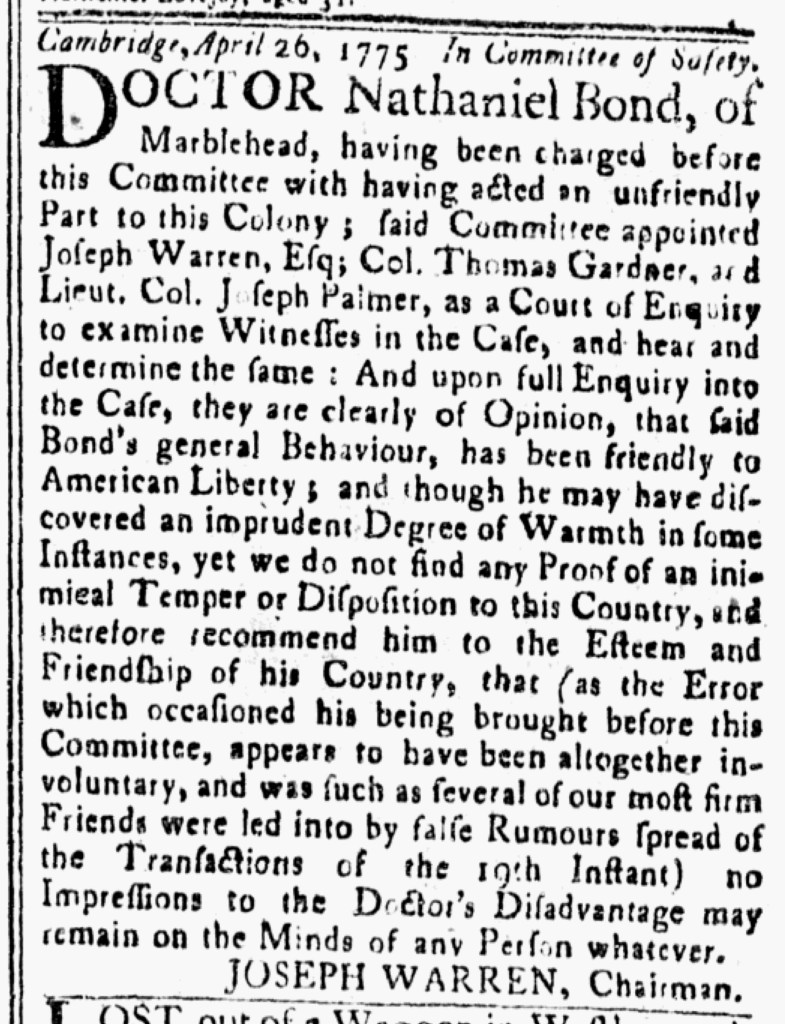
“We do not find any Proof of an inimical Temper or Disposition to this Country.”
Advertisements in early American newspapers often delivered local news beyond the items that printers selected to cover. Such was the case for an advertisement placed by the Committee of Safety in the May 2, 1775, edition of the Essex Gazette. Convening in Cambridge a week after the battles at Lexington and Concord, the committee considered the case of “DOCTOR Nathaniel Bond, of Marblehead,” who had been accused of “acting an unfriendly Part to this Colony.” The committee appointed a “Court of Enquiry” consisting of Joseph Warren, then serving as president pro tem of the Massachusetts Provincial Congress, Colonel Thomas Gardner, and Lieutenant Colonel Joseph Palmer to “examine Witnesses in the Case.”
On behalf of the Committee of Safety, Warren declared that a “full Enquiry” led him, Gardner, and Palmer to the conclusion that “Bond’s general Behaviour, has been friendly to American Liberty; and though he may have discovered an imprudent Degree of Warmth in some Instance, yet we do not find any Proof of an inimical Temper or Disposition to this Country.” Accordingly, the Committee of Safety “recommend him to the Esteem and Friendship of his Country, that … no Impressions to the Doctor’s Disadvantage may remain on the Minds of any Person whatever.” Given that Boston’s newspapers “are all stopt, and no more will be printed for the present,” as the printer of the New-Hampshire Gazette put it, some sort of coverage in the Essex Gazette, whether an article or an advertisement, was one of the few remaining options for Bond to rehabilitate his reputation in the public prints in Massachusetts.
While Bond may have been pleased with the Committee of Safety’s notice to the public to accord him “Esteem and Friendship” rather than shun him, readers may have been disappointed that the advertisement did not carry as much news as they wanted. Warren noted that “the Error which occasioned [Bond] being brought before this Committee, appears to have been altogether involuntary, and was such as several of our most firm Friends were led into by false Rumours spread of the Transactions of the 19th Instant.” What happened that brought Bond to the attention of the committee in the wake of the “Transactions” at Lexington and Concord? What had the “Error” been? Providing such details was not necessary to achieve Warren’s purpose of clearing Bond of the charges, yet not giving a more complete accounting may have left readers wanting to know more about what had supposedly transpired. For some, gossip likely filled in the gaps left by an incomplete narrative in the newspaper advertisement.