January 18

What was advertised in a colonial American newspaper 250 years ago today?
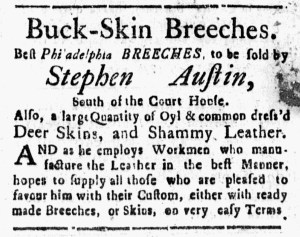
Connecticut Courant (January 18, 1774).

“He employs Workmen who manufacture the Leather in the best Manner.”

Stephen Austin sold “Buck-Skin Breeches” as well as “dress’d Deer Skins, and Shammy Leather” at his shop “South of the Court House” in Hartford.  In an advertisement that he placed in the January 18, 1774, edition of the Connecticut Courant, he not only highlighted the quality of his products but also the skill of those who labored in his shop.  Austin informed prospective customers that he “employs Workmen who manufacture the Leather in the best Manner.”  Among his competitors, Cotton Murray, a tailor, also ran an advertisement in the Connecticut Courant.  The tailor focused primarily on the services that he performed, but also added a nota bene about an employee who dressed leather.  Murray declared that he “carries on Leather Breeches making in all its branches, has a quantity of Leather of the best kind, and has employed a Workman in that business who serv’d his time in Europe.”

Both Austin and Murray promoted contributions that employees made to their businesses.  Artisans often relied on various assistants, whether employees, apprentices, or family members, but such workers did not regularly appear in newspaper advertisements.  Instead, the proprietors personified their shops, especially in an era that most businesses did not have names.  Austin’s shop, for instance, did not have a name.  Instead, his own name and one of the products he sold appeared as headlines.  For Murray, it was his name and occupation in the headlines.  Even artisans who ran shops identified by signs, like Daniel King, a brass founder “At the Sign of the Bell and Brand” in Philadelphia, deployed their own names rather than the sign that doubled as a shop’s name in the headlines of their advertisements.  Such methods emphasized work undertaken by the proprietor while obscuring the labor of others in a shop.  Artisans often considered such name recognition the best strategy for building their own reputations and the reputations of their businesses, but occasionally some of them saw benefits in marketing the skills of their employees.  Austin and Murray both hoped that doing so would help convince customers to select them over their competitors.
January 29

What was advertised in a colonial American newspaper 250 years ago today?

Jan 29 - 1:29:1770 Connecticut Courant
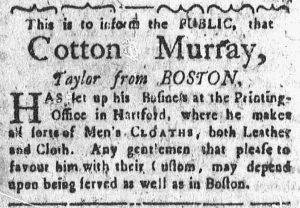
Connecticut Courant (January 29, 1770).

“Any gentlemen … may depend upon being served as well as in Boston.”

Cotton Murray, “Taylor from BOSTON,” inserted a brief advertisement in the January 29, 1770, edition of the Connecticut Courant “to inform the PUBLIC” that he recently began serving clients in Hartford, though he had not opened his own shop. Instead, he “set up his Business at the Printing-Office, where he makes all sorts of Men’s CLOATHS.” Though an unusual location for a tailor, he pledged that “Any gentleman that please to favour him with their Custom, may depend upon being served as well as in Boston.”

In making that promise, Murray played on anxieties common among colonial consumers. Those in the largest cities looked to London and other major cities on the other side of the Atlantic, comparing the goods and services available in the two locales. Similarly, consumers in smaller cities and towns in the American colonies looked to Boston, Charleston, New York, and Philadelphia as centers of fashion and refinement. Yet artisans like Murray assured prospective customers in places like Hartford that their cities and towns need not have the advantage of size in order for consumers to benefit from the same services available in the larger port cities.

Murray exerted some authority in making that claim. After all, he had formerly resided and worked in Boston. He knew the quality of service customers received there and stood ready to transfer the experience to his new clientele in Hartford and the surrounding towns. He may have also expected that his origins, “from BOSTON,” gave his enterprise additional cachet among prospective customers, just as artisans in urban ports frequently proclaimed in their newspapers advertisements that they were “from London.” Doing so simultaneously introduced and promoted artisans by associating them with places considered more cosmopolitan than their new homes. That was the primary appeal to prospective customers Murray made in his advertisement. He presented his case implicitly at the beginning of his notice, stating he was “from BOSTON,” and explicitly at the conclusion to aid readers in making the connection that if they became clients they could “depend upon being served as well” as in the largest city in New England.