July 26

What was advertised in a colonial American newspaper 250 years ago today?
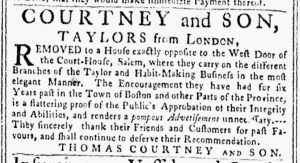
Essex Gazette (July 26, 1774).

“Public approbation … renders a pompous advertisement unnecessary.”

When Thomas Courtney and Son relocated from Boston to Salem, they ran in advertisement in the Essex Gazette to inform readers that they “carry on the different Branches of the Taylor and Habit-Making Business” at a shop near the courthouse.  They described themselves as “from LONDON,” hoping that their origins gave them some cachet among prospective clients, yet also reported that they had followed their trade “for six Years past in the Town of Boston.”

Their experience there served as even more of a recommendation and evidence that prospective customers should give them a chance.  The “Encouragement” they received for so many years, the tailors argued, “is a flattering proof of the Public’s Approbation of their Integrity and Abilities.”  No tailoring shop could have lasted for so long without the “Encouragement” of satisfied customers who gave them return business or offered positive reviews to friends.  Courtney and Son earned such a reputation that “renders a pompous Advertisement unnecessary.”  With that critique of the elaborate appeals made by some of their competitors and other purveyors of goods and services, the tailors expressed gratitude to former customers and declared that they “shall continue to deserve their Recommendation.”

It was not the first time that Courtney and Son deployed that marketing strategy.  Nine months earlier, they moved to a new location in Boston.  On that occasion, they ran an advertisement in the Massachusetts Spy.  Its copy was so similar, nearly identical, to their notice in the Essex Gazette that the tailors may have clipped it from the Massachusetts Spy and later from it.  The two advertisements featured variations in capitalization, not uncommon when advertisers ran notices in more than one newspaper.  In both, the phrase “pompous advertisement” appeared in italics.  While this does not reveal the effectiveness of the advertisement, it does suggest that Courtney and Son believed that it met with a positive reception that merited republishing it rather than devising other sorts of appeals to prospective customers in their new town.

October 14

What was advertised in a colonial American newspaper 250 years ago today?

Massachusetts Spy (October 14, 1773).

“The encouragement they have had … renders a pompous advertisement unnecessary.”

Although they had operated a shop in Boston for quite some time, Thomas Courtney and Son continued to describe themselves as “TAYLORS, from LONDON,” when they advertised in the October 14, 1773, edition of the Massachusetts Spy.  Like many tailors, milliners, and other artisans, they believed that associating themselves with the cosmopolitan center of the empire conferred a certain amount of cachet in the eyes of prospective customers.  The tailors placed the notice to alert the public that they moved to a new location but continued to “carry on the different branches of the Taylor and Habit making business, in the truest and most elegant manner.”

Despite trumpeting their London origins in the headline of their advertisement, Courtney and Son asserted that they did not need to publish an extensive description of the quality of their work, the exceptional customer service they provided, or any of the other appeals that often appeared in notices placed by members of the garment trades.  Their work spoke for itself, as demonstrated by the longevity of their business and the clientele they cultivated during their time in Boston.  “The encouragement they have had for six years past in the town and province,” Courtney and Sons proclaimed, “is a flattering proof of the public approbation of their integrity and abilities.”

That being the case, the tailors considered “a pompous advertisement unnecessary.”  On occasion, eighteenth-century advertisers promoted their goods and services by critiquing the kinds of marketing that appeared in the public prints.  They suggested something unsavory in the manner that many of their competitors boasted of their abilities or told elaborate stories about their merchandise.  Courtney and Son cast suspicion on the extravagant prose presented in many advertisements, implying that those advertisers oversold what they could deliver to customers.  In the process, they attempted to enlist savvy consumers in expressing the same skepticism … and demonstrating that they could not be fooled with clever marketing by giving their business to Courtney and Son.  After all, the tailors insisted, their reputation spoke for itself.  Rather than publishing overzealous appeals to prospective customers, Courtney and Sons “sincerely thank[ed] their Friends and customers for past favours” and pledged to “continue to deserve their recommendation.”  They considered their reputation essential in marketing their business.