June 15

What was advertised in a colonial American newspaper 250 years ago today?
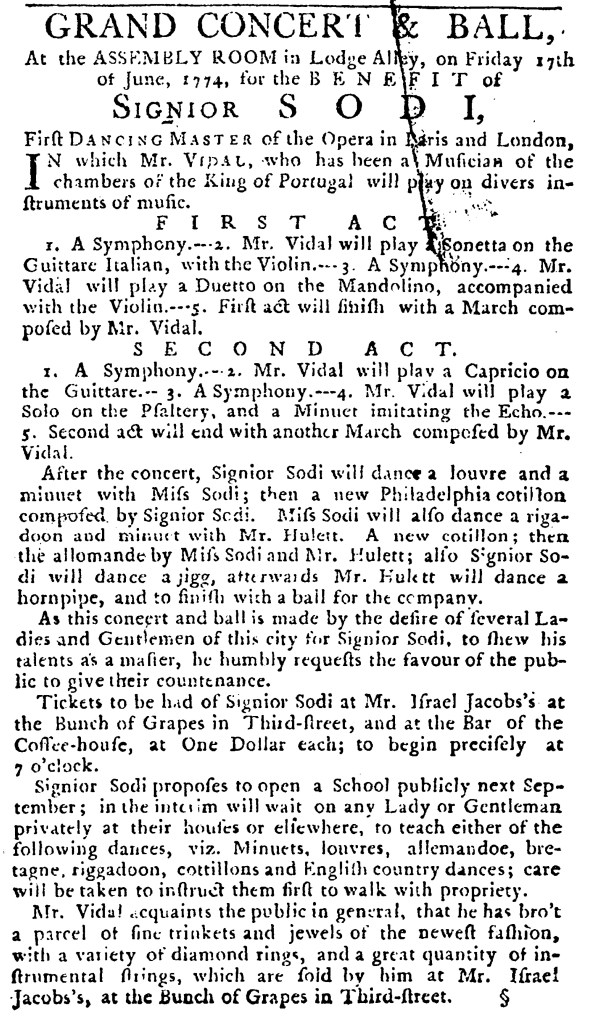
Pennsylvania Journal (June 15, 1774).

“This concert and ball is made by the desire of several Ladies and Gentlemen of this city.”

Genteel residents of Philadelphia did not want to miss the “GRAND CONCERT & BALL, At the ASSEMBLY TOOM in Lodge Alley” on June 17, 1774.  At least that was the intention of Signior Sodi, “First DANCING MASTER of the Opera in Paris and London,” when he advertised the event in the Pennsylvania Journal.  Sodi worked with “Mr. VIDAL, who has been a Musician of the chambers of the King of Portugal,” in putting together a program that included ten musical performances in two acts followed by demonstrations of Sodi’s dancing.  He claimed that he hosted the event “by the desire of several Ladies and Gentlemen of this city” who wished for him “to shew his talents as a master.”  For his part, he “humbly requests the favour of the public to give their countenance.”  To do that, the audience needed to purchase tickets, either from Sodi “at the Bunch of Grapes” on Third Street or “at the Bar” at the London Coffee House, a popular place for socializing and conducting business.

Whether or not “Ladies and Gentlemen of this city” encouraged Sodi to host a concert and ball, he used the opportunity to market other endeavors to support himself beyond ticket sales for that event.  He used the occasion to announce that he planned to “open a School” in September.  Until then, he “will wait on any Lady or Gentleman privately at their houses or elsewhere” to give lessons.  In addition to learning the steps for several dances, his students would also receive instruction “to walk with propriety.”  His pupils, Sodi suggested, would demonstrate more grace both on and off the dance floor, an important goal for colonizers anxious about so many aspects of their comportment.  Indeed, those interested in lessons from Sodi may have also taken note of lessons that Francis Daymon, “Master of the French and Latin Languages,” advertised in the same column in the Pennsylvania Journal.  Yet Sodi did not stake his entire livelihood on teaching the genteel and those aspiring to join their ranks to dance.  He also “acquaints the public in general” that he “bro’t a parcel of fine trinkets and jewels of the newest fashion, with a variety of diamond rings, and a great quantity of instrumental strings.”  He offered those items for sale at the Bunch of Grapes.  His “GRAND CONCERT & BALL” presented an opportunity for merchandising, not unlike the modern entertainment industry.
March 30

What was advertised in a colonial American newspaper 250 years ago today?

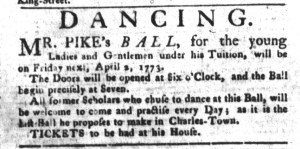
South-Carolina Gazette and Country Journal (March 30, 1773).

“It is the last Ball he proposes to make in Charles-Town.”

Mr. Pike, a dancing master who enhanced his image and authority by never including his first name in his advertisements, offered lessons in Charleston for many years.  (His earliest advertisement examined by the Adverts 250 Project appeared in the September 2, 1766, edition of the South-Carolina Gazette and Country Journal.)  In addition to advertising lessons, he also promoted the balls that he hosted, opportunities for his students to demonstrate the skills they developed and refined under his guidance.  Pike encouraged prospective students and their parents to consider those gatherings rites of passage within polite company, provided that they comported themselves well.  Accordingly, his marketing efforts sometimes leveraged a sense of anxiety.  For instance, when he announced a ball scheduled for December 1772, he advised parents to send their children for lessons “as soon as possible, that he may be enabled to complete his Figures in a proper Manner.”  In other words, if they did grant Pike sufficient time for instruction then they risked their children embarrassing themselves at the ball.

Pike did not take that approach when he announced that his “BALL, for the young Ladies and Gentlemen under his Tuition” would take place on the first Friday in April 1773.  That may have been because the dancing master had plans to depart the city.  (He began placing newspaper advertisements for dancing and fencing lessons in Philadelphia the following year.)  Pike proclaimed that this one was “the last Ball he proposes to make in Charles-Town.”  That being the case, he no longer needed to resort to the same tactics for attracting pupils.  Instead, he attempted to incite demand for tickets by presenting his final ball as a reunion for his students and a farewell fête.  Pike invited “former Scholars who chuse to dance at this Ball … to come and practise every Day” to prepare for it.  That allowed them to brush up on their skills and perhaps receive some pointers, free of charge, from their former instructor as a gift prior to his departure.  Anticipating both “the young Ladies and Gentlemen under his Tuition” and “former Scholars” in attendance, Pike arranged for a retrospective of his instruction and influence in cultivating a genteel pastime in one of the largest and most cosmopolitan cities in the colonies.  He hoped that would sell tickets.  After all, it was not merely the “ANNUAL BALL” for current students that he sometimes promoted in the public prints but instead his “last Ball” and final chance to partake in one of the gatherings he hosted.