October 31

What was advertised in a revolutionary American newspaper 250 years ago today?
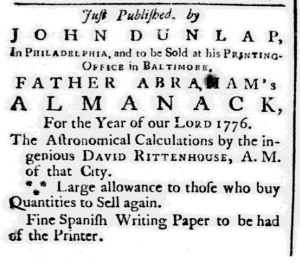
Dunlap’s Maryland Gazette (October 31, 1775).

“Large allowance to those who buy Quantities to Sell again.”

When John Dunlap published “FATHER ABRAHAM’S ALMANACK, For the Year of our LORD 1776,” in the fall of 1775, he set about advertising the handy reference manual.  He gave the advertisement a privileged place in the September 11, 1775, edition of Dunlap’s Pennsylvania Packet, the newspaper he printed in Philadelphia.  It ran immediately below the lists of ships arriving and departing from the customs house, increasing the chances that readers interested more in news than advertisements would see it.  Unlike other printers who hawked almanacs, Dunlap did not provide an extensive description of the contents to entice prospective customers, though he did indicate that “the ingenious DAVID RITTENHOUSE … of this city” prepared the “Astronomical Calculations.”  The printer believed that the astronomer’s reputation would help sell copies of the almanac.

He also ran advertisements in Dunlap’s Maryland Gazette, the newspaper he printed in Baltimore.  One of those notices appeared in the October 31 edition, again highlighting Rittenhouse’s role in making the “Astronomical Calculations.”  This advertisement did not include additional information about the contents, but it did include an appeal to retails that did not appear in the first iteration of the advertisement in Dunlap’s Pennsylvania Packet on September 11 nor in the most recent insertion on October 30.  Dunlap promised a “Large allowance to those who buy Quantities to Sell again.”  In other words, he offered discounts for purchasing in volume to make the almanac attractive to booksellers, shopkeepers, and peddlers.  Did Dunlap offer the same deal at his printing office in Philadelphia yet not advertise it in the public prints?  Other printers advertised discounts for buying almanacs by the dozen or by the hundred frequently enough to suggest that it was a common practice.  Given that Philadelphia had far more printers than Baltimore, many of them publishing one or more almanacs of their own, Dunlap may have carefully managed the discounts, offering one rate in one city and another rate in the other.  That did not necessarily matter to retailers who saw his advertisement in Dunlap’s Maryland Gazette.  His printing office in Baltimore, opened less than a year earlier, gave them easier access to almanacs than in the past.  The “Large allowance” was a bonus to convince them to take advantage of the convenience rather than order almanacs from other printers in Philadelphia or Annapolis.
September 21

What was advertised in a colonial American newspaper 250 years ago today?

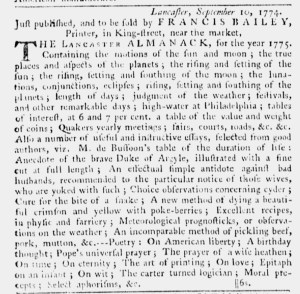
Pennsylvania Gazette (September 21, 1774).

“THE LANCASTER ALMANACK, for the year 1775.”

It was a sign of the changing seasons.  As the summer of 1774 came to a close, the first advertisements for almanacs for 1775 began to appear in newspapers, part of an annual ritual.  Each year printers deployed advertisements in weekly periodicals to hawk their annual periodicals.  Francis Bailey, a printer in Lancaster, was among the first to do so in 1774, placing notices in the Pennsylvania Gazette and the Pennsylvania Journal on September 21.  Readers still had more than three months to acquire their almanacs before the new year, yet each year many printers saw opportunities to increase sales and beat their competitors by making the useful and entertaining pamphlets available in the late summer and early fall.  That also allowed plenty of time for shopkeepers to purchase in volume, often receiving a discount, to stock and sell to their own customers.

For his part, Bailey relied on the contents of the “LANCASTER ALMANACK, for the year 1775” in generating the copy for his advertisement, adopting a common practice among printers of almanacs.  It was his first endeavor in printing and marketing an almanac, having opened a printing office Lancaster in 1771 and initially focusing on job printing.  Bailey realized that printing an almanac of his own could be a lucrative venture, supplementing the other sources of revenue in his printing office.  Some of the contents he could compile on his own, such as the essays and poetry, but he needed a mathematician or astronomer to supply the astronomical calculations, including “the motions of the sun and moon; the true places and aspects of the planets; the rising and setting of the sun; [and] the rising, setting and southing of the moon.”  The title page listed Anthony Sharp as the author of those astronomical calculations, though, as was the case with many other almanacs, the author was a pseudonym.  According to the entry in the American Antiquarian Society’s catalog, Anthony Sharp was “a pseudonym found only in the almanacs published by Bailey.”  Furthermore, the “calculations throughout duplicate those in Father Abraham’s almanack for 1775 (Philadelphia) whose title page states that it is [David] Rittenhouse’s work.”

Each year colonizers in and near Lancaster had ready access to various almanacs published by the several printers in Philadelphia, yet Bailey recognized his chance to give them an option for a local edition.  He established a relationship with a noted astronomer to provide the tables, then advertised his Lancaster Almanack before the Philadelphia editions went to press.  The success of his venture depended in part on making his new almanac available to local customers before they had an option to purchase any of the alternatives that would come off the presses in Philadelphia.

February 17

What was advertised in a colonial American newspaper 250 years ago today?

Pennsylvania Gazette (February 17, 1773).

“A SECOND PUBLICATION OF THE UNIVERSAL ALMANACK, For the Year 1773.”

Nearly six weeks into the new year, James Humphreys, Jr., commenced advertising a “SECOND PUBLICATION OF THE UNIVERSAL ALMANACK, For the Year 1773” with astronomical calculations “performed with the greatest exactness and truth” by David Rittenhouse.  Humphreys had advertised the first printing of the almanac more than three months earlier with notices in the November 9, 1772, edition of the Pennsylvania Packet and the November 11, 1772, edition of the Pennsylvania Gazette.  Those advertisements featured identical copy, though the compositors devised very different formats.

When Humphreys advertised the second publication in Pennsylvania Gazette on February 17, 1773, he used a slightly truncated version of the original advertisement.  (Perhaps the compositor took advantage of type already set from the previous run of the notice.)  Two days earlier, however, a much shorter version, one without a list of the contents, appeared in the Pennsylvania Packet.  In the next issue, published on February 22, Humphrey’s advertisement once again included the contents of the almanac, doubling the length of the notice.  That represented some expense for Humphreys, though John Dunlap, printer of the Pennsylvania Packet, may have given him a discount on advertising since he also sold the almanac.  Unlike the notice that ran in the Pennsylvania Gazette, one that listed only Humphreys, the advertisement in the Pennsylvania Packet stated that the almanac was “SOLD by JAMES HUMPHREYS junr. at his Printing-office, … and by John Dunlap.”

No matter the particulars of his arrangement with Dunlap, Humphreys took a chance on a second publication of the almanac so far into the year.  Other printers advertised surplus copies of almanacs that had not yet sold, hoping to achieve better returns on their investments for items that became more and more obsolete with each passing day.  Perhaps the initial publication did well enough that Humphreys considered printing a small number for the second publication worth the risk.  Perhaps he believed that the calculations by “that ingenious master of mathematics, Mr. DAVID RITTENHOUSE,” well known in Philadelphia, would recommend the almanac above all others.  In his first round of advertising, he asserted that “it is the only almanac published of his calculating.”  Perhaps Humphreys thought the other contents, a variety of poems, recipes, short essays, and even directions for “guarding against smutty crops of wheat,” were interesting enough to prospective customers that they would want to consult and enjoy them throughout the remainder of the year.  Perhaps he did not produce a second publication at all, but instead claimed he did in an effort to make the almanac appear popular and sell leftover copies of the first publication that he passed off as a subsequent printing.  Advertising a second publication of an almanac so far into the year was unusual, whatever Humphrey’s inspiration in doing so.