September 11

What was advertised in a revolutionary American newspaper 250 years ago today?
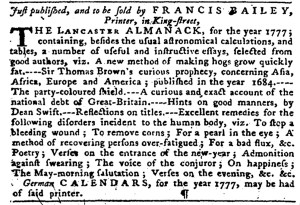
Pennsylvania Gazette (September 11, 1776).

“THE LANCASTER ALMANACK, for the year 1777.”

It was one of the first advertisements for an almanac for 1777 that ran in American newspapers in the fall of 1776.  In the September 11 edition of the Pennsylvania Gazette, Francis Bailey advertised “THE LANCASTER ALMANACK, for the year 1777.”  In some years such notices began appearing as early as the middle of August, but shortages of paper and other disruptions caused by the Revolutionary War may have slowed the production of almanacs.  Still, Bailey and other printers knew from experience that the handy reference manuals did good business.  They sold well and generated revenue.

This almanac was the first that Bailey published since the Continental Congress declared independence.  During the imperial crisis, some almanacs featured items that advocated for the American cause.  Two years earlier, for instance, Bailey listed a poem, “On American liberty,” among the contents of his almanac for 1775.  Yet he did not make explicit reference to current events acknowledge independence in his marketing of his almanac for 1777.  As he had in the past, he highlighted “a number of useful and instructive essays, selected from good authors,” that supplemented “the usual astronomical calculations, and tables.”  Those included “A new method of making hogs grow quickly fat,” “Hints on good manners, by Dean Swift,” and “Verses on the entrance of the new-year.”  Among those items, Bailey inserted “A curious and exact account of the national debt of Great-Britain.”  That touched on politics, but it did not commemorate or celebrate the revolution that continued to unfold in the former colonies that united to form a new nation.  Two years later, Bailey’s almanac for 1779 would be among the first publications to name George Washington, the commander-in-chief of the Continental Army, as “Father of his country,” so the printer did not abandon integrating politics and patriotism in the almanacs he published.[1]  For some reason, he chose not to do so in marketing his almanac for 1777.

**********

[1] Carl Robert Keyes, “A Revolution in Advertising: ‘Buy American’ Campaigns in the Late Eighteenth Century,” in Creating Advertising Culture:  Beginnings to the 1930s, vol. 1, We Are What We Sell:  How Advertising Shapes American Life … And Always Has, eds. Danielle Coombs and Bob Batchelor (New York:  Praeger, 2013), 9.
September 21

What was advertised in a colonial American newspaper 250 years ago today?

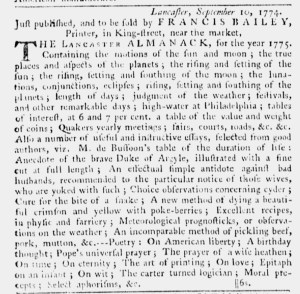
Pennsylvania Gazette (September 21, 1774).

“THE LANCASTER ALMANACK, for the year 1775.”

It was a sign of the changing seasons.  As the summer of 1774 came to a close, the first advertisements for almanacs for 1775 began to appear in newspapers, part of an annual ritual.  Each year printers deployed advertisements in weekly periodicals to hawk their annual periodicals.  Francis Bailey, a printer in Lancaster, was among the first to do so in 1774, placing notices in the Pennsylvania Gazette and the Pennsylvania Journal on September 21.  Readers still had more than three months to acquire their almanacs before the new year, yet each year many printers saw opportunities to increase sales and beat their competitors by making the useful and entertaining pamphlets available in the late summer and early fall.  That also allowed plenty of time for shopkeepers to purchase in volume, often receiving a discount, to stock and sell to their own customers.

For his part, Bailey relied on the contents of the “LANCASTER ALMANACK, for the year 1775” in generating the copy for his advertisement, adopting a common practice among printers of almanacs.  It was his first endeavor in printing and marketing an almanac, having opened a printing office Lancaster in 1771 and initially focusing on job printing.  Bailey realized that printing an almanac of his own could be a lucrative venture, supplementing the other sources of revenue in his printing office.  Some of the contents he could compile on his own, such as the essays and poetry, but he needed a mathematician or astronomer to supply the astronomical calculations, including “the motions of the sun and moon; the true places and aspects of the planets; the rising and setting of the sun; [and] the rising, setting and southing of the moon.”  The title page listed Anthony Sharp as the author of those astronomical calculations, though, as was the case with many other almanacs, the author was a pseudonym.  According to the entry in the American Antiquarian Society’s catalog, Anthony Sharp was “a pseudonym found only in the almanacs published by Bailey.”  Furthermore, the “calculations throughout duplicate those in Father Abraham’s almanack for 1775 (Philadelphia) whose title page states that it is [David] Rittenhouse’s work.”

Each year colonizers in and near Lancaster had ready access to various almanacs published by the several printers in Philadelphia, yet Bailey recognized his chance to give them an option for a local edition.  He established a relationship with a noted astronomer to provide the tables, then advertised his Lancaster Almanack before the Philadelphia editions went to press.  The success of his venture depended in part on making his new almanac available to local customers before they had an option to purchase any of the alternatives that would come off the presses in Philadelphia.