October 31

What was advertised in a revolutionary American newspaper 250 years ago today?
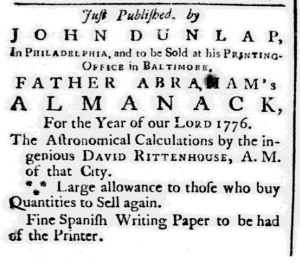
Dunlap’s Maryland Gazette (October 31, 1775).

“Large allowance to those who buy Quantities to Sell again.”

When John Dunlap published “FATHER ABRAHAM’S ALMANACK, For the Year of our LORD 1776,” in the fall of 1775, he set about advertising the handy reference manual.  He gave the advertisement a privileged place in the September 11, 1775, edition of Dunlap’s Pennsylvania Packet, the newspaper he printed in Philadelphia.  It ran immediately below the lists of ships arriving and departing from the customs house, increasing the chances that readers interested more in news than advertisements would see it.  Unlike other printers who hawked almanacs, Dunlap did not provide an extensive description of the contents to entice prospective customers, though he did indicate that “the ingenious DAVID RITTENHOUSE … of this city” prepared the “Astronomical Calculations.”  The printer believed that the astronomer’s reputation would help sell copies of the almanac.

He also ran advertisements in Dunlap’s Maryland Gazette, the newspaper he printed in Baltimore.  One of those notices appeared in the October 31 edition, again highlighting Rittenhouse’s role in making the “Astronomical Calculations.”  This advertisement did not include additional information about the contents, but it did include an appeal to retails that did not appear in the first iteration of the advertisement in Dunlap’s Pennsylvania Packet on September 11 nor in the most recent insertion on October 30.  Dunlap promised a “Large allowance to those who buy Quantities to Sell again.”  In other words, he offered discounts for purchasing in volume to make the almanac attractive to booksellers, shopkeepers, and peddlers.  Did Dunlap offer the same deal at his printing office in Philadelphia yet not advertise it in the public prints?  Other printers advertised discounts for buying almanacs by the dozen or by the hundred frequently enough to suggest that it was a common practice.  Given that Philadelphia had far more printers than Baltimore, many of them publishing one or more almanacs of their own, Dunlap may have carefully managed the discounts, offering one rate in one city and another rate in the other.  That did not necessarily matter to retailers who saw his advertisement in Dunlap’s Maryland Gazette.  His printing office in Baltimore, opened less than a year earlier, gave them easier access to almanacs than in the past.  The “Large allowance” was a bonus to convince them to take advantage of the convenience rather than order almanacs from other printers in Philadelphia or Annapolis.
July 5

What was advertised in a colonial American newspaper 250 years ago today?

Jul 5 - 7:5:1769 Georgia Gazette
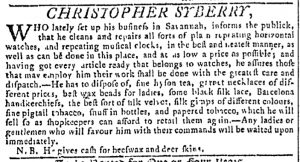
Georgia Gazette (July 5, 1769).

“He will sell so as shopkeepers can afford to retail them again.”

When watchmaker Christopher Syberry announced to the public that he “lately set up his business” in Savannah in 1769, he also informed prospective customers that he simultaneously sold a variety of goods. His inventory included “fine hyson tea, garnet necklaces of different prices, best wax beads for ladies, some black silk lace, Barcelona handkerchiefs, the best sort of silk velvet, silk gimps of different colours, fine pigtail tobacco, snuff in bottles, and papered tobacco.” Selling these items provided an additional revenue stream in case Syberry could not drum up enough business to support himself cleaning and repairing clocks and watches.

Syberry made it clear that he did not merely retail the items listed in his advertisement; he also acted as a wholesaler who distributed goods to shopkeepers in the small port and throughout the rest of the colony. He did not emphasize price as much as many other advertisers during the period, but he did pledge to sell his wares “so as shopkeepers can afford to retail them again.” Although unstated, this may have included discounts for purchasing in volume. Syberry implicitly presented himself as an alternative to merchants in England who fulfilled orders by letter. Shopkeepers who opted to acquire goods from him gained the advantage of examining the merchandise in his shop and choosing those items they considered good prospects for retailing themselves. Syberry emphasized quality in his advertisement, repeatedly describing items as “fine” or “best,” but shopkeepers did not have to accept his assessment. They could examine those goods before buying them to retail. Those who visited Syberry’s shop saw and selected their wares rather than describing what they wished to order in a letter or instructing correspondents to send the latest fashions and then hoping for the best.

Other colonists who advertised similar goods in the Georgia Gazette operated as both merchants and shopkeepers, wholesalers and retailers, but Syberry distinguished his business by explicitly addressing shopkeepers and assuring them that he offered reasonable prices for his wares so they could “retail them again.” He may have anticipated that shopkeepers would make more substantial purchases than consumers, providing greater security for an entrepreneur who had “lately” launched a new enterprise in Savannah.