What was advertised in a revolutionary American newspaper 250 years ago today?

“We think proper to notify the public, that the charge against us is wholly and totally false.”
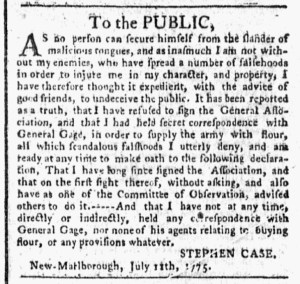
Rumors and misrepresentations spread in conversation and in print when the imperial crisis intensified and hostilities between the colonies and Britain commenced. Upon finding themselves the subjects of gossip that damaged their reputations, Abraham Hatfield and William Lounsbery published a newspaper advertisement to set the record straight. It started with an entry in the October 5, 1775, edition of the New-York Journal. Among the news received from correspondents in the city, John Holt, the printer, inserted this report: “We understand from North Castle, that on last Saturday night, Abraham Hatfield, Esq; of the White Plains, and Lieutenant William Lownsburry, of Mamaroneck, were discovered in the very act of endeavouring to cut down a Liberty Pole, which was so well fortified with iron that it occasioned their being found out, and for that time disappointed in their loyal attempt.”
Whether or not they held Tory sentiments, Hatfield and Lounsbery vigorously denied that they had acted on them by attempting to cut down the liberty pole. In the next issue of Rivington’s New-York Gazetteer, published on October 12, they inserted an advertisement that identified the allegations and dismissed them as fabrications. “WE the subscribers” (or undersigned) “having understood that Mr. Holt has inserted in his last week’s paper, a piece charging us with being concerned, and of even being detected in the fact of attempting to cut down a Liberty-pole – we think proper to notify the public, that the charge against us is wholly and totally false.” It ran twice more, on October 19 and 26. Hatfield and Lounsbery disseminated their denial that they had anything to do with the incident multiple times in their effort to combat an accusation made in the public prints just once.
Why didn’t they submit a correction to Holt or place a similar advertisement in the New-York Journal since that newspaper carried the piece that spread what they claimed was misinformation? Perhaps they did, but Holt, a Patriot printer, felt confident enough in the source of the report that he declined to publish anything submitted by Hatfield and Lounsbery. Alternately, they may have been so upset with Holt that they did not wish to give him the satisfaction of acknowledging the allegations in his newspapers (or contributing to his advertising revenue) that they instead opted for another newspaper, one with a circulation that rivaled or exceeded the New-York Journal. Whatever the case, they did not allow the accusation that they were Loyalists who had attempted to cut down a liberty pole go unanswered.
The same issue of the New-York Journal that featured the report that identified Hatfield and Lounsbery as the culprits involved in the liberty tree incident in New Castle also carried letters addressed to Holt concerning rumors that colonizers had scalped a British soldier and cut off his ears after the battles at Lexington and Concord. The correspondents believed that Holt could “serve the cause of truth and liberty” by publishing their accounts of the actual events, stating that they “buried the dead bodies of the king’s troops that were killed at the north bridge in Concord, on the 19th day of April, 1775,” and none of them “were scalped, not their ears cut off, as has been represented” by those who sought to “dishonour the Massachusetts people, and to make them appear to be savage and barbarous.” In articles, letters, and advertisements, accusations and rebuttals about the misbehavior and even depravity of Patriots and Loyalists circulated in the public prints during the Revolutionary War.