July 17

What was advertised in a revolutionary American newspaper 250 years ago today?
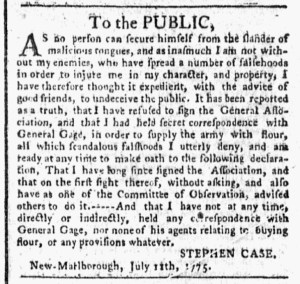
New-York Gazette and Weekly Mercury (July 17, 1775).

“I have not at any time, directly or indirectly, held any correspondence with General Gage.”

Stephen Case of New Marlborough, Massachusetts, needed to set the record straight.  To do so, he placed a notice “To the PUBLIC” in the July 17, 1775, edition of the New-York Gazette and Weekly Mercury.  The stakes were too high to let unsubstantiated rumors go unanswered.

“As no person can secure himself from the slander of malicious tongues, and as inasmuch I am not without my enemies, who have spread a number of falsehoods in order to injure me in my character, and property,” Case asserted, “I have therefore thought it expedient, with the advice of good friends, to undeceive the public.”  Even readers who had never heard of case likely found this introduction intriguing and wanted to learn more.  “It has been reported as a truth,” Case continued, “that I have refused to sign the General Association,” the nonimportation agreement devised by the First Continental Congress in response to the Coercive Acts.  Even worse, gossip spread that Case “held secret correspondence with General Gage, in order to supply the army with flour.”  Gage simultaneously served as governor of Massachusetts and commander of the British regulars involved in the battles at Lexington and Concord, the siege of Boston, and the Battle of Bunker Hill.  Such allegations against Case made him an enemy to the American cause and no doubt unpopular among many of his neighbors and associates.

Case strenuously objected.  He denied the “scandalous falshoods” and was “ready at any time to make oath” about them.  As far as the nonimportation agreement was concerned, he had “long since signed the Association, and [did so] on the first sight thereof, without asking” or prompting from others, “and also have as one of the Committee of Observation advised others to do it.”  When it came to the other accusations, Case proclaimed, “I have not at any time, directly or indirectly, held any correspondence with General Gage, nor none of his agents relating to buying flour, or any provisions whatever.”

To deliver this message “To the PUBLIC,” Case purchased advertising space in a newspaper that circulated in western Massachusetts.  The printer served as editor when it came to news items, letters, and other content, yet provided a forum for advertisers to publish their own news about current events.  Case attempted to take advantage of such access to the public prints to repair the damage to his reputation, but perhaps too much damage had been done.  Four months later he placed another advertisement in the New-York Gazette and Weekly Mercury (and the New-York Journal and Rivington’s New-York Gazetteer) that offered his farm in New Marlborough for sale or exchange “for a House in New-York.”  Case may have remained at odds with other residents of his town, despite the assertions he made in his first advertisement, and decided that he would be better off starting over somewhere else.  If so, it was the damage cause by rumors rather than the danger and destruction of battles that displaced him from his farm during the Revolutionary War.

October 29

What was advertised in a colonial American newspaper 250years ago today?

Connecticut Journal (October 29, 1773).

“SIR, PLEASE to return with speed, for things are bad.  WR”

Among the several advertisements in the October 29, 1773, edition of the Connecticut Journal, Job Perit sold a “large Assortment of English & India GOODS,” Daniel Huntington peddled a “fresh Parcel of Drugs and Medicine,” and Amos Morrision, a “Wigg-Maker & Hair-Dresser,” presented his services to prospective clients.  John Danielson and John Row each placed real estate notices, while John Lothrop called on “all those that are any Ways indebted to him” to settle accounts or face legal action.  One notice announced a fair “for the Barter and Sale of all Kinds of Goods, homespun or other Manufactures, Horses, Sheep,” and other livestock.  Another announced a delay in drawing numbers for the New Haven Lottery.  Jonathan Brown and Ebenezer Townsend offered rewards for a strayed or stolen horses.  The printers, Thomas Green and Samuel Green, advertised “THE MACARONIE JESTER,” a book of jokes, and invited subscribers for the Royal American Magazine to submit their names to the printing office to be forwarded to Isaiah Thomas in Boston.

Some of these advertisements may have been of greater interest than others to various readers, but each of them addressed the public and clearly stated their purpose.  A more cryptic advertisement did not do so.  In its entirety, that brief notice stated, “SIR, PLEASE to return with speed, for things are bad.  WR.”  What did it mean?  Who placed the advertisement?  What was the relationship between “WR” and “SIR”?  What had happened to prompt “WR” to place this notice?  Why did “WR” choose to place an advertisement in the public prints along with whatever other means of contacting “SIR” they used?  Did some readers suspect that they knew the identities of “WR” and “SIR” and the circumstances that inspired the advertisement?  Did they gossip and share their suspicions with others?  How much did the printers know about “WR” and their situation?  Whatever the answers to these questions, the Greens surrendered a small bit of editorial control over the contents of their newspaper when they published the advertisement.  Every printer did so with every advertisement they published, allowing others to determine some of the contents of their publications while simultaneously exercising the prerogative to reject paid notices if they did not believe they matched the tone of the newspaper.  Each advertisement, like each news item, essay, and letter, told a story and disseminated information to the reading public.  In the case of “WR” and “SIR,” however, the advertisement obscured most of the relevant information and addressed a single reader.  In placing the notice, “WR” leveraged the power of the press for their own purposes, just as every advertiser did when they purchased space in newspapers.

February 15

What was advertised in a colonial American newspaper 250 years ago today?

Boston-Gazette (February 15, 1773).

“THE Persons who may incline to purchase PATTY HALL’s House … need not be afraid of the Neighbours.”

The feud between Patty Hall and her neighbors continued in the advertisements in the February 15, 1773, edition of the Boston-Gazette.  The altercation first appeared in the public prints when Hall placed a notice offering her house for sale in the February 1 edition of the Boston-Gazette.  She noted that her neighbors made “a great Bustle” in court about “a Piece of Land” associated with the property, but then “dropt the Matter.”  That being the case, she assured “Any Person that inclines to Purchase, may depend that a good Title will be given.”  Hall also accused her neighbors of various acts of vandalism and intimidation, including throwing stones at her.

Hall’s neighbors apparently read or heard about the advertisement.  They did not wait a week to respond in the next issue of the Boston-Gazette.  Instead, they placed notices in the next newspapers published in town, the Massachusetts Gazette and Boston Weekly News-Letter and the Massachusetts Spy on February 4.  Hall’s neighbors sarcastically mentioned the “Politeness” accorded to them before clarifying that the matter had moved to another court and requesting that public “suspend their Judgment” until “Evidences on both Sides are properly examined.”  They also inserted their advertisement in the next issue of the Boston-Gazette on February 8, a week after Hall’s original notice.  It ran immediately above a response from Hall.  She described additional harassment she claimed that she experienced from her neighbors.

Having set the record straight once already, Hall’s neighbors did not feel the need to rush to publish a response to Hall’s latest advertisement.  Instead, they waited for the next edition of the Boston-Gazette on February 15.  In what they framed as a letter to the editors, Hall’s neighbors assured anyone “who may incline to purchase PATTY HALL’s House – with such a Title as she can give – need not be afraid of the Neighbours.”  They asserted that knocking at all hours and other alleged torments “were never heard by the Neighbours” and concluded that “it was all done within Doors.”  That being the case, they declared, Hall was in the best position to identify the real culprits.  Her neighbors recommended that if anyone who purchased the house wished to avoid such intrusions that they “need not keep the same Company” as Hall.

Edes and Gill, the printers of the Boston-Gazette, may have enjoyed the argument between Hall and her neighbors.  They almost certainly appreciated the revenue that their advertisements generated.  In publishing those advertisements, Edes and Gill and the printers of other newspapers abdicated a small amount of editorial control to those who paid to purchase space in their publications.  The advertisements carried news, of a sort, that would not have appeared among the articles and editorials that the printers selected to include elsewhere in their newspapers.  Hall and her neighbors could have relied on rumors and gossip to malign each other, but they realized that advertisements gave them a much larger audience for presenting their grievances to the court of public opinion.

February 8

What was advertised in a colonial American newspaper 250 years ago today?

Boston-Gazette (February 8, 1773).

“MRS. HALL is sensible that the Advertisement in Thursday’s Papers was intended to injure her in the Sale of her House.”

The feud between Patty Hall and her neighbors continued to move back and forth between newspapers.  It began when Hall inserted a notice in the February 1, 1773, edition of the Boston-Gazette.  She accused five of her neighbors of conspiring to drive her out of her house on Hanover Street by making spurious claims in court before dropping the matter and simultaneously vandalizing the house and even throwing stones at her as she passed through her year.  Hall did not give any reason that her neighbors felt such enmity, but she did declare that she could give “a good Title” to anyone who purchased the house.

Rather than waiting a week to respond in the next issue of the Boston-Gazette, Hall’s neighbors inserted a response in the February 4 editions of both the Massachusetts Gazette and Boston Weekly News-Letter and the Massachusetts Spy.  They described themselves as “THE PERSONS mentioned with so much Politeness by Mrs. HALL in her Advertisement” and directed readers to “See Edes and Gill’s last Gazette.”  They advised that the “Conduct of both Parties” would become apparent, “either to their Honor or Disgrace,” upon more extensive examination.  In other words, they cautioned readers not to believe everything that Hall put into print.  At the same time, they warned against trusting the title that Hall offered “until the same shall be determined in a due Course of Law,” clarifying that they had not dropped the case, as Hall indicated, but instead moved it to another court.

Hall had at least one thing in common with her neighbors.  She did not wait to respond in the same newspaper that carried their notice.  She did not allow them that much time to frame the narrative.  Instead, she once again published an advertisement in the Boston-Gazette, this time in the February 8 edition.  Her neighbors apparently decided to insert their advertisement in that newspaper as well.  The compositor conveniently combined the two notices into a single advertisement that told a story for readers.  The format, a short line instead of a full line separating the two notices, allows the possibility that Hall reprinted the advertisement to provide context for her response, but her reference to suspending further advertisements because she had “no Money to trifle with” suggests that she would not have taken on the expense of reprinting an advertisement she found so objectionable.

She certainly meant to acknowledge that “the Advertisement in Thursday’s Papers was intended to injure her in the Sale of her House.”  She intentionally misunderstood the “Compliment to her Politeness,” stressing that she “least intended” any pleasantries because she “knew to whom she was speaking, and chose to address them in a Language they understood.”  She adamantly asserted that she had “no Notion of treating Persons politely” when she suspected them of perpetrating the “dirty Actions” she described in her first advertisements as well as “daubing her Yard and Doors with the most nauseous Filth, beating at her Shutters with Axes and Clubs, and disturbing her with repeated Noises at all Hours of the Night.”  She lamented that she gave her neighbors “no other Provocation” except her “Refusal to cut down Part of her House” until a court determined the true ownership of the land that portion of the dwelling occupied.  Hall claimed that she welcomed a court decision because she was confident that it “will do her Justice, and act without Partiality.”  Beyond the courts, she continued to use the public prints to excoriate her neighbors for their malicious behavior.

Both Hall and her neighbors expected that the public engaged with their version of events across multiple publications and through discussing what they read in one newspaper or another or what their acquaintances told them they had read or heard.  As the adversaries waited for a legal decision from the court, they pursued another sort of vindication in the court of public opinion.

February 4

What was advertised in a colonial American newspaper 250 years ago today?

Massachusetts Gazette and Boston Weekly News-Letter (February 4, 1773).

“The Conduct of the Parties from first to last will best appear … when the Evidences on both Sides are properly examined.”

Printers selected which items appeared among the news and editorials in their newspapers, yet colonizers exercised some amount of editorial authority when they published news in the form of advertisements.  Consider and exchange between Patty Hall and her neighbors in two newspapers published in Boston in the first week of February 1773.

Hall initiated the exchange with an advertisement in the February 1 edition of the Boston-Gazette.  Placing the notice for the purpose of selling a house, Hall seized the opportunity to name several of her neighbors and report that they “made a Complaint to the Selectmen, about a Piece of Land; and they laid it before the Grand Jury; and after making a great Bustle, dropt the Matter.”  The matter being settled, Hall declared that the purchaser “may depend that a good Title will be given.”  According to Hall, that was only the beginning of the trouble she supposedly had with her neighbors.  She claimed that at the same time she “had her Windows broke, Spouts tore down, the Drane stopt,and frequently Stones thrown at all Parts of the House.”  To make matters even worse, she “very nearly escap’d a great Stone thrown at her passing thro’ the Yard.”  She suspected that her neighbors were directly responsible or “employ somebody to do it” and offered a reward to anyone “that will apprehend the Person or Persons concern’d.”

Boston-Gazette (February 1, 1773).

The neighbors that Hall named – “Constable Hale, James Bailey, Samuel Sloan, Retailer, Elizabeth Clarke and Nowell, and Deacon Barrett” – objected to the version of events that Hall published in the Boston-Gazette.  Rather than wait a week to make their rebuttal in the next edition of that newspaper, they inserted their own notice in both the Massachusetts Gazette and Boston Weekly News-Letter and the Massachusetts Spy just three days later.  They identified themselves as “THE PERSON mentioned with so much Politeness by Mrs. HALL in her advertisement, *” and directed readers to “* See Edes and Gill’s last Gazette.”  They offered clarifications about the outcome of the “Bustle” in court, stating that when Hall “gave Notice that the Matter was dropt, she should have added,—  “in order to be taken up at another Court.’”  Unlike Hall, the neighbors considered the matter far from settled.  They encouraged others “to suspend their Judgment both as to the Merits of the Cause and the Title … until the same shall be determined in a due course of law.”  As for the other allegations made by Hall, her neighbors implied that she fabricated the story.  “The Conduct of the Parties from first to last will best appear, either to their Honor or Disgrace,” they asserted, “when the Evidences on both Sides are properly examined.”  In refusing the dignify Hall’s allegations with any more of a response, her neighbors suggested they had no merit.

Hall wished to frame the narrative of her troubles with her neighbors.  Purchasing a paid notice in one of the local newspapers allowed her to do so.  Similarly, those neighbors also bought advertising space to tell their side of the story.  This allowed both parties to bypass the printer-editors of the Boston-Gazette, the Massachusetts Gazette and Boston Weekly News-Letter, and the Massachusetts Spy to determine for themselves what kind of content the public read or heard about as colonizers discussed the altercation that appeared among newspaper advertisements that delivered all kinds of local news.

May 15

What was advertised in a colonial American newspaper 250 years ago this week?

Essex Gazette (May 14, 1771).

“[The following was paid for as an Advertisement.]”

Newspaper editors selected which articles and letters to print or reprint in their publications, but that did not exclude others, especially advertisers, from shaping the contents and messages disseminated to readers.  In the era of the American Revolution, for instance, many advertisers enhanced their notices with political commentary, encouraging consumers to graft politics onto their decisions in the marketplace.  Aggrieved husbands regularly published advertisements warning others not to extend credit to wives who had the audacity to resist the patriarchal authority husbands were supposed to exercise in their households.  In the process, husbands gave details about marital discord and the misbehavior of their wives.  On occasion, some of those wives responded with advertisements of their own, painting less than flattering portraits of abusive or negligent husbands.  Other advertisers disputed land titles or pursued personal grudges.  Editors temporarily transferred editorial authority to advertisers who paid for space in their newspapers.

That seems to have been the case concerning a poem that ran in the May 15, 1771, edition of the Essex Gazette.  Many eighteenth-century newspapers featured a poetry corner, often positioned in the upper left corner of the final page, but that was not the case with this poem.  Instead, it appeared at the bottom of the last column on the third page.  Given the production process for a standard four-page issue, that meant that the poem was the last item the compositor inserted into that issue.  Perhaps Samuel Hall, the printer of the Essex Gazette, had second thoughts about including it at all.  An editorial note preceded the poem, suggesting that Hall decided that its appearance in his newspaper required some sort of explanation: “[The following was paid for as an Advertisement.]”  In other words, Hall did not select it for the edification or amusement of his readers.  He might not have even fully understood its purpose or meaning, but a customer paid for the space.  The poem very well may have bewildered Hall and most readers.  A preamble declared, “The folloing lines were Presented to A lat skull mistres in this town by 4 of her skolers the morning after her mareg.”  The misspellings continued throughout the poem, suggesting that the “skull mistres” (school mistress) achieved only partial success with these “skolers” (scholars) who sent tidings following her “mareg” (marriage).  The poem was an inside joke not intended for all readers of the Essex Gazette.

Hall could have refused to publish the poem, exercising his prerogative as editor and proprietor of the Essex Gazette.  He was not obligated to publish anything submitted to the printing office, even if accompanied by payment to appear as an advertisement.  Yet that payment justified temporarily surrendering editorial control to an advertiser.  Indeed, Hall abbreviated an advertisement from Nathaniel Sparhawk, Jr., explaining that “[Want of Room obliges us to defer the Particulars till next Week.]”  Hall could have given Sparhawk the space devoted to the poem, but instead opted to collect payment and insert the poem with a disclaimer.  The four “skolers” then found their ode to their “skull mistres” in the public prints.