December 1

What was advertised in a revolutionary American newspaper 250 years ago today?
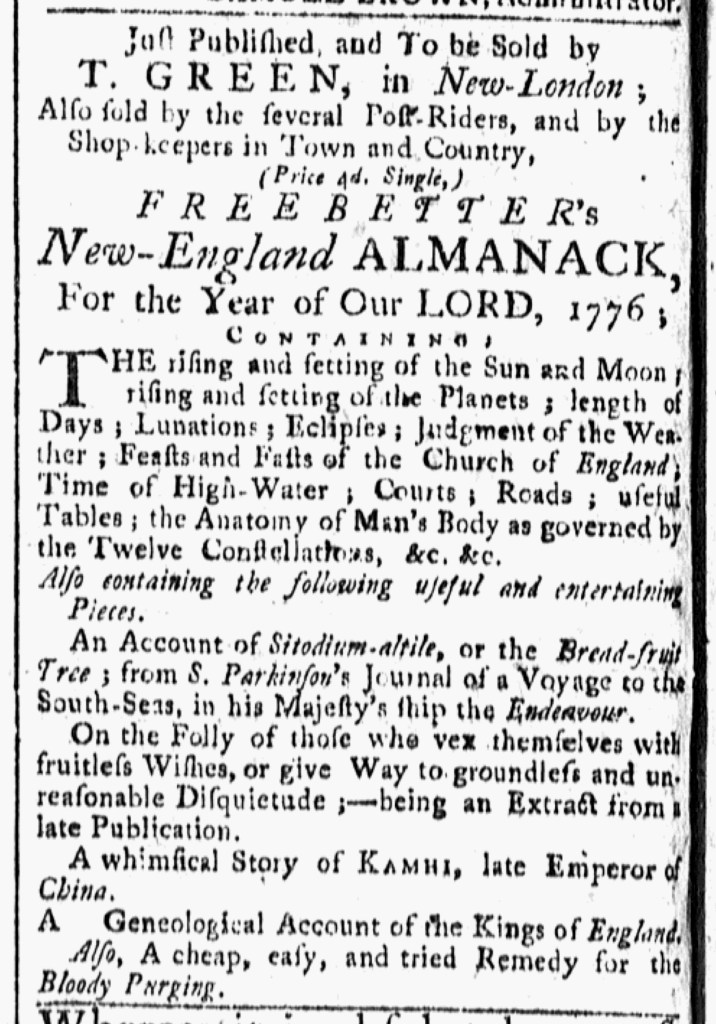
Connecticut Gazette (December 1, 1775).

“Sold by the several Post-Riders, and by the Shop-keepers in Town and Country.”

With only a month until the new year began, Timothy Green, the printer of the Connecticut Gazette, advertised “FREEBETTER’s New-England ALMANACK, For the Year of Our LORD, 1776.”  He emphasized items that usually appeared in almanacs and called attention to special features.  The former included the “rising and setting of the Sun and Moon; rising and setting of the Planets; length of Days; Lunations; Eclipses; Judgment of the Weather; Feasts and Fasts of the Chrich of England; Times of High-Water; Courts; Roads; useful Tables; [and] the Anatomy of Man’s Body as governed by the Twelve Constellations.”  The special features included a “whimsical Story of KAHM, late Emperor of China,” and a “Geneological Account of the Kings of England.”  They also included an “Account of Sitodium-altile, or the Bread-fruit Tree; from S. Parkinson’s Journal of a Voyage to the South-Seas, in his Majesty’s ship the Endeavour” and an essay on “the Folly of those who vex themselves with fruitless Wishes, or give Way to groundless and unreasonable Disquietude; –being an Extract from a late Publication.”  Green may have intended those excerpts as teasers to encourage readers to purchase the original works at his printing office in New London.

To acquire the almanac, however, customers did not have to visit Green or send an order to him.  Instead, he advised that “the several Post-Riders” with routes in the region and “the Shop-keepers in Town and Country” also sold “FREEBETTER’s New-England ALMANACK, For … 1776.”  The printer established a distribution network for the useful reference manual.  Shopkeepers often stocked a variety of almanacs so their customers could choose among popular titles.  Printers sometimes offered discount prices for purchasing multiple copies, usually by the dozen or by the hundred.  That allowed retailers to charge competitive prices to generate revenue with small markups over what they paid.  In this instance, Green did not indicate how much shopkeepers paid for the almanac, only that it sold for “4d. Single” or four pence for one copy.  That constrained shopkeepers when it came to marking up prices.  In addition to shopkeepers, “several Post-Riders” sold the almanac.  That arrangement meant greater convenience for customers and, printers hoped, increased sales and circulation.  In the 1770s, printers in New England began mentioning postriders in their advertisements for almanacs and other printed materials, perhaps acknowledging an existing practice or perhaps establishing a new means of engaging with customers.  The price that Green listed in his advertisement also kept customers aware of reasonable prices charged by post riders.

October 23

GUEST CURATOR: Megan Watts

What was advertised in a colonial American newspaper 250 years ago today?

oct-23-10231766-massachusetts-gazette
Massachusetts Gazette (October 23, 1766).

“West-India rum, Muscovado Sugars by the Hogshead, Spices of all sorts.”

One thing that has not changed in advertisements for hundreds of years is the purpose of gaining the attention of consumers. This advertisement for the Broker’s Store at the “Corner of Kilby-Street” strove to catch readers’ eyes with the myriad items listed, a tactic used by colonial advertisers. The long account of available items was supposed to intrigue readers and make them curious about the sundry different goods. There was something at the Broker’s Store for everyone. The items included varied from “Lisbon Wines” to “Carolina Sole-Leather” to “best refined Iron.”

Another element of this advertisement that would have warranted attention in 1766 was the incorporation of goods imported from faraway places, not just other North American colonies or England. The advertisement mentioned “a small Invoice of English Goods” as well as “West-India Rum.”

These products were noted because there was a demand for them in the colonies and that would have motivated some consumers to visit the store. These few lines are important because they speak to the demand and the availability of imported goods. The inclusion of these goods demonstrates that the North American colonies were not isolated from the motherland or other British colonies (like the West Indies); they were, in fact, engaged in political, social, and, especially, commercial exchanges within and beyond the British Empire.

T.H Breen, when analyzing the effects of peddlers in eighteenth-century America, recognizes the large network which was the colonial economy. Breen specifically comments on the extensive trade relations, in a section describing the activities of an unlicensed peddler who was prosecuted for selling goods in Maine in 1721. “This unfortunate peddler brought the settlers into contact with a vast market economy that linked them to the merchants of Boston and London, to the manufacturers of England, to the exploding Atlantic economy.”[1]

**********

ADDITIONAL COMMENTARY: Carl Robert Keyes

In his monumental study of the merchant community in Philadelphia during the decades on either side of the American Revolution, Thomas M. Doerflinger made a distinction between those that specialized in the dry goods trade and their counterparts who specialized in the provisions trade. The inventory at the “BROKER’S STORE” in Boston suggests that it operated primarily as part of the provisions trade. The items that received first billing and constituted the bulk of the advertisement included “Lisbon Wines,” “Florence Oil,” “Hyson and Bohea Teas,” and a variety of other imported spices and grocery items. A limited number of dry goods appeared near the end of the advertisement: “Men’s ready-made Camblet Cloaks lin’d with Baize” and “a small Invoice of English Goods.”

The proprietors of the “BROKER’S STORE” facilitated the distribution of these goods to colonial retailers and, ultimately, consumers. Doerflinger notes that “certain firms specialized in the collection and distribution of groceries imported by other firms from overseas.” They sometimes handled dry goods, but never extensively. The name of the establishment, the “BROKER’S STORE,” suggests that was the case for this advertisement. By breaking up large shipments into smaller lots, the merchants who operated the store provided a clearinghouse for others to move their goods off of incoming ships, through the busy port of Boston, and on to retailers and consumers. Doerflinger asserts that merchants from Philadelphia who pursued such ventures did not become “long-term specialists in this activity, but instead used it as a relatively low-risk entry into the mercantile world.”[2] They then invested their profits into other activities likely to generate even more significant returns.

Many eighteenth-century advertisements invited readers to visit shops that would cater to them as potential customers. Advertisements like this one, however, focused instead on moving inventory through warehouses, leaving it to the retailers who purchased these goods to nurture relationships with consumers.

**********

[1] T.H. Breen, “An Empire of Goods: The Anglicization of Colonial America, 1690-1776,” Journal of British Studies 25, no. 4 (October 1986): 468.

[2] Thomas F. Doerflinger, A Vigorous Spirit of Enterprise: Merchants and Economic Development in Revolutionary Philadelphia (Chapel Hill: University of North Carolina Press for the Omohundro Institute of Early American History and Culture, 1986). See Chapter 2. Both quotations appear on 125.