March 29

What was advertised in a revolutionary American newspaper 250 years ago today?
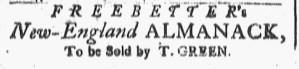
Connecticut Gazette (March 29, 1775).

FREEBETTER’s New-England ALMANACK, To be Sold by T. GREEN.”

Timothy Green, the printer of the Connecticut Gazette, needed something short to complete the first column on the last page of the March 29, 1776, edition of his newspaper.  Most of the column consisted of news from Williamsburg, Philadelphia, New York, and Providence, but those updates did not quite fill the column.  He seized the opportunity to insert an advertisement for “FREEBETTER’s New-England ALMANACK” available at his printing office in New London.  It was late to advertise an almanac.  After all, one quarter of the year already elapsed, yet readers would still find many of the contents useful or entertaining.

Throughout the colonies, advertisements for almanacs usually began appearing as fall arrived.  They increased in number and frequency as the new year approached before tapering off during the winter months.  When they had surplus copies, some printers continued advertising their almanacs into March, though they often ran less elaborate notices than those they used to promote the popular pamphlets when they first came off the press.  Green, for instance, ran a much longer advertisement for “FREEBETTER’s New-England ALMANACK, For the Year of Our LORD, 1776,” in December 1775, encouraging readers to acquire their copies before the new year began.  That advertisement featured an overview of the contents, including reference material like “Feasts and Fasts of the Church of England; Time of High-Water [or high tide]; Courts; Roads; [and] useful Tables” and “useful and entertaining Pieces” like “A cheap, easy, and tried Remedy for the Bloody Purging” and an essay “On the Folly of those who vex themselves with fruitless Wishes.”

Green devoted much more space in his newspapers to the advertisement he ran in early December than to the one in late March.  He likely realized that he had much better prospects for selling almanacs before the first of the year, yet he still thought he had a chance to make some sales in early spring.  Still, the placement and length of his latest advertisement suggests that he decided to insert it, at least in part, because he needed to fill the space at the bottom of a column and not solely because he prioritized marketing the remaining copies of the almanac.
December 1

What was advertised in a revolutionary American newspaper 250 years ago today?

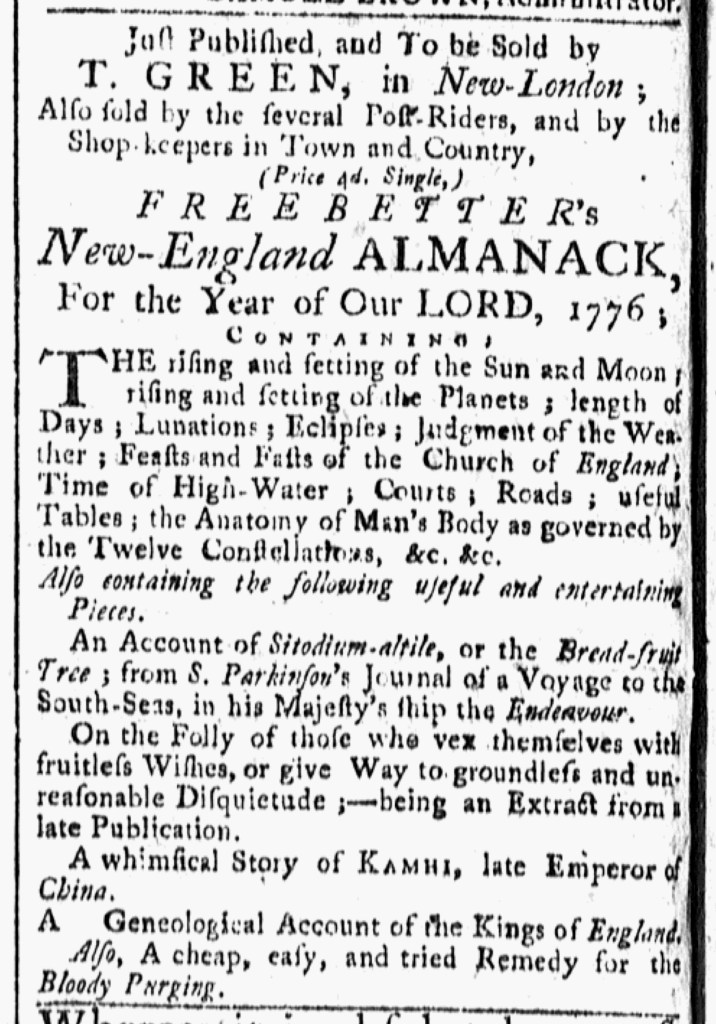
Connecticut Gazette (December 1, 1775).

“Sold by the several Post-Riders, and by the Shop-keepers in Town and Country.”

With only a month until the new year began, Timothy Green, the printer of the Connecticut Gazette, advertised “FREEBETTER’s New-England ALMANACK, For the Year of Our LORD, 1776.”  He emphasized items that usually appeared in almanacs and called attention to special features.  The former included the “rising and setting of the Sun and Moon; rising and setting of the Planets; length of Days; Lunations; Eclipses; Judgment of the Weather; Feasts and Fasts of the Chrich of England; Times of High-Water; Courts; Roads; useful Tables; [and] the Anatomy of Man’s Body as governed by the Twelve Constellations.”  The special features included a “whimsical Story of KAHM, late Emperor of China,” and a “Geneological Account of the Kings of England.”  They also included an “Account of Sitodium-altile, or the Bread-fruit Tree; from S. Parkinson’s Journal of a Voyage to the South-Seas, in his Majesty’s ship the Endeavour” and an essay on “the Folly of those who vex themselves with fruitless Wishes, or give Way to groundless and unreasonable Disquietude; –being an Extract from a late Publication.”  Green may have intended those excerpts as teasers to encourage readers to purchase the original works at his printing office in New London.

To acquire the almanac, however, customers did not have to visit Green or send an order to him.  Instead, he advised that “the several Post-Riders” with routes in the region and “the Shop-keepers in Town and Country” also sold “FREEBETTER’s New-England ALMANACK, For … 1776.”  The printer established a distribution network for the useful reference manual.  Shopkeepers often stocked a variety of almanacs so their customers could choose among popular titles.  Printers sometimes offered discount prices for purchasing multiple copies, usually by the dozen or by the hundred.  That allowed retailers to charge competitive prices to generate revenue with small markups over what they paid.  In this instance, Green did not indicate how much shopkeepers paid for the almanac, only that it sold for “4d. Single” or four pence for one copy.  That constrained shopkeepers when it came to marking up prices.  In addition to shopkeepers, “several Post-Riders” sold the almanac.  That arrangement meant greater convenience for customers and, printers hoped, increased sales and circulation.  In the 1770s, printers in New England began mentioning postriders in their advertisements for almanacs and other printed materials, perhaps acknowledging an existing practice or perhaps establishing a new means of engaging with customers.  The price that Green listed in his advertisement also kept customers aware of reasonable prices charged by post riders.

November 27

What was advertised in a colonial American newspaper 250 years ago today?

New-London Gazette (November 27, 1772).

Just Published, and to be Sold by TIMOTHY GREEN, Freebetter’s New-England ALMANACK.”

The “POETS CORNER,” a regular feature, appeared in the upper left corner of the final page of the New-London Gazetteon November 27, 1772.  Except for the colophon, advertising filled the remainder of the page.  Although some colonial printers interspersed news and advertising throughout their newspapers, Timothy Green, the printer of the New-London Gazette, tended to segregate advertisements from the news, running articles and editorials on the first several pages and then reserving the remainder for paid notices.  Such was the case in the November 27 edition.  Advertising began in the final column of the third page and filled the rest of the issue, except for the poem and colophon.

That description, however, does not take into account an advertisement for “Freebetter’s New-England ALMANACK, For the Year of Our Lord CHRIST 1773” that ran just below the masthead as the first item in the first column on the first page.  The news, starting with “An Act for preventing and punishing he stealing of Horses,” followed that advertisement.  Like many other advertisements for almanacs, it promoted a variety of “useful, entertaining, and instructive” contents “beside the usual astronomical Calculations,” including “a Table of the Weight and Value of Coins, as they pass in England, New-England, and New York,” an essay on “the mental and personal Qualifications of a Husband,” and a guide to “an infallible Method to preserve our Health, to secure and improve our Estates, to quiet our Minds, and to advance our Esteem and Reputation.”

Why did that advertisement merit such a privileged place in the newspaper?  It happened to be “Just Published, … and Sold by TIMOTHY GREEN.”  The printer took advantage of his access to the press to give his own advertisement a prime spot that increased the likelihood that prospective customers would see it.  Given that printers exchanged newspapers in order to reprint content for their own subscribers, Green may have seen John Carter, the printer of the Providence Gazette, recently deploy the same strategy to hawk “The NEW-ENGLAND ALMANACK, Or Lady’s and Gentleman’s DIARY.”  On the other hand, Green did not need to see that example to take the initiative in placing an advertisement for the almanac he printed on the front page of his newspaper.  Colonial printers frequently gave their own notices priority over news, editorials, and paid advertisements.