
GUEST CURATOR: Dominic Bonanno
What was advertised in a colonial American newspaper 250 years ago today?
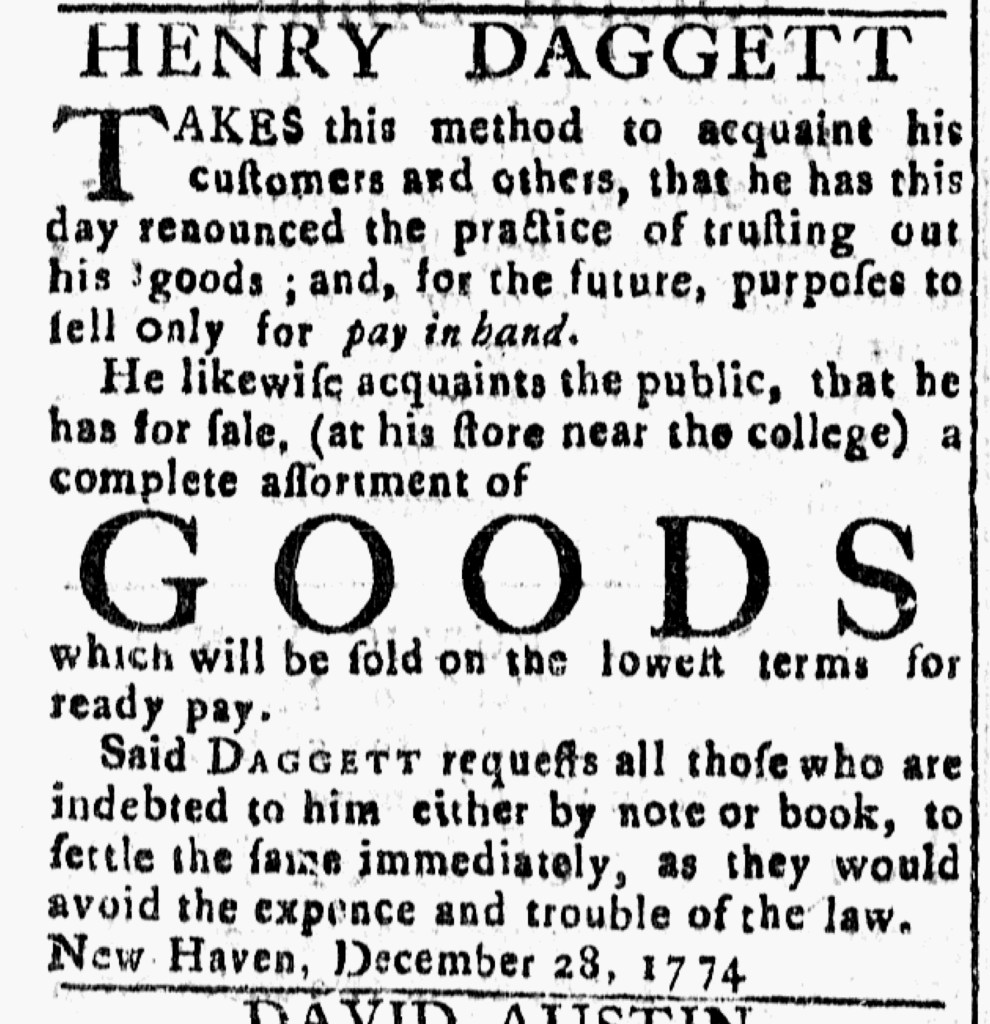
“HENRY DAGGETT TAKES this method to acquaint his customers and others …”
The advertisement from the Connecticut Journal that I have selected was published by Henry Daggett. He created it with three different purposes. First, Daggett mentions that he has stopped accepting lines of credit as payments from customers: he “renounced the practice of trusting out his goods; and, for the future, purposes to sell only for pay in hand.” He wanted customers to pay the same day as their purchases. Next, Daggett moves into stating that he has an assortment of goods to sell in his store “on the lowest terms” or for the lowest prices. Finally, Daggett aggressively mentions that anyone who is in debt to him “either by note or book” must settle with him immediately or he will take them to court, what he called “the expence and trouble of the law.”
In addition to figuring out why Daggett placed this advertisement, I wanted to know more about how it was distributed to the public. I read about “Printing Presses and Distribution” on the webpage about “Connecticut’s Newspaper History” created by the Connecticut State Library.” Once newspapers were printed, “[d]istribution of the final product was usually by the carrier, often the printer’s apprentice. Subscribers who had the paper delivered to their homes were charged a fee. … Outside of town, the post rider was the main distributor of newspapers. The post, or mail, came in once a week in the early days. Often the printer was also postmaster and would see that newspapers were carried free of charge from office to office.” I imagine that Henry Daggett got his point across to the public because of wide distribution of newspapers in Connecticut during the era of the American Revolution. They were delivered not only in the town of publication but also to many other towns as well.
**********
ADDITIONAL COMMENTARY: Carl Robert Keyes
When Dominic and I met to discuss this advertisement, I asked him why he chose Henry Daggett’s notice in the Connecticut Journal. He was especially interested in the circulation of newspapers and the advertisements they contained. As Dominic outlines, Daggett had several reasons for running his advertisement. He wanted to know more about how confident Daggett would have been that others, especially prospective customers and former customers who still owed him for previous purchases, would see the advertisement. That gave us a chance to talk about readership and distribution throughout the colonies and then look for secondary sources about newspapers published in Connecticut in the eighteenth century.
This also gave me an opportunity to share with Dominic that the production of newspapers in Connecticut differed from other many other colonies in early 1775. The sites of publication were more centralized in other colonies. For instance, three newspapers were published in South Carolina, all of them in Charleston, and disseminated throughout the colony from there. Similarly, two newspapers were published in Virginia (with a third established only a few weeks after Daggett’s advertisement ran on January 18, 1775). Printers in Williamsburg published those newspapers. In Pennsylvania, three English-language newspapers were published in Philadelphia (with two more established by the end of the month) and two German-language newspapers were published in Germantown. Three newspapers were published in New York, all of them in New York City.
The situation was a little different in most colonies in New England. While the New-Hampshire Gazette, published in Portsmouth, was the only newspaper in that colony, Rhode Island has two newspapers, the Newport Mercury and the Providence Gazette, and Massachusetts had five newspapers printed in Boston as well as Essex Gazette, published in Salem, and the Essex Journal, published in Newburyport. In early 1775, Connecticut was the only colony with newspapers published in four towns: the Connecticut Courant and Hartford Weekly Intelligencer, the Connecticut Gazette (published in New London), the Connecticut Journal and New-Haven Post-Boy, and the Norwich Packet and the Connecticut, Massachusetts, New-Hampshire, and Rhode-Island Weekly Advertiser. As the full title of the Norwich Packet suggests, colonial newspapers circulated widely beyond their sites of publication.
Advertisers in Boston, Charleston, New York, Philadelphia, and Williamsburg could easily visit or send messages to multiple printing offices when they wished for their notices to appear in more than one newspaper. In contrast, advertisers in Connecticut had ready access to one printing office, if they happened to live in one of the four towns with a newspaper, yet had to devote more effort in submitting their notices to other printing offices when they wished to disseminate them in multiple newspapers.