March 8

GUEST CURATOR:  Massimo Sgambati

What was advertised in a revolutionary American newspaper 250 years ago today?

Virginia Gazette [Purdie] (March 8, 1776).

“I WILL give good wages for a journeyman SHOEMAKER.”

In this advertisement in the Virginia Gazette, Francis Moreland searched for a “journeyman SHOEMAKER.” The specificity of a journeyman implies that Moreland wanted to hire a shoemaker who was quite skilled rather than a young apprentice who still had much to learn. In eighteenth-century America, according to Patrick Grubbs, there was a difference in the levels of craftsmanship. The master oversaw production, owned the shops, and trained journeymen and apprentices. The journeyman was a skilled worker who had finished an apprenticeship, but did not have master status. An apprentice was a beginner learning the trade under a master.

“Cordonnier et cordonnier-bottier [Shoe and boot making]” (1765).  Courtesy Encyclopedia of Diderot & d’Alembert Collaborative Translation Project.

To help us better understand a shoemaker’s shop, Thomas Ford provides an image in The Leatherworker in Eighteenth-Century Williamsburg. In this image we see the inner workings of the customer-shoemaker relationship. Shoemaking as a craft grew across the colonies during the eighteenth century, not just in Virginia. In Philadelphia, Grubbs explains, the occupation grew from a handful in 1680 to over three hundred in 1774, due to a rise in demand and the colonists deciding it would be better to shop domestically for shoes. Craftsmanship was important in the eighteenth century, including in the market for shoes. Although some shoemakers made large quantities of shoes, colonists did not have access to mass produced shoes in the same way that modern consumers purchase Nike and Adidas, so they often relied on their local shoemakers to meet their needs.

**********

ADDITIONAL COMMENTARY:  Carl Robert Keyes

When I asked students in my senior capstone research seminar about advertising and consumer culture in early America to choose advertisements about consumer goods and services for the portfolios they created throughout the semester, I did not necessarily have employments advertisements in mind, but I allow for flexibility and creativity in selecting and interpreting newspaper notices for their portfolios and for publication via the Adverts 250 Project.  As I have written on other occasions, one of my favorite parts of enlisting my students as junior colleagues in the production of this digital humanities work is the opportunity to see sources that are so familiar to me through new eyes.  I likely would have passed over Moreland’s advertisement, but Massimo demonstrated its relevance to our readings and discussions about colonizers participating in consumer culture.  Consumption, after all, occurs in a reciprocal relationship with production and distribution of goods, as T.H. Breen highlights in The Marketplace of Revolution: How Consumer Politics Shaped American Independence, a book we read and discussed in our seminar.

Massimo chose one of three employment advertisements in the March 8, 1776, edition of Alexander Purdie’s Virginia Gazette.  In another notice, Thomas Warren sought a “BRICKLAYER, who is a good workman,” for the next season. He limited his search to those “coming well recommended.”  Robert Anderson also wanted “well recommended” applicants to respond to his advertisement for a “GOOD HOSTLER” to care for horses.  The “journeyman SHOEMAKER” would have been the only one of the three who served an apprenticeship and may have worked more closely with customers than the bricklayer and the hostler.  On the other hand, Moreland may have had other plans for a new employee. In another advertisement in that issue, William Aylett informed the public that he “WANTED, for the army, a large number of SHOES.”  Moreland may have had his journeyman shoemaker craft shoes for individual clients or he may have tasked him with producing a quantity of shoes to supply the army, a precursor to modern mass production.

March 4

GUEST CURATOR:  Ethan Sawyer

What was advertised in a revolutionary American newspaper 250 years ago today?

Norwich Packet (March 4, 1776).

“All Sorts of Doe and Buck-Skin Breeches.”

This advertisement announced the arrival of John Saltmarsh, a “LEATHER BREECHES MAKER” from London.  He offered to make breeches for anyone who needed them in Norwich, Connecticut.  He uses both doe and buckskin and made them fit properly.  He also promised they would fit well, offering to “make them fit properly, or demand nothing for his trouble.” This sounds confusing, but it was the equivalent of modern lawyers only asking for a payment if they win.  Saltmarsh was that confident in his ability to make new breeches or alterations that pleased his customers.

I was not sure what “breeches” were when I first read this advertisement.  From an interview with historian Kate Haulman in Vox, I learned that breeches are a kind of pants made distinctive through the wrappings that tighten them just below the knees.  Some had buttons or buckles, but for a cheaper option some just had simple ties to hold them in place.  They were fashionable, which was one reason Saltmarsh said that he was “from London,” but that was not the only way he tried to convince customers to buy breeches from him.  He also focused on service, promising the work to be done with “one Day’s Notice” or else he will compensate the customer for the inconvenience.  He even said, “he will pay for their trouble of coming after them.”  Overall, Saltmarsh ran an honest business. He focused on not only making a good product that fits the needs of each customer, but also on a timetable that works for them.

**********

ADDITIONAL COMMENTARY:  Carl Robert Keyes

One of my favorite parts of having students in my upper-level early American history courses serve as guest curators for the Adverts 250 Project is observing their sense of wonder and discovery as they encounter everyday life in the eighteenth century for the first time.  That starts with each student compiling an archive that consists of one week of newspapers published during the era of the American Revolution.  Those newspapers look familiar, but they also have significant difference compared to modern newspapers … and not just the long “s” that looks so strange to novice researchers.  The purposes of some advertisements surprise them, such as what are today known as “runaway wife” advertisements in which husbands made public proclamations that they would not pay any expenses incurred by the unruly women who abandoned their household responsibilities (and that gives us a chance to discuss both coverture and the perspectives of the wives who did not have ready access to the public prints).  Students also encounter consumer goods commonly advertised in early America that are not familiar to them, such as andirons and “AMERICAN CAKE-INK.”  Breeches also fall in that category.  Ethan was not the only student enrolled in my senior seminar in Fall 2025 who included an entry on breeches in the advertising portfolio he created throughout the semester.

In addition to seeing fresh perspectives on consumer goods, I am always interested to see which advertisements draw the attention of my students because they usually select different advertisements to examine as guest curators than I would if I produced that entry of the Adverts 250 Project on my own.  I would have skipped over “JOHN SALTMARSH, LEATHER BREECHES MAKER, FROM LONDON,” in favor of the two advertisements for Thomas Paine’s Common Sense that appeared in the March 4, 1776, edition of the Norwich Packet, advertisements even more notable because the printers also included “EXTRACTS FROM A PAMPHLET ENTITLED, COMMON SENSE.”  Perhaps they previewed the pamphlet for the edification of their readers, though they likely also hoped to incite greater demand for sales of the pamphlet at their printing office.  This helps make a point that I underscore in all my courses: the stories that historians tell about the past depend on the sources they consult and, among those, which they choose to examine in greater detail.  Ethan and I both chose advertisements that illuminate the past, though different advertisements engaged our curiosity.  Elsewhere in his advertising portfolio, Ethan examined other advertisements from other newspapers.  Considered together, his advertisements looked at many aspects of consumer culture, commerce, politics, and everyday life during the first year of the Revolutionary War.  They included an advertisement for a riding manual “for gentlemen of every rank and profession,” an advertisement for pig iron, an advertisement for an assortment of books and pamphlets for supporters of the American cause, … and an advertisement for a local edition of Common Sense that appeared in the March 1 edition of the Connecticut Gazette.  When we perused that newspaper, Ethan and I selected the same advertisement!

February 22

GUEST CURATOR:  Madison Sandusky

What was advertised in a revolutionary American newspaper 250 years ago today?

Pennsylvania Evening Post (February 22, 1776).

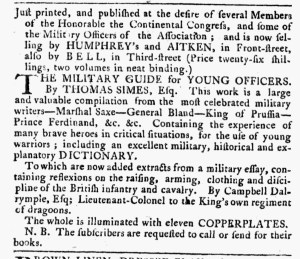
“THE MILITARY GUIDE for YOUNG OFFICERS.  By THOMAS SIMES, Esq.”

Several printers in Philadelphia advertised “THE MILITARY GUIDE for YOUNG OFFICERS” by Thomas Simes in February 1776.  The manual was published in 1776 and contained a compilation of “works of several military authors, including Humphrey Bland and the comte de Saxe.”  When the American Revolution began in 1775, military manuals, such as the one Simes wrote, became popular among young men preparing to join the war and those who had already joined. According to the American Revolution Institute of the Society of the Cincinnati, “to meet the demand for military texts, a flood of printings began to appear from the American presses.”  Additionally, the advertisement above, published in the Pennsylvania Evening Post, which was a newspaper located in Philadelphia, displays how that flood of printing was “centered in Philadelphia, where more than thirty works on military subjects were published in the years 1775 and 1776 alone.”  The advertisement briefly summarizes the book, stating that it included “the experience of many brave heroes in critical situations, for the use of young warriors” to entice the target audience of young men who would serve as officers to purchase the book as a helpful guide. The advertisement even noted that the guide came with its own “explanatory DICTIONARY,” a bonus section. One signer of the Declaration of Independence, William Floyd, owned a copy of Simes’s guide, which can be taken as an indicator of both the quality and popularity of its contents.

**********

ADDITIONAL COMMENTARY:  Carl Robert Keyes

Robert Bell, the publisher of the first edition of Thomas Paine’s Common Sense, continued his feud with William Bradford and Thomas Bradford, the printers of the Pennsylvania Journal, with a new advertisement in the February 22, 1776, edition of the Pennsylvania Evening Post.  Dissatisfied with Bell’s bookkeeping, Paine collaborated with the Bradfords on an expanded edition of his popular political pamphlet, yet Bell took an unauthorized second edition to press and simultaneously published diatribes about Paine and the Bradfords.  His latest advertisement would be the last in the series that attacked the author and his fellow printers.  It filled more than a column, starting on the third page of the February 22 issue of the Pennsylvania Evening Post and overflowing onto the fourth page.  The advertisement for Thomas Simes’s Military Guide for Young Officers, jointly published by Bell, Robert Aitken, and James Humphreys, Jr., immediately followed Bell’s advertisement.  In the column to the right, the Bradfords promoted their “NEW EDITION of COMMON SENSE, With ADDITIONS and IMPROVEMENTS,” and warned that the “Pamphlet advertised by Robert Bell intitled ADDITIONS to COMMON SENSE … consists of Pieces taken out of News Papers, and not written by the Author of COMMON SENSE.”

The advertisement for Simes’s Military Guide for Young Officers thus appeared in the middle of the controversy over the publication of new editions of Common Sense.  Unlike Bell’s questionable decision to produce a second edition of the political pamphlet and then attempt to capitalize off it by publishing another pamphlet of “ADDITIONS” drawn from newspapers rather than written by Paine, he collaborated with Aitken and Humphreys in producing the military manual “at the desire of several Members of the Honorable the Continental Congress, and some of the Military Officers of the Association.”  Bell (along with Aitken and Humphreys) had the right endorsements for an American edition of a manual previously published in London and the printers attempted to leverage that in marketing Simes’s Military Guide for Young Officers to prospective customers who, as Madison notes, could choose from among many similar works published in Philadelphia at the time.  In the Pennsylvania Evening Post, the advertisement appeared in the middle of the various notices in the February 22 edition, but two days later it had a privileged place in the Pennsylvania Ledger.  Humphreys, the printer of that newspaper, placed the advertisement on the first page, making it the first item in the first column.  The printers of the Pennsylvania Gazette gave the advertisement the same treatment in the February 28 edition of their newspaper.  The flamboyant Bell took a more measured approach to marketing the military manual compared to some of the other books and pamphlets he printed and, especially, his new editions of Common Sense.  Perhaps his partners in the endeavor took the lead in marketing Simes’s Military Guide for Young Officers.

February 19

GUEST CURATOR:  Michael “OB” O’Brien

What was advertised in a revolutionary American newspaper 250 years ago today?

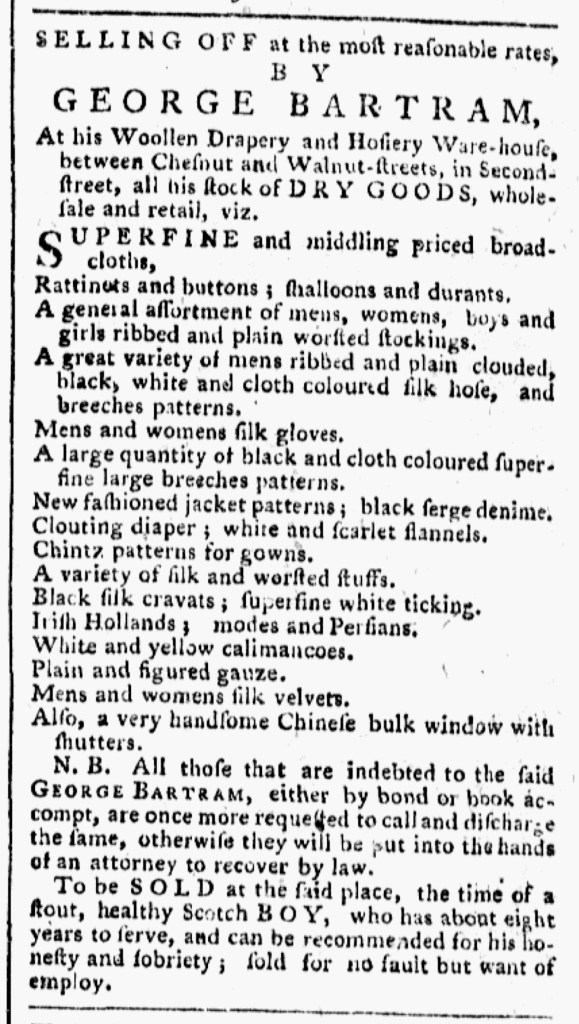
Dunlap’s Pennsylvania Packet (February 19, 1776).

“Rattinets and buttons; shalloons and durants.”

When I first examined George Bartram’s advertisement in the Pennsylvania Packet on February 19, 1776, I noticed how crowded it was with imported fabrics and fashionable goods. Bartram listed “New fashioned jacket patterns,” a “general assortment of mens, womens, boys and girls ribbed and plain worsted stockings,” silk gloves, and numerous types of cloth (such as rattinets, shalloons, and durants), all meant to appeal to customers looking for style and choice. His shop offered more than just the necessities. He encouraged customers to browse, compare, and imagine new possibilities of how they might dress. In The Marketplace of Revolution: How Consumer Politics Shaped American Independence, T.H. Breen states that “as the index of choice expanded, so too the dreams of possession flourished.”[1]  Bartram’s advertisement reflected exactly that expanding world of choice. The abundance of fabrics and fashionable goods available in his Philadelphia shop shows how deeply colonists participated in the marketplace even on the brink of the American Revolution.

**********

ADDITIONAL COMMENTARY:  Carl Robert Keyes

Nearly a year after George Bartram announced in the Pennsylvania Evening Post that he “resolved to decline his Retail Trade,” he once again ran an advertisement about “SELLING OFF” the inventory at his “Woollen Drapery and Hosiery Ware-house” in Philadelphia.  He offered his wares “wholesale and retail,” indicating that he had neither gone out of business nor became a merchant who dealt solely in wholesale transactions.  As Michael notes, Bartram stocked a wide array of imported goods.  He conveniently did not mention whether his merchandise arrived in Philadelphia before the Continental Association went into effect.

By the time he ran his advertisement in February 1776, Bartram’s warehouse on Second Street between Chestnut Street and Walnut Street was a landmark familiar to residents of Philadelphia.  In 1767, he opened his “new Shop at the Sign of the Naked Boy.”  His advertisements in the Pennsylvania Chronicle featured a woodcut depicting that sign.  In a cartouche in the center, a naked boy unfurled a length of fabric.  Bolts of textile flanked the cartouche with Bartram’s name appearing beneath them.  Replicating his shop sign in the public prints likely improved Bartram’s visibility in the busy port city.  He continued publishing advertisements with that image for several years.

Yet Bartram eventually abandoned the device that marked his location for so long in favor of rebranding his store as “GEORGE BARTRAM’s WOOLLEN DRAPERY AND HOSIERY WARE-HOUSE, At the Sign of the GOLDEN FLEECE’S HEAD,” though he remained at the same location on Second Street.  His new advertisements sometimes featured a woodcut depicting his new device, though on other occasions he opted for no decorative elements or a border comprised of printing ornaments rather than the image of “the Sign of the GOLDEN FLEECE’S HEAD.”  His advertisements did not reveal why he opted for a new sign to mark his location and identify his business.

In subsequent advertisements, Bartram proclaimed that he was “SELLING OFF” his inventory and leaving the “Retail Trade.”  He made such pronouncements in March 1775 and September 1775, though in the latter he clarified that he would cease retail operations “so soon as the trade is open between Britain and America.”  Once the war that started in April 1775 became a revolution, the resumption of trade became even more uncertain.  For the moment, Bartram continued “SEELING OFF” his inventory “at the most reasonable rates,” making him a precursor to modern businesses that constantly promote sales to draw customers.  The marketing tried to create a sense of urgency by suggesting a limited-time offer, yet savvy consumers likely realized that one sale followed another at Bartram’s “Woollen Drapery and Hosiery Ware-house.”

**********

[1] T.H. Breen, The Marketplace of Revolution: How Consumer Politics Shaped American Independence (New York: Oxford University Press, 2004), 58.

Welcome, Guest Curator Massimo Sgambati

Massimo Sgambati with Old Number One at the American Antiquarian Society (AAS). He conducted much of his research in the reading room at the AAS, one of the nation’s oldest research libraries and learned societies.

Massimo Sgambati is a senior double majoring in History and Secondary Education at Assumption University in Worcester, Massachusetts. Originally from Farmington Hills, Michigan, he discovered his love for history through his father and time spent growing up in England. He is passionate about studying both the era of slavery and Reconstruction in America, hoping to attend grad school and specialize in the effects of those periods on Black Americans and connections to today’s mass incarceration. He hopes to continue research in the field and eventually become a professor, spreading awareness for how slavery has continued to resonate in American society. Massimo is involved in activities across campus, working in both the university’s d’Alzon Library and the Office of Admissions, serving as the Vice President of the Education Club, and being the kicker on the football team. Massimo conducted the research for his contributions as a guest curator for the Slavery Adverts 250 Project as a summer research assistant, funded through the D’Amour College of Liberal Arts and Sciences Summer Scholars Program.

Welcome, guest curator Massimo Sgambati!

Welcome, Guest Curator Gabriela Vargas

Gabriela Vargas is a senior double majoring in History and Elementary Education as she pursues a dual graduate degree in Special Education at Assumption University in Worcester, Massachusetts. She hopes to become a special education teacher and an education attorney. Gabriela has been involved in Campus Ministry as a bible study leader. She also co-founded Latinos Unidos, the first Latin club. She served as public relations representative for ALANA, the multi-cultural club on campus.  She is currently the head editor for MUSE, the campus literary magazine. Gabriela also, published her first book, The Rhymes of My Times, when she was sixteen. She has also been involved in various community service and advocacy projects. Gabriela made her contributions to the Adverts 250 Project and the Slavery Adverts 250 Project while enrolled in HIS 359 Revolutionary America, 1763-1815, in Fall 2024.

Welcome, guest curator Gabriela Vargas!

Welcome, Guest Curator Ashley Schofield

Ashley Schofield is a junior at Assumption University in Worcester, Massachusetts. She is majoring in Psychology with a mental health concentration and minoring in Theology. Ashley is involved with Best Buddies on campus and enjoys going on nature walks, working out at the gym, drinking good coffee, and spending time with friends and family. She intends to obtain her Master’s of Clinical Psychology, become a therapist, and support the community around her in any way she can. Ashley made her contributions to the Adverts 250 Project and the Slavery Adverts 250 Project while enrolled in HIS 359 Revolutionary America, 1763-1815, in Fall 2024.

Welcome, guest curator Ashley Schofield!

Welcome, Guest Curator Ella Holtman

Ella Holtman is a first-year student at Assumption University in Worcester, Massachusetts. She is currently planning on triple majoring in Criminology, Sociology, and Spanish. Still, history, especially the American Revolution, is her favorite thing to learn about. She graduated from Charles W. Baker High School in New York last summer and is very excited to continue her education. A member of the National Honors Society and eight different sports teams during high school, she values hard work and determination. Ella is also on the DII Assumption Field Hockey Team and is looking forward to the coming years. Hopefully, with knowledge and passions to fuel her, she can make a true difference for the better in the world. She made her contributions to the Adverts 250 Project and the Slavery Adverts 250 Project while enrolled in HIS 359 Revolutionary America, 1763-1815, in Fall 2024.

Welcome, guest curator Ella Holtman!

Welcome, Guest Curator Jack Driscoll

James “Jack” Driscoll is a Junior at Assumption University in Worcester, Massachusetts.  He is majoring in Criminology and minoring in History.  He hopes to one day work for the U.S. Marshal Service, doing case work on fugitives and providing security to prisoners in transport and in the courtroom.  He decided to pursue a history minor because ever since he was a kid he has always been very passionate about learning about the past because it serves as an explanation for the present.  At Assumption, he plays left tackle for the football team, one of his proudest achievements.  He consistently devotes hard work to that position top contribute to positive outcomes on the field for his entire team.  Jac made his contributions to the Adverts 250 Project and the Slavery Adverts 250 Project while enrolled in HIS 359 Revolutionary America, 1763-1815, in Fall 2024.

Welcome, guest curator Jack Driscoll!

Welcome, Guest Curator Braydon Booth-Desmarais

Braydon Booth-Desmarais is a senior at Assumption University in Worcester, Massachusetts. He is a History major with a minor in Theology. He has had a passion for all parts of American history ever sense he could remember. In Fall 2024, he researched, wrote, and presented “The Bomb Heard Around America: Martin Luther King’s Response to the Bombing of His Home and What It Teaches Us” for his capstone seminar. His goals include furthering his education to work towards becoming a college professor. Braydon made his contributions to the Adverts 250 Project and the Slavery Adverts 250 Project while enrolled in HIS 359 Revolutionary America, 1763-1815, in Fall 2024.

Welcome, guest curator Braydon Booth-Desmarais!