What was advertised in a revolutionary American newspaper 250 years ago today?

“THE NEW EDITION OF COMMON SENSE.”
“LARGE ADDITIONS TO COMMON SENSE.”
The March 7, 1776, edition of the New-York Journal included competing advertisements for Thomas Paine’s Common Sense and “LARGE ADDITIONS TO COMMON SENSE.” Although John Anderson, the printer of the Constitutional Gazette, recently published a New York edition of Paine’s pamphlet, neither of these advertisements promoted pamphlets printed in that city. Instead, both advertisements hawked pamphlets printed in Philadelphia and sent to New York.

Garrat Noel and Ebenezer Hazard stocked the “NEW EDITION OF COMMON SENSE; With Additions and Improvements in the Body of the WORK” published by William Bradford and Thomas Bradford, printers of the Pennsylvania Journal. When Paine and Robert Bell, the publisher of the first edition of Common Sense, had a falling out, the author collaborated with the Bradfords on a “NEW EDITION” that featured new material, including “AN APPENDIX, And an ADDRESS to the People, called, QUAKERS.” As the Bradfords prepared that edition for press, Bell published an unauthorized second edition and then supplemented it with yet another pamphlet of “LARGE ADDITIONS” that included “The American Patriot’s Prayer” and “American Independency defended, by Candidus.” In their advertisements, the Bradfords warned that the pamphlet “consists of pieces taken out of News-Papers, and NOT written by the AUTHOR of Common Sense.” To spite Paine and the Bradfords, Bell then pirated “An Appendix to Common Sense; together with an Address to the People called Quakers, on their Testimony concerning Kings and Government, and the present Commotions in America” and packaged it with the “LARGE ADDITIONS.”
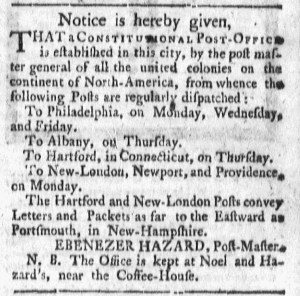
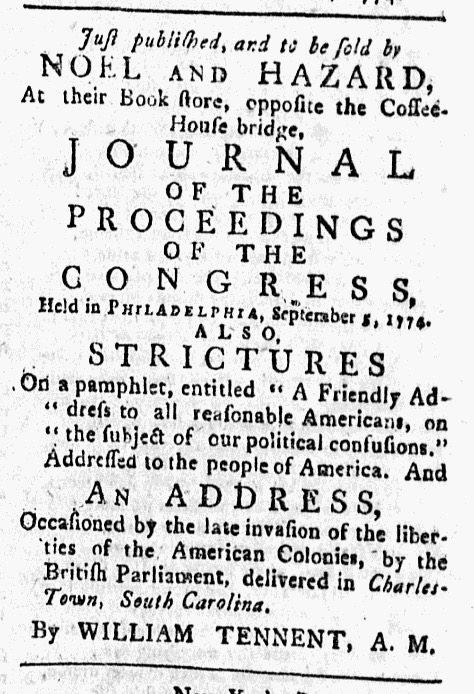
The advertisements in the New-York Journal reveal that Noel and Hazard stocked the Bradfords’ edition of Common Sense at the Constitutional Post Office and that William Green, a bookseller and bookbinder in Maiden Lane, carried Bell’s “LARGE ADDITIONS.” Noel and Hazard’s advertisement included the warning about items from newspapers passed off as Paine’s work. Green previously placed the first advertisement for Common Sense that appeared in any newspaper beyond Philadelphia, identifying himself as Bell’s local agent for distributing the pamphlet. That he now advertised the “LARGE ADDITIONS” demonstrated that Bell continued supplying him with pamphlets to peddle in New York. Even as printers in New York and other towns produced local editions of Common Sense, printers in Philadelphia tried to expand their share of the market for the popular pamphlet by sending copies to local agents to advertise and sell.