January 28

What was advertised in a colonial American newspaper 250 years ago today?
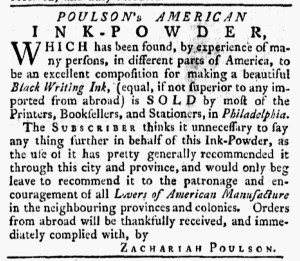
Pennsylvania Ledger (January 28, 1775).

POULSON’s AMERICAN INK-POWDER.”

Just four days after Benjamin Towne launched the Pennsylvania Evening Post, James Humphreys, Jr., commenced publication of the Pennsylvania Ledger on January 28, 1775.  In less than a week, the number of English-language newspapers printed in Philadelphia increased from three to five, rivaling the number that came off the presses in Boston.  No other city in the colonies had as many newspapers.  Humphreys incorporated the colophon into the masthead, advising that he ran his printing office “in Front-street, at the Corner of Black-horse Alley:– Where Essays, Articles of News, Advertisements, &c. are gratefully received and impartially inserted.”

Unlike the first issue of the Pennsylvania Evening Post, the inaugural edition of the Pennsylvania Ledger carried advertisements.  Humphreys placed some of them, one hawking “POLITICAL PAMPHLETS … on Both Sides of the Question,” another promoting an assortment of books he sold, and a final one seeking “an APPRENTICE to the Printing Business.”  Nine other advertisers placed notices, all of them for consumer goods and services.  They took a chance that the new newspaper had sufficient circulation to merit their investment in advertising in its pages.

Among those advertisers, Zachariah Poulson marketed “POULSON’s AMERICAN INK-POWDER.”  He asserted that “most of the Printers, Bookseller, and Stationers, in Philadelphia” stocked that product.  Customers just needed to request it.  With the deteriorating political situation in mind, especially the boycott of imported goods outlined in the Continental Association, Poulson called on “all Lovers of American Manufacture” in Pennsylvania and “in the neighbouring provinces and colonies” to choose his ink powder over any other.
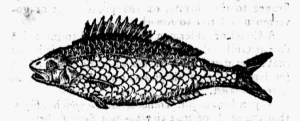
Detail from Edward Pole’s Advertisement in the Pennsylvania Ledger (January 28, 1775).

Edward Pole inserted the lengthiest advertisement (except for Humphreys’s notice cataloging the books he sold).  It filled half a column, the first portion devoted to the merchandise available “at his GROCERY STORE, in Market-street” and the rest to “FISHING TACKLE of all sorts,” “FISHING RODS of various sorts and sizes,” and other fishing equipment.  In advertisements in several newspapers published in Philadelphia (and, later, with ornate trade cards that he distributed), Pole regularly marketed himself as a sporting goods retailer.  For the first issue of the Pennsylvania Ledger, he adorned his advertisement with a woodcut depicting a fish that previously appeared in his notices in Dunlap’s Pennsylvania Packetin May and June 1774.

Humphreys provided residents of Philadelphia and other towns greater access to news and editorials with the Pennsylvania Ledger, but that was not all.  The publication of yet another newspaper in Philadelphia increased the circulation of advertising in the city and region, disseminating messages to consumers far and wide.  Not long after Humphreys published that first issue, advertisers took to the pages of the Pennsylvania Ledger to publish notices for a variety of purposes, supplementing the information the editor selected for inclusion.

August 29

What was advertised in a colonial American newspaper 250 years ago today?

Pennsylvania Chronicle (August 29, 1772).

“FISHING TACKLE.”

In the summer of 1772, Edward Pole advertised a variety of items available at his ‘GROCERY STORE” on Second Street in Philadelphia.  He stocked everything from wines and spirits to “Green, Bohea, Hyson and Soushong Teas” to raisins and currants to “mustard by the bottle or pound.”  Pole declared that he would “make it his chief study to merit” repeat business from his customers “by keeping an assortment of the best kind of GROCERIES, and selling them on the lowest terms.”

Yet Pole stocked more than just groceries.  His advertisement in the August 29 edition of the Pennsylvania Chronicle included a headline and a section for “FISHING TACKLE” available at his store.  He carried “Fishing rods of various kinds, best Kerby and common hooks of all sizes, artificial flies, wheels, silk, hair and trolling lines of every kind, length, and goodness, deapseas, casting, minnow and scoop nets,” and other items.  He made a point of promoting “the best kind of fish-hooks, made by ROBERT CARTER, fish-hook maker, from Trenton.”

Over time, the appropriately-named Pole placed greater emphasis on marketing fishing supplies.  By 1781, he was placing advertisements for “Fishing Tackle Of all sorts, for Use of either SEA or RIVER, MADE AND SOLD By Edward Pole” in the Pennsylvania Packet.  A woodcut depicting a fish adorned those advertisements.  He commissioned another woodcut of a fish, this one with a decorative border, for his advertisement in the March 24, 1784, edition of the Freeman’s Journal.  At about the same time, he made an even greater investment in a trade card engraved by David Tew.  A vignette showed two gentlemen fishing, one with a rod and the other with a net.  The gentleman with the rod had a fish on the line, its head sticking out of the water, while the gentleman with the net attempted to scoop up the fish.  An ornate cartouche, complete with fishing lures dangling from it, served as border for the text of this advertisement.  The trade card announced that “Edward Pole FISHING-TACKLE-MAKER … es & Sells all kinds of the best Fishing Tackle for the use of either Sea or River.”  A nota bene advised, “Gentlemen going on parties, in the Fishing Way Compleatly fitted out on the shortest notice.”

The headline for “FISHING TACKLE” in Pole’s newspaper advertisements published in 1772 foreshadowed the more extensive marketing efforts he launched in the 1780s.  He further enhanced newspaper notices with visual images as he increasingly specialized in fishing supplies.  He also distributed an engraved trade card that featured images that rivaled any on the hundreds of trade cards distributed in London in the eighteenth century, making his business all the more memorable to the gentlemen he aimed to serve.

Edward Pole, Trade Card, engraved by David Tew (Philadelphia, 1780s). Courtesy Historical Society of Pennsylvania.

Bonus: Edward Pole’s Advertising Campaign

Yesterday evening I discovered that the American Antiquarian Society included a newspaper advertisement in its Instagram feed earlier in the day, a delightful surprise made even better by a generous reference to the Adverts 250 Project.  Please visit the AAS Instagram feed to see the advertisement and their commentary.

I was also excited because I recognized the advertiser, Edward Pole, a “Fishing-Tackle-Maker” who also operated a wholesale and retail grocery store in Philadelphia in the 1770s and 1780s.  Unlike most newspaper advertisements featured in the Adverts 250 Project so far, Pole’s advertisement (from fifteen years later, June 1781) included a woodcut to catch readers’ attention:  a striking image of a fish, certainly appropriate for an entrepreneur who peddled fishing tackle.  Woodcuts accompanying newspaper advertisements became more common during the last third of the eighteenth century.  Some advertisers, like Pole, used them as brands for their products and businesses.

Pole’s woodcut probably looked familiar to consumers in Philadelphia in 1781.  It appeared regularly in the Pennsylvania Packet (at least as early as May 1774), but that was not the only newspaper that included a woodcut of a fish with Pole’s commercial notices.  Pole placed advertisements for fishing tackle, including a very similar fish (this time with a decorative border), in the Freemen’s Journal in 1784.

Pole Newspaper Advert
Advertisement from the Freemen’s Journal (March 24, 1784).  Historical Society of Pennsylvania.

In addition,the savvy Edward Pole made use of multiple advertising media.  He distributed an engraved billhead for his receipts as early as the 1770s.  The billhead’s elaborate engraving featured a triptych logo in the upper left corner of the sheet, complete with rococo-style frames surrounding casks, crates, and scales on the left and right and the words “Edwd Pole’s GROCERY STORE Wholesale & Retail” in the center.  This billhead, with manuscript notations from 1771, is part of the Norris Papers at the Historical Society of Pennsylvania.

Sometime in the late 1770s or early 1780s, he also distributed engraved trade cards featuring a rectangular vignette of two gentlemen fishing in a stream above a description of the wares stocked in his shop.  Pole eventually resorted to broadsides (or, in modern terms, posters) for his business ventures.

Edward Pole Trade Card
Edward Pole’s Trade Card (ca. 1780).  Historical Society of Pennsylvania.

In addition to trade cards, billheads, and broadsides, Pole most prolifically advertised in several of Philadelphia’s newspapers, often distinguishing his advertisements from others on the page by including a woodcut of a fish, as we have seen.  Pole’s use of multiple media allowed him to publicize his wares widely.  Most advertisements relied exclusively on newspapers for their marketing, but Pole took an innovative approach by experimenting with other forms as he encouraged potential customers to visit his shop.