January 28

What was advertised in a colonial American newspaper 250 years ago today?
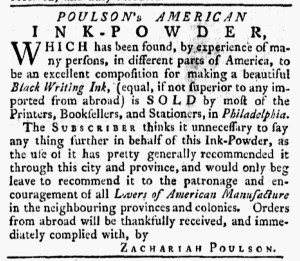
Pennsylvania Ledger (January 28, 1775).

POULSON’s AMERICAN INK-POWDER.”

Just four days after Benjamin Towne launched the Pennsylvania Evening Post, James Humphreys, Jr., commenced publication of the Pennsylvania Ledger on January 28, 1775.  In less than a week, the number of English-language newspapers printed in Philadelphia increased from three to five, rivaling the number that came off the presses in Boston.  No other city in the colonies had as many newspapers.  Humphreys incorporated the colophon into the masthead, advising that he ran his printing office “in Front-street, at the Corner of Black-horse Alley:– Where Essays, Articles of News, Advertisements, &c. are gratefully received and impartially inserted.”

Unlike the first issue of the Pennsylvania Evening Post, the inaugural edition of the Pennsylvania Ledger carried advertisements.  Humphreys placed some of them, one hawking “POLITICAL PAMPHLETS … on Both Sides of the Question,” another promoting an assortment of books he sold, and a final one seeking “an APPRENTICE to the Printing Business.”  Nine other advertisers placed notices, all of them for consumer goods and services.  They took a chance that the new newspaper had sufficient circulation to merit their investment in advertising in its pages.

Among those advertisers, Zachariah Poulson marketed “POULSON’s AMERICAN INK-POWDER.”  He asserted that “most of the Printers, Bookseller, and Stationers, in Philadelphia” stocked that product.  Customers just needed to request it.  With the deteriorating political situation in mind, especially the boycott of imported goods outlined in the Continental Association, Poulson called on “all Lovers of American Manufacture” in Pennsylvania and “in the neighbouring provinces and colonies” to choose his ink powder over any other.
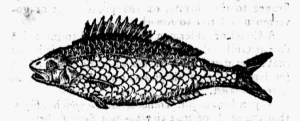
Detail from Edward Pole’s Advertisement in the Pennsylvania Ledger (January 28, 1775).

Edward Pole inserted the lengthiest advertisement (except for Humphreys’s notice cataloging the books he sold).  It filled half a column, the first portion devoted to the merchandise available “at his GROCERY STORE, in Market-street” and the rest to “FISHING TACKLE of all sorts,” “FISHING RODS of various sorts and sizes,” and other fishing equipment.  In advertisements in several newspapers published in Philadelphia (and, later, with ornate trade cards that he distributed), Pole regularly marketed himself as a sporting goods retailer.  For the first issue of the Pennsylvania Ledger, he adorned his advertisement with a woodcut depicting a fish that previously appeared in his notices in Dunlap’s Pennsylvania Packet in May and June 1774.

Humphreys provided residents of Philadelphia and other towns greater access to news and editorials with the Pennsylvania Ledger, but that was not all.  The publication of yet another newspaper in Philadelphia increased the circulation of advertising in the city and region, disseminating messages to consumers far and wide.  Not long after Humphreys published that first issue, advertisers took to the pages of the Pennsylvania Ledger to publish notices for a variety of purposes, supplementing the information the editor selected for inclusion.

March 11

What was advertised in a colonial American newspaper 250 years ago today?

Massachusetts Spy (March 11, 1773).

“American Ink-Powder.”

Buy American!  That was the message that many advertisers presented to consumers during the imperial crisis, before the first shots were fired at Lexington and Concord.  It was the message that Samuel Norton of Hingham, who made ink powder, and Ann Norton of Boston, his broker in town, proclaimed to prospective customers in the March 11, 1773, edition of the Massachusetts Spy.  Other advertisers made similar appeals, including Abraham Cornish for his “New England COD and MACKEREL FISH HOOKS.”

For their part, the Nortons introduced their product with a headline for “American Ink-Powder” followed immediately by a secondary headline that declared, “Experienced and found to be equal, if not superior to any imported.”  Earlier in the week, Henry William Stiegel made similar assertions about the glassware he made in Manheim, Pennsylvania.  To entice colonizers to try the ink powder made in Hingham, the Nortons listed several of its “excellent qualities.”  They claimed that even when documents written with the ink were “exposed to extreme wet” the ink did not run; instead, it “alters not, but will remain as long as the paper endures.”  Furthermore, the ink powder contained an ingredient that “precents ink from becoming think and mouldy.”  These factors prompted the Nortons to proclaim that this ink powder “makes the best black writing-ink,” doubling down on the secondary headline about it being as good as, or even better than, imported alternatives.

The Nortons also offered practical advice for using the ink powder.  They considered it “very convenient for gentlemen, merchants, attornies and others that travel, it being not cumbersome and liable to those mischances that other ink is.”  Purchasers could choose to mix ink “in large or small quantities, as is most convenient,” and did not have to worry about it freezing if they used “a little brandy or other spirits not liable to freeze” instead of water.  In guiding prospective customers in how to use the product, the Nortons hoped to increase the chances that some of them would purchase their ink powder and follow their directions.

They also benefited from the compositor’s choice about where to place their advertisement within that issue of the Massachusetts Spy.  It appeared immediately below coverage of the annual commemoration of the Boston Massacre. Residents of Boston marked the third anniversary with an oration “on the dangerous tendency of standing armies being placed in free and populous cities” by Dr. Benjamin Church, a lantern with paintings that depicted soldiers firing on colonizers, and the tolling of bells.  The Nortons did not make arguments about consumers’ civic responsibility to practice politics in the marketplace by purchasing domestic manufactures, goods produced in the colonies, as explicitly as some other advertisers.  Given the commemoration of the Boston Massacre that just occurred and other news about current events that crowded the pages of the Massachusetts Spy, they did not necessarily need to do so.  Prospective customers very well understood the context in which the Norton’s hawked their “American Ink-Powder.”