September 22

What was advertised in a colonial American newspaper 250 years ago today?

Maryland Gazette (September 22, 1774).

“YES, YOU SHALL BE PAID; BUT NOT BEFORE YOU HAVE LEARNED TO BE LESS INSOLENT.”

The saga continued.  Elie Vallette, the clerk of the Prerogative Court in Annapolis and author of the Deputy Commissary’s Guide, did not bow to the public shaming that Charles Willson Peale, the painter, undertook in the pages of the Maryland Gazette in September 1774.  Earlier in the year, Peale had painted a family portrait for Vallette and then attempted through private correspondence to get the clerk to pay what he owed.  When Vallette did not settle accounts, Peale turned to the public prints.  He started with a warning shot in the September 8 edition of the Maryland Gazette: “IF a certain E.V. does not immediately pay for his family picture, his name shall be published at full length in the next paper.”  Peale meant it.  He did not allow for any delay in Vallette taking note of the advertisement and acting on it.  A week later, he followed through on his threat, resorting to all capitals to underscore his point, draw more attention to his advertisement, and embarrass the recalcitrant clerk.  “MR. ELIE VALLETTE,” Peale proclaimed in his advertisement, “PAY ME FOR PAINTING YOUR FAMILY PICTURE.”

That still did not do the trick.  Instead, it made Vallette double down on delaying payment.  He responded to Peale’s advertisement, attempting to put the young painter in his place.  In a notice also in all capitals, he lectured, “MR. CHARLES WILSON PEALE; ALIAS CHARLES PEALE – YES, YOU SHALL BE PAID; BUT NOT BEFORE YOU HAVE LEARNED TO BE LESS INSOLENT.”  Vallette sought to shift attention away from his own debt by critiquing the decorum of an artist he considered of inferior status.  That strategy may have worked, though only for a moment.  Peale’s advertisement did not run in the next issue of the Maryland Gazette.  That could have been because Peale instructed the printer, Anne Catharine Green, to remove his notice and returned to working with Vallette privately.  Even if that was the case, it was only temporary.  “MR. ELIE VALLETTE, PAY ME FOR PAINTING YOUR FAMILY PICTURE” appeared once again in the October 6 edition.  Peale was not finished with his insolence.  He placed the advertisement again on October 13 and 20.  Vallette did not run his notice a second time, perhaps considering it beneath him to continue to engage Peale in the public prints.  He had, after all, made his point, plus advertisements cost money.  That being the case, the painter eventually discontinued his notice.  Martha J. King notes that Vallette “eventually settled his account about a year later.”[1]  For a time, advertisements in the only newspaper printed in Annapolis became the forum for a very public airing of Peale’s private grievances and Vallette’s haughty response.

**********

[1] Martha J. King, “The Printer and the Painter: Portraying Print Culture in an Age of Revolution,” Transactions of the American Philosophical Society 109, no. 5 (2021): 79.

September 15

Who was the subject of an advertisement in a colonial American newspaper 250 years ago today?

Maryland Gazette (September 15, 1774).

“MR. ELIE VALLETTE, PAY ME FOR PAINTING YOUR FAMILY PICTURE.”

Charles Willson Peale followed through on his threat.  He had placed an advertisement in the September 8, 1774, edition of the Maryland Gazette warning that “IF a certain E.V. does not immediately pay for his family picture, his name shall be published at full length in the next paper.”  The subject of the painter’s notice had not heeded it, perhaps mistakenly believing that Peale would not have the audacity to actually do what he suggested.  If that was the case, he miscalculated because a week later the very first advertisement in the next issue of the Maryland Gazette proclaimed, “MR. ELIE VALLETTE, PAY ME FOR PAINTING YOUR FAMILY PICTURE.”  Using all capital letters signaled the artist’s frustration; it also called greater attention to the advertisement.

Another advertisement involving Vallette appeared on the next page of the newspaper.  That one, which had first appeared four months earlier, promoted the Deputy Commissary’s Guide, a book that Vallette had authored and invested many months in acquiring subscribers before taking it to press.  He had advertised extensively in the Maryland Gazette.  His name did not happen to appear in the most recent advertisement; instead, it gave the title of the book and featured an endorsement by William Fitzhugh, the colony’s commissary general.  Martha J. King suggests that Vallette did not place the advertisement for the Deputy Commissary’s Guide, asserting that Anne Catherine Greene, the printer of both the Maryland Gazette and Vallette’s book, ran that notice.[1]  To whatever extent Vallette was or was not involved in continuing to advertise the Deputy Commissary’s Guide following publication, he was proud enough of his achievement as an author that the book with its engraved title page appeared in the foreground of the family portrait Peale painted.  Peale’s notices may not have been the kind of acclaim that Vallette desired, but the painter had given him public notice after seeking payment in private letters for several months.

Readers of the Maryland Gazette witnessed one side of the feud as it escalated from one week to the next in September 1774.  Some may have found the spectacle entertaining, a good bit of gossip.  Now that he had been named in the public prints, how would Vallette react?  Would the disagreement escalate even more?  Readers had a new reason to peruse the advertisements in the next edition of the Maryland Gazette.

**********

[1] Martha J. King, “The Printer and the Painter: Portraying Print Culture in an Age of Revolution,” Transactions of the American Philosophical Society 109, no. 5 (2021): 79.
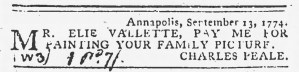
September 8

What was advertised in a colonial American newspaper 250 years ago today?

Maryland Gazette (September 8, 1774).

“IF a certain E.V. does not immediately pay for his family picture, his name shall be published at full length in the next paper.”

A private scuffle over paying for a portrait became a public spectacle when Charles Willson Peale resorted to shaming Elie Vallette, author of the Deputy Commissary’s Guide, in a newspaper advertisement.  A notice in the September 8, 1774, edition of the Maryland Gazette advised that “IF a certain E.V. does not immediately pay for his family picture, his name shall be published at full length in the next paper.”  The painter, who signed his name as “CHARLES PEALE,” was near the beginning of his career, though he had already studied with Benjamin West in London for two years and then provided his services in Annapolis for a dozen more.  Still, at the time he sought the overdue payment, he was not yet the prominent figure, one of the most influential America painters and naturalists of his era, that he would become in the decades after the American Revolution.  He gained access to the power of celebrity later in his career, but at the moment he vied with Vallette he sought to leverage public shaming as the most effective tool available.

As Martha J. King notes, Peale “obtained a commission to paint a group portrait of the Vallette family and portrayed the author seated at a table with the engraved title page of the Deputy Commissary’s Guide clearly visible in the foreground.  [His] wife and two children clustered in the picture’s right.”[1]  Vallette had extensively advertised the Deputy Commissary’s Guide in the Maryland Gazette, gaining prominence for himself and his manual for settling estates and writing wills.  Commissioning a family portrait served to further enhance his status, yet the dispute that followed did not necessarily reflect well on Vallette.  On May 28, 1774, Peale sent a letter to Vallette to request payment, explaining that he needed to cover immediate expenses that included rent on the house where his family resided.[2]  The author did not heed that request.  Three months later, Peale decided to escalate his methods for collecting on the debt, placing the advertisement that gave Vallette’s initials and enough information that the author would recognize himself and perhaps enough that some readers could work out his identity, but not so much that readers in Annapolis and throughout the colony knew without a doubt that Peale addressed Vallette.  Was this strategy effective?  Next week the Adverts 250 Project will examine the subsequent issue of the Maryland Gazette to determine whether Peale had to further escalate his demand for payment.

**********

[1] Martha J. King, “The Printer and the Painter: Portraying Print Culture in an Age of Revolution,” Transactions of the American Philosophical Society 109, no. 5 (2021): 78.

[2] King, “Printer and the Painter,” 78.

May 12

What was advertised in a colonial American newspaper 250 years ago today?

Maryland Gazette (May 12, 1774).

“I do hereby recommend [this guide] to the several deputy commissaries within this province.”

Publishing the Deputy Commissary’s Guide took more than a year.  The first advertisement, Elie Vallette’s lengthy subscription proposal, ran in the February 25, 1773, edition of the Maryland Gazette.  It featured an excerpt and notable image depicting how each copy would be personalized for the subscriber.  The original version ran for several weeks before an abbreviated version appeared; it eliminated the excerpt but retained the image.  Such visual distinctiveness made even the shorter advertisement the focal point among other newspaper notices.  In the summer of 1773, Vallette ran a new advertisement, this one featuring an endorsement from several prominent “gentlemen of the law” who testified to the “general utility” of the volume.  At that time, Vallette stated that the work “Is now in the Press, and will be speedily published.”

Yet subscribers still had to wait for their copies.  In May 1774, Vallette ran a notice to announce that The Deputy Commissary’s Guide was “JUST PUBLISHED, And ready to be delivered to the subscribers, neatly bound, at the respective places where they were subscribed for.”  Local agents in towns throughout the colony had collected subscriptions on behalf of Vallette.  He now set about sending copies to each of them to distribute, including additional copies or “a few remaining books” for “non-subscribers” who decided that they did indeed wish to purchase this helpful guide.  To aid in selling those surplus copies, Vallette included a recommendation for The Deputy Commissary’s Guide from William Fitzhugh, the colony’s commissary general.  Fitzhugh declared that he had “perused” the work and “approving of the regulations therein made … I do hereby recommend [the book] to the several deputy commissaries within this province” to aid them in a variety of their duties.  What better endorsement could Vallette and his reference guide have received?!

Vallette had no guarantee of success when he first distributed subscription proposals for The Deputy Commissary’s Guide.  Many proposed books did not gain sufficient numbers of subscribers to make them viable ventures for authors and printers.  Even after taking the book to press, Vallette still hustled to sell leftover copies.  His latest advertisement was not as lengthy or flashy as previous ones, but he likely figured that a key testimonial provided the best incentive to acquire the book once it hit the market.

August 8

What was advertised in a colonial American newspaper 250 years ago this week?

Maryland Gazette (August 5, 1773).

“Every possessor of a copy may himself enter the proper alteration or addition, agreeable to the advertisements I shall from time to time insert in the Gazette.”

In the summer of 1773, Elie Vallette placed an advertisement in the Maryland Gazette to provide an update on The Deputy Commissary’s Guide.  Intending to publish the book by subscription, he commenced a marketing campaign several months earlier.  He successfully attracted subscribers to the project, a sufficient number that the book “Is now in the Press, and will be speedily published.”  Still, Vallette continued to promote the book, hoping to gain additional subscribers to defray the costs and generate more revenue.  To that end, he once again declared that those who subscribed in advance would have their names printed on a personalized title page, but they needed “to be speedy in their application, as none but such can have their names printed in the title page.”  In the end, that particular enticement worked out a bit differently than Vallette originally described it.

The author also presented an endorsement from several prominent colonizers, all of them “gentlemen of the law” in Maryland, publishing it with their permission.  “WE have perused your manuscript, entitled ‘The deputy Commissary’s Guide,’” the lawyers wrote, “and do much approve of it; we apprehend that performance will be of general utility, and that it well deserves the encouragement of the publick.”  Even before this endorsement, the number of subscribers “increased far beyond what was conjectured” … and Vallette still had not received lists of subscribers from all of the “gentlemen who have been so obliging to take in subscriptions” throughout the colony.  Perhaps an unexpected number of subscribers played a role in Vallette ultimately altering his plans for the title page.  In this advertisement, he confided that the subscribers exceeded his original “provision.”

Vallette balanced the popularity and demand for the book with the opportunity to become a subscriber.  It was not too late!  To help convince any prospective subscribers who might have been wavering, the author revealed another feature of the book.  He planned to include “a number of blank leaves” for manuscript additions to reflect changes in the laws.  “In some few instances,” Vallette acknowledged, “the testamentary laws now existing, may, and probably will, soon undergo the revival of the legislature.”  In such instances, “every possessor of a copy [of The Deputy Commissary’s Guide] may himself enter the proper alteration or addition.”  To aid in that endeavor, the author pledged that he would place advertisements in the Maryland Gazette to guide subscribers in updating their books “whenever any such alteration shall take place.”  Vallette’s relationship with subscribers extended beyond a single transaction.  He continued to offer services after buyers received their books.

Vallette intended for each of these marketing strategies – personalized title pages, an endorsement from six prominent lawyers, and blank pages to enter alterations to current laws – to entice even more subscribers for The Deputy Commissary’s Guide.  Other authors, booksellers, printers, and publishers sometimes included recommendations from well-known figures in their advertisements for books.  The title pages and blank pages, however, represented innovative and novel techniques for encouraging prospective subscribers to reserve their own copies of the book.

April 1

What was advertised in a colonial American newspaper 250 years ago today?

Maryland Gazette (April 1, 1773).

“Every Subscriber shall have his Name and Title printed in the Title Page, in a Label adapted for that Purpose, as in the above Scheme, provided their Signature come timely to Hand.”

For several weeks in the winter and spring of 1773, subscription proposals for Elie Vallette’s Deputy Commissary’s Guide within the Province of Maryland ran in the Maryland Gazette.  When the advertisement first appeared in the February 25 edition, it filled an entire column.  An excerpt from the preface accounted for approximately half of the space required to publish the notice.  Vallette and the printers, Anne Catharine Green and Son, eventually revised the notice, eliminating the excerpt.

The advertisement retained its most distinctive feature: a “scheme” or depiction of a label to include the name, title, and county of the subscriber.  Vallette and the Greens hoped that personalizing the title page would help in selling more books, but warned that only subscribers who placed their orders early would qualify for the labels.  Those labels, however, do not seem to have been part of the book when it went to press.  Instead, subscribers (and others who eventually purchased copies or received them as gifts) received something that they likely considered even better: an engraved title page that included a blank banner.

Curious to learn more about the proposed label, I examined the four copies of the Deputy Commissary’s Guide in the collections of the American Antiquarian Society.  None of them featured the label depicted in the advertisements in the Maryland Gazette, but each of them did include a title page engraved by Thomas Sparrow.  Annotations made by catalogers and curators indicated that Sparrow also engraved currency that circulated in Maryland in the early 1770s.  In addition, those annotations also stated that the Deputy Commissary’s Guide was the first book with an engraved title page printed in America, certainly a premium for subscribers and other readers who acquired copies.

Title pages engraved by Thomas Sparrow (Elie Vallette, The Deputy Commissary’s Guide, 1774). Courtesy American Antiquarian Society.

The engraved title page certainly enhanced the book.  The blank banner allowed colonizers to further enhance their copies in whatever manner they wished to personalize the title page.  The banners in two of the copies at the American Antiquarian Society remain empty.  One has the words “TO MR. J: MACNABB* *1775*” clumsily stamped within the banner.  A handwritten note on another page reads, “The Gift of Elie Vallette to his Friend John McNabb.”  The other copy has the name “R. Tilghman” gracefully written inside the banner.

Vallette and the Greens did not supply the personalized labels that they promoted in the subscription proposals for the Deputy Commissary’s Guide.  That probably did not matter to most subscribers when they discovered the ornate and expensive engraved title page that they received instead.  The author and the printers substituted an even better premium than the one they marketed to prospective subscribers.

February 25

What was advertised in a colonial American newspaper 250 years ago today?

Maryland Gazette (February 25, 1773).

“Every Subscriber shall have his Name and Title printed in the Title Page.”

As spring approached in 1773, the printers Anne Catharine Green and Son prepared to take The Deputy Commissary’s Guide within the Province of Maryland to press.  The first advertisement for the work appeared in the February 25 edition of the Maryland Gazette.  Extending an entire column, it included several features intended to entice subscribers to reserve their copies by May 1.

Like many proposals, the advertisement explained the purpose of the book and provided a list of the contents.  In this instance, that meant publishing an excerpt from the book.  In the “PREFACE,” Elie Vallette, the author, explained that he wrote the Guide to establish “a general Uniformity in the Proceedings of Deputy Commissaries, and of assisting Executors and Administrators in the Performance of their Duties.”  He asserted that he gained valuable experience in “my Office of Register, which I have executed for Eight Years past with Application and Diligence,” and, as a result, could provide valuable advice to anyone “concerned in the Management of the Estates of deceased Persons, as Creditors, Executors, Administrators, Legatees, Relations, or in what they have to leave, as well as to claim.”  Vallette’s preface also devoted a paragraph to outlining the nine chapters and promised “a general Index to the Whole” for easy reference.

To facilitate reserving copies of the Guide, Vallette and the printers enlisted the assistance of several local agents.  According to the advertisement, “the several Deputy Commissaries in each respective County of this Province” took orders and accepted payments.  In addition, local agents in seven towns and four more in Annapolis also received subscriptions.  Customers could also contact the printing office directly.

The proposal also described the material aspects of the book and gave prices.  The printers planned to issue “one large Octavo Volume, containing about Three Hundred Folios” for ten shillings.  They also hoped to procure a bookbinder.  If they managed to do so, “the Volume will be neatly bound in Calf, gilt, and lettered.”  That would increase the price by “an additional half Crown.”

Vallette and the printers also promoted a special feature: subscribers would receive personalized copies “provided their Signature comes timely to Hand.”  Each customer who subscribed early enough “shall have his Name and Title printed in the Title Page, in a Label adapted for that Purpose.” The advertisement included an image of that label.  It featured a decorative border made of printing ornaments enclosing the words “FOR MR.” with space to fill in the name and title of the subscriber and the word “County” to appear after the subscriber’s location.  The image of the label likely helped to draw attention to the advertisement.  Readers then discovered the value added by personalizing copies they ordered in advance.

This lengthy advertisement deployed a variety of marketing strategies to convince consumers to reserve copies of the Deputy Commissary’s Guide.  An excerpt from the book explained the author’s purpose and credentials and provided an overview of the contents.  That included describing the chapters and drawing attention to the index.  A list of local agents directed customers where to place their orders.  The printers described the size of the book and the number of pages.  They also indicated that they hoped to hire a bookbinder and gave prices for unbound and bound copies.  Finally, the advertisement offered the option of personalizing the title page, including an image of the label, but only if prospective customers acted quickly to reserve their copies.  Vallette and the Greens ran a sophisticated campaign to promote this book.