November 5

What was advertised in a colonial American newspaper 250 years ago today?

New-London Gazette (November 5, 1773).

“HAVING perused all the most material parts of Mr. Gale’s manuscript copy of the complete surveyor, I beg leave to recommend it.”

Samuel Gale, the deputy surveyor general of New York, tried once again.  He had written a manual, “the COMPLEAT SURVEYOR,” that he wished to publish, but first he needed to find a sufficient number of subscribers to make it a viable venture for both the author and the printer, presumably Hugh Gaine in New York.  Gale had previously advertised in Gaine’s newspaper, the New-York Gazette and Weekly Mercury, in June 1773.  In November, he placed an advertisement with identical copy in the New-London Gazette.  It filled nearly an entire column, starting in one and overflowing into another.

Approximately half of the lengthy advertisement consisted of five “RECOMMENDATIONS” for the proposed book. William Alexander, the Earl of Stirling, a member of the American Philosophical Society in Philadelphia, stated that the manual “will be a very useful work to most of the surveyors in North-America, as well as others who are desirous of making themselves acquainted with both the theory and part of that art.”  Alexander Colden, the Surveyor General of New York, testified that he “perused such parts of Mr. Gale’s manuscript copy, as relates to practical surveying in America (which has been omitted in the former authors) and I find it well handled, and worthy of the encouragement of the public.  Similarly, David Rittenhouse, a prominent astronomer, mathematician, and surveyor in Philadelphia, reported that he read the manuscript and “recommend it as a work, in my opinion, well deserving the encouragement of the public.”  John Lukens, the Surveyor General of Pennsylvania, asserted that the work “deserves public encouragement” because “the rules therein laid down in practical surveying, … especially that part relating to surveying our rough lands in America, may be of great advantage to those concerned in surveying, as well as others.” John A. De Normandie, a prominent physician and scientist, proclaimed that Gales’s “rules are extremely good, and his demonstrations easier and better adapted to the understanding of mankind, than any I have ever met with.”  The first four of those testimonials also appeared on a handbill that Gale distributed the previous year.

New-London Gazette (November 5, 1773).

In addition to these endorsements, Gale recruited printers and other local agents to collect subscriptions in more than a dozen cities and towns from Boston to Savannah.  Those included Timothy Green, the printer of the newspaper carrying the surveyor’s subscription proposal.  Gale also indicated that “all the Booksellers and Printers in America and the West-India Islands” accepted and forwarded subscriptions.  Anyone who wished to contact Gale directly could do so “by applying to Hugh Gaine, at New York.”

Gale managed to enlist some subscribers but still needed to entice more.  His advertisement served as an update for “the PUBLIC in general, and to the SUBSCRIBERS in particular,” alerting them that he had “not yet been favoured with a sufficiency of the subscribers to enable me to carry it into immediate execution, without running too great a hazard.” He needed to entice more subscribers among the “well-wishers to mathematical learning among the public.” Apparently, Gale did not manage to do so, despite his advertisements in the New-York Gazette and Weekly Mercury and the New-London Gazette, his handbill, the endorsements for his manual, and the network of local agents collecting subscriptions.  The surveyor deployed a variety of marketing strategies, but that did not guarantee success.

June 28

What was advertised in a colonial American newspaper 250 years ago today?

New-York Gazette and Weekly Mercury (June 28, 1773).

I have not yet been favoured with a sufficiency of subscribers to enable me to carry it into immediate execution.”

Samuel Gale, the author of The Complete Surveyor, looked for subscribers to publish his work for more than a year.  He distributed a handbill with the dateline “PHILADELPHIA, MARCH 12th, 1772,” to advise those who already subscribed for copies of the book that even though he already collected two hundred subscribers on his own and expected to receive others from local agents in other cities and towns “the number in the whole falls considerably short of my expectations.”  Furthermore, he anticipated that “this work will be large, and the expence of printing it considerably greater than would be defrayed by the present number of subscribers.”  Accordingly, others had advised him “to delay the printing of it a little longer” out of concerns that he “might perhaps be a loser by proceeding too hastily.”  In other words, Gale received sound advice that he would likely incur expenses that he could not pay if he took the book to press without enough subscribers to defray the costs.

To that end, he hoped “for many Gentlemen in America, to encourage this publication” by becoming subscribers or, if they had already subscribed, recruiting other subscribers.  To reassure prospective subscribers of the quality of The Complete Surveyor, Gale asserted that the “Manuscript Copy has met with the approbation of some of the best judges of these matters in America,” including William Alexander, the Earl of Stirling, a member of the American Philosophical Society in Philadelphia; Alexander Colden, the Surveyor General of New York; David Rittenhouse, a prominent astronomer, mathematician, and surveyor in Philadelphia; and John Lukens, the Surveyor General of Pennsylvania.  Gale inserted short testimonials from each of these supports below a heading that called attention to “RECOMMENDATIONS OF THE ABOVE WORK.”  In addition, he hoped to entice subscribers by promising to insert an “Essay on the Variation of the Needle, written by the late Mr. LEWIS EVANS,” a renowned Welsh surveyor and geographer who published the General Map of the Middle British Colonies in America in 1755.  Gale concluded the handbill with a list of local agents who accepted subscriptions in a dozen towns from Boston to Savannah.  In addition, he declared that “all the Booksellers and Printers in America” accepted subscriptions.

Apparently, such an extensive network did not yield a sufficient number of subscribers.  At the end of June 1773, more than fifteen months later, Gale ran an advertisement in the New-York Gazette and Weekly Mercury.  He once again stated that the “manuscript copy has met with the greatest approbation,” yet “I have not yet been favoured with a sufficiency of subscribers to enable me to carry it into execution, without running too great a hazard.”  He requested that those who already subscribed give him a few more months to solicit subscribers among “the other well-wishers to mathematical learning among the public.”  He included the endorsements that previously appeared on the handbill and an even more extensive list of local agents, concluding with a note that “all the Booksellers and Printers in America and the West-India Islands” forwarded subscriptions to him.

Despite his best efforts, Gale never managed to attract enough subscribers to publish the book.  A note in the American Antiquarian Society’s catalog entry for the handbill states that “an insufficient number of subscriptions were received to encourage publication.”  Gale circulated advertising materials in more than one format, deployed testimonials from prominent experts in his field, offered a bonus essay as a premium, and made it convenient to subscribe via local agents throughout the colonies.  He developed a sophisticated marketing campaign, but it ultimately fell short of inciting sufficient demand for the book he wished to published.

Samuel Gale’s handbill promoting The Complete Surveyor. Courtesy Historical Society of Pennsylvania.

August 20

What was advertised in a colonial American newspaper 250 years ago today?

Aug 20 - 8:20:1767 Pennsylvania Gazette
Supplement to the Pennsylvania Gazette (August 20, 1767).

“A considerable number of rolling screens for cleansing wheat.”

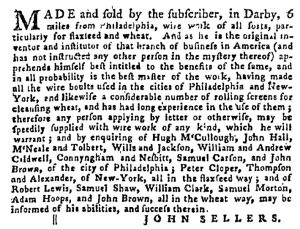
John Sellers and Richard Truman both advertised their “SCREENS for cleaning all sorts of Grain” in the August 20, 1767, issue of the Pennsylvania Gazette. Truman devoted more than half of the space in his notice to a woodcut depicting a machine that used one of the screens he made. This strategy likely garnered a fair amount of attention since visual images were relatively rare in eighteenth-century newspapers; even the most humble woodcuts distinguished the advertisements they adorned from the vast majority of others.

Sellers purchased the same amount of space, but, like most advertisers, densely filled it with text. He used that space to develop two marketing strategies: an appeal to unparalleled expertise in his field and roll call of existing customers who could testify to his abilities and their experience using the screens he made.

Sellers not only “MADES and sold” screens for cleaning flaxseed and wheat, he claimed to be “the original inventor and institutor of that branch of business in America.” Furthermore, he protected his trade secrets by not sharing his techniques with anyone else. As evidence that former customers recognized the quality and utility of his “wire work of all sorts,” Sellers argued that he had made “all the wire boults used in the cities of Philadelphia and New-York” as well as a “considerable number” of rolling screens akin to those advertised by Truman. Due to his “long experience” and status as “the best master of the work,” he believed that he was “best intitled” to the patronage of those who needed to purchase such equipment.

Potential customers did not need to take Sellers’ word. Instead, he listed eight associates in Philadelphia and another eight in New York, encouraging readers to enquire of them for further endorsements. Realizing that consumers would rightfully be skeptical of what amount to nothing more than braggadocio, Sellers made it possible for them to independently verify his claims by speaking with satisfied customers.

Without a woodcut decorating his advertisement, John Sellers instead worked to convince potential customers of the superiority of his product over others marketed and sold by his competitors. Richard Truman’s advertisement was rudimentary in comparison. It included an eye-catching visual image, but did little beyond announcing that he sold fans and screens for cleaning grains. In contrast, Sellers explained why customers should prefer the products he made and sold. In addition, he directed them to satisfied customers who could speak authoritatively about his screens.