January 10

What was advertised in a revolutionary American newspaper 250 years ago today?
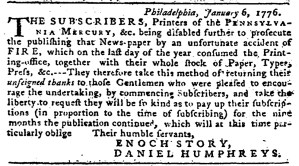
Pennsylvania Gazette (January 10, 1776).

“Disabled further to prosecute the publishing that News-paper by an unfortunate accident of FIRE.”

As the imperial crisis intensified, Enoch Story and Daniel Humphreys launched the Pennsylvania Mercury (quickly renamed Story and Humphreys’s Pennsylvania Mercury) on April 7, 1775.  That newspaper joined two others founded earlier in the year, the Pennsylvania Evening Post on January 24 and the Pennsylvania Ledger on January 28, as well as Dunlap’s Pennsylvania Packet, the Pennsylvania Gazette, the Pennsylvania Journal, and the Wochentliche Pennsylvanische Staatsbote.  During the first four months of 1775, Philadelphia surpassed Boston in terms of the number of newspapers printed there.  With the outbreak of hostilities at Lexington and Concord on April 19 and the ensuing siege of Boston, several of Boston’s newspapers ceased publication or relocated to other towns.

Yet Boston was not the only major port city that saw one of its newspapers cease publication during the first year of the Revolutionary War.  Story and Humphreys’s Pennsylvania Mercury lasted less than a year, though disruptions caused by the war did not lead to its demise.  Unfortunately, “an unfortunate accident of FIRE … consumed the Printing-office, together with their whole Stock of Paper, Types, Press,” and other equipment on December 31.  The situation did not leave any possibility for the partners to recover and eventually resume publication.  “[B]eing disabled further to prosecute the publishing [of] that News-paper,” they announced in an advertisement in the Pennsylvania Gazette, they instead expressed “their unfeigned thanks” to the subscribers who had supported the venture and requested that they “will be so kind as to pay up their subscriptions (in proportion to the time of subscribing) for the nine months the publication continued.”  In other words, they expected customers to make prorated payments based on the number of issues they received.  Humphreys eventually tried again, but not until after the Revolutionary War.  On August 20, 1784, he commenced publishing a new Pennsylvania Mercury.

Even with the loss of Story and Humphreys’s Pennsylvania Mercury, Philadelphia still had more newspapers than any other city or town in the colonies.  As the war continued, not all of them survived.  Some closed permanently while others moved to other towns or suspended publication during the British occupation of Philadelphia.  Yet, as the “unfortunate accident of FIRE” at Story and Humphreys’s printing office demonstrated, disruptions caused by the war were not the only dangers that forced newspapers to fold.

October 11

What was advertised in a colonial American newspaper 250 years ago today?

Essex Gazette (October 11, 1774).

“LOST at the Fire on Wednesday Night last … the following Pieces of Merchandise.”

The October 11, 1774, edition of the Essex Gazette included coverage of a fire in Salem on October 6.  The conflagration destroyed the homes of several families as well as the shops and stores of more than a dozen merchants and shopkeepers.  In addition, the fire consumed a meeting house and the customs house.  Samuel Hall and Ebenezer Hall, the printers of the Essex Gazette, lost their printing office.  Just below the article about the fire, they inserted a notice alerting the public that they had relocated.  The Halls also reported that “Great Quantities of Goods, House Furniture and Papers of Value were lost, stole and destroyed in the Confusion and Destruction occasioned by the Fire; but it is impossible to obtain Accounts from the several Sufferers, sufficiently accurate to publish at this Time.”

That did not prevent others from publishing more information about the fire, either as letters to editors or by taking out advertisements that supplemented the coverage provided by the Halls.  One letter, for instance, noted that “the Sufferers in the late Fire in this Town, and others whose Goods were removed, still miss great Quantities of their Furniture and Goods.”  Such items clearly had not been misplaced and would soon be recovered as the confusion subsided and the town recovered; instead, the anonymous author asserted that goods and personal property “were stolen by the hardened Villains who ever stand ready to make their Harvest at such Times of Danger and Distress.”  Furthermore, those “Miscreants, in the Form of Pedlars, will doubtless be hawking these Goods about the Country,” capitalizing on the misfortune of others.  The letter concluded with a call for “well disposed People” to identify and imprison the thieves and encouraging justices of the peace to invoke existing laws to regulate peddlers to make sure they did not sell stolen goods when they “stroll[ed] about the Country.”

Nathaniel Sparhawk was among those with missing goods following the fire.  In an advertisement, he listed and described “Pieces of Merchandise” he “LOST at the Fire.”  He offered a reward to “Whoever will bring the above Articles or any of them” to him.  In a nota bene, he added, “No Questions will be asked.”  In other words, he only sought to recover goods apparently looted during the fire, choosing to give the benefit of the doubt that they had been removed to save them.  In exchange for that polite fiction, he would not prosecute anyone whose conscience (or the reward) prompted them to return the items.  He hoped that a reward given without questions or the possibility of prosecution would seem more attractive than whatever thieves might earn if they risked selling or fencing the stolen items.

Other advertisements also provided additional information about the fire.  One offered “300 Dollars Reward” to anyone who “will give Information” that the fire “was kindled with Design.”  Many residents believed the fire had been set intentionally.  Anyone who could prove that was the case would receive the reward “on Conviction of the Perpetrator or Perpetrators.”  Henry Putnam, who lost his shop in the fire, feared that he was a suspect.  In his own advertisement, he reported that “some ill-minded Person or Persons” spread “false Reports … intimating that there was reason to suspect that I had been guilty of the horrid Crime of being the Occasion of the late terrible Fire.”  Doing what he could to combat such gossip, he harnessed the power of the press to inform the public, especially “People at a Distance” who might hear such rumors, that “the People of this Place are fully convinced that the Reports are false and groundless.” Putnam defended his reputation in print, hoping to reach people who heard tales that spread by word of mouth.

Readers of the Essex Gazette pieced together a more complete account of the fire and its aftermath when they consulted the coverage written by the printers, the letter to the editors, and the advertisements.  As was often the case in colonial newspapers, advertisements delivered news that supplemented information that appeared elsewhere.  In this instance, the advertisements appeared in the next column, immediately to the right of the news, helping readers to make connections among the different kinds of reporting.

January 29

What was advertised in a colonial American newspaper 250 years ago today?

Providence Gazette (January 29, 1774).

“Had the Fire got to any Height, it would have raged to an unknown Degree, for Want of Buckets to supply the Engines.”

Newspaper advertisements often delivered local news that did not appear elsewhere in the publication.  Such was the case in the wake of a fire in Providence that took place on January 21, 1774.  The following day the Providence Gazettereported, “Yesterday Evening the Town was alarmed by the Cry of Fire, which proved to be in the Pot-Ash Works, on the West Side of the Bridge; but by timely Assistance it was suppressed before much Damage had ensued.”  John Carter, the printer, downplayed the danger, perhaps unintentionally.  He did not have much time to gather information about the fire before the newspaper went to press, so important details did not appear in the Providence Gazette until the next issue.  When they did, they ran among the paid notices rather than in the news that Carter compiled.

On January 29, the newspaper carried an advertisement that transmitted an “Order of the Engine-Company, No. 1,” to residents of the town.  The dateline indicated it had been written the day after the fire, the same day as the previous issue of the Providence Gazette, but too late to appear in the weekly publication.  “WHEREAS it was observed at the Place of the Fire last Evening,” the advertisement proclaimed, “that the greater Part of the People attending had no Buckets; and it is generally thought, that had the Fire got to any Height it would have raged to an unknown Degree, for Want of Buckets to supply the Engines: Therefore all Families, for their own Preservation, are required to provide themselves with Buckets immediately.”  Carter’s initial reporter emphasized “timely Assistance” that “suppressed” the fire “before much Damage had ensued,” but this subsequent advertisement underscored how catastrophic the fire could have been as a result of so many residents not being prepared to provide the right kind of assistance.  Not only had they been negligent, they also disregarded a local ordinance.  The Engine Company instructed “all Families” to acquire buckets so they could provide aid in the future not only “for their own Preservation” but also to “avoid the Penalty of the Law.”  The advertisement concluded with a warning about “an Examination being intended to be made throughout the Town, and the Law put into Execution.”

Those details likely spread by word of mouth in the week between the fire and the advertisement running in the Providence Gazette, so Carter may not have considered it necessary to include the additional details among the local news.  In addition, having received the Engine Company’s advertisement in the printing office, he probably thought it a sufficient update.  Readers who lived at any distance would have been less likely to hear that so many people who showed up to the fire could not assist in putting it out because they did not bring buckets, so the advertisement did indeed present new news to them.  As was so often the case, collating information in news articles and advertisements yielded more complete coverage of local events.