September 24

What was advertised in a colonial American newspaper 250 years ago today?
Providence Gazette (September 24, 1774).

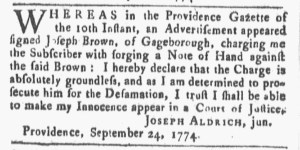
“I am determined to prosecute him for the Defamation.”

Defamation!  That was the defense Joseph Aldrich, Jr., made against allegations that appeared in the September 10, 1774, edition of the Providence Gazette.  The original accusation and Aldrich’s response both ran as advertisements.  It started with one that read, “I JOSEPH BROWN, of Gageborough, in the County of Berkshire, and Province of the Massachusetts-Bay, give this public Notice, that Joseph Aldrich, jun. of Gloucester, in the County of Providence, hath forged or counterfeited a Note of Hand against me the said Joseph Brown, for Ninety odd Pounds Lawful Money.”  The notice offered a warning: “All Persons are therefore cautioned against taking any Assignment of said Note, as I am determined to prosecute for the Forgery, instead of paying the Contents.”

Aldrich apparently did not become aware of what Brown charged right away since he did not respond in the next issue of Providence Gazette, but not much time passed before he either read Brown’s advertisement or someone told him about it. That spurred the aggrieved Aldrich into action.  He placed his own advertisement that cited the notice “charging me the Subscriber with forging a Note of Hand against the said Brown” and asserting that “the Charge is absolutely groundless.”  Just as Brown stated that he intended to take the matter to court, so did Aldrich.  “I am determined to prosecute him for the Defamation,” he declared, confident that “I shall be able to make my Innocence appear in a Court of Justice.”

Yet it was not a “Court of Justice” that mattered immediately; it was the court of public opinion that Aldrich sought to sway.  Brown had damaged his reputation, perhaps imperiling his ability to conduct business and support his family.  For Aldrich, the most important news in the September 10 edition of the Providence Gazette appeared among the advertisements, not among the articles and editorials that so animated readers as the imperial crisis intensified.  Paying to run a notice gave Brown access to the public prints to share his version of events involving the supposedly forged and counterfeit note.  In turn, taking out his own notice allowed Aldrich to defend himself against that calumny.  In both instances, advertisements doubled as local news.
August 6

What was advertised in a colonial American newspaper 250 years ago today?

Providence Gazette (August 6, 1774).

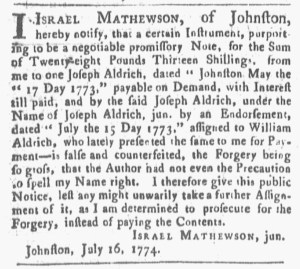
“The Forgery being so gross, that the Author had not even the Precaution to spell my Name right.”

As readers flipped through the August 6, 1774, edition of the Providence Gazette, they encountered news and editorials on the first three pages, followed by advertisements in the final column on the third page and filling the entire final page.  The news and editorials included an “Address to the Citizens of New-York on the present critical Situation of Affairs … here inserted by Request” signed by “ANGLUS AMERICANUS,” a letter from London’s Morning Post addressed to Lord North, the prime minister, by “A SOLDIER,” and updates from Paris, London, Philadelphia, New York, and Boston.  The short section for news with the header “PROVIDENCE, August 6” relayed six items, including a note that “the Honourable JAMES BOWDOIN, Esq; of Boston, one of the Delegates appointed for the General Congress,” now known as the First Continental Congress, “passed through this Town” two days earlier “on a Journey Southward.”  Most of those items did not relate to local news at all; instead, they drew from reports received in Providence.  For instance, the final item mentioned “a provincial Meeting of Deputies, from the several Counties of Pennsylvania, … held at Philadelphia” with a promise to print the “Resolves and Proceedings” in the next issue.

Providence Gazette (August 6, 1774).

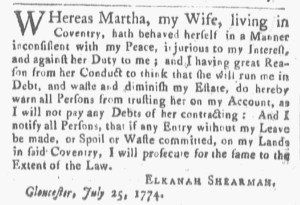
That did not mean that the Providence Gazette did not carry local news.  Indeed, the advertisements, including legal notices, kept readers updated about some of what was occurring in Providence and nearby towns.  In Johnston, Israel Mathewson, Jr., contended with a case of fraud and sought to warn the public against becoming victims of an unscrupulous forger.  He described a “negotiable promissory Note, for the Sum of Twenty-eight Pounds Thirteen Shillings, from me to one Joseph Aldrich.”  That instrument, Mathewson exclaimed, “is false and counterfeited, the Forgery being so gross, that the Author had not even the Precaution to spell my Name right.”  He cautioned others not to “unwarily” accept the note because “I am determined to prosecute for the Forgery, instead of paying the Contents.”  Reading that news among the advertisements in the Providence Gazette had the potential to prevent trouble and inconvenience.  In another notice, Elkanah Shearman of Glocester revealed discord within his household, asserting that his wife, Martha, then “living in Coventry, hath behaved herself in a Manner inconsistent with my Peace, injurious to my Interest, and against her Duty to me.”  He feared that she “will run me in Debt” as well as “diminish my Estate.”  Accordingly, he issued instructions that he would pay “any Debts of her contracting,” expecting merchants, shopkeepers, and other purveyors of goods and services to take note.  Furthermore, he threatened to prosecute for any “Spoil or Waste” on his land or even “Entry without my Leave.”  Martha did not possess any authority to grant access on behalf of her husband.  Her husband expected others to take note of this news.

Several other advertisements delivered local news to readers of the Providence Gazette.  Although John Carter, the printer, limited the amount of local news he selected to publish under the header “PROVIDENCE, August 6,” that did not mean that the newspaper did not contain news from nearby towns.  Advertisers placed notices for a variety of purposes, many of them delivering news in an alternate format.

June 17

What was advertised in a colonial American newspaper 250 years ago today?

Rivington’s New-York Gazetteer (June 17, 1773).

“A Rogue!  A Rogue!  A Rogue!”

The headline set one advertisement apart from others that appeared in the June 17, 1773, edition of Rivington’s New-York Gazetteer.  Some of those others had headlines like “TO BE SOLD,” “IMPORTED,” “TO BE LETT,” or “WANTED.”  Many deployed the name of the advertiser as the headline, including “ABRAHAM DURYEE,” “ENNIS GRAHAM,” “THOMAS HAZARD,” and “JOSEPH PEARSALL.”  Even the printer used his own name, “JAMES RIVINGTON,” as the headline for his advertisement.  A few headlines provided more specific details, such as “DELAWARE LOTTERY,” “HORSEMANSHIP,” “INDIGO,” “THEATRE,” and “WATCHES.”

One distinctive advertisement paired two headlines, “FIVE POUNDS REWARD” and “A Rogue!  A Rogue!  A Rogue!” The first frequently appeared in advertisements describing and offering rewards for the capture and return of apprentices and indentured servants who ran away from their masters and enslaved people who liberated themselves from their enslavers.  In contrast, the repetition of “A Rogue!  A Rogue!  A Rogue!” set the advertisement apart from any of the others and likely demanded the attention of readers, inciting curiosity about what kind of offenses merited such a headline.

When they set about learning more, readers discovered that the rogue was an “atrocious villain, known by the name of Isaac Vanden Velden” who had recently “imposed on several persons in this city, with bills of exchange, which he has forged in the name of Mr. Paul Hogstraffer, of Albany.”  Even before those incidents, Vanden Velden had a reputation for misconduct in both Philadelphia and Albany, according to the advertisement, and sometimes “pretends to have large rights in land on the Mississippi.  The con artist “talks fast, and affects a good deal of propriety in his conversation,” so much so that he “has a very good address, and appears capable of executing any artful piece of fraud.”  Readers might detect Vander Velden, “a German,” from his speech; although he “speak good English,” he retained “a little of his own country accent.”

A nota bene indicated that the rogue was headed in the direction of Philadelphia.  Given the circulation of Rivington’s New-York Gazetteer well beyond the city, the advertiser hoped that readers put on alert about Vanden Velden would capture and “secure the above impostor in any of his Majesty’s jails, so that he may be brought to justice.”  In this instance, the advertisement with its extraordinary headline served as a public service announcement and a supplement to the news that ran elsewhere in the newspaper.

September 30

What was advertised in a colonial American newspaper 250 years ago today?

Sep 30 - 9:30:1769 Providence Gazette
Providence Gazette (September 30, 1769).

“Advertise the said William Hambleton Scholar as a notorious Cheat.”

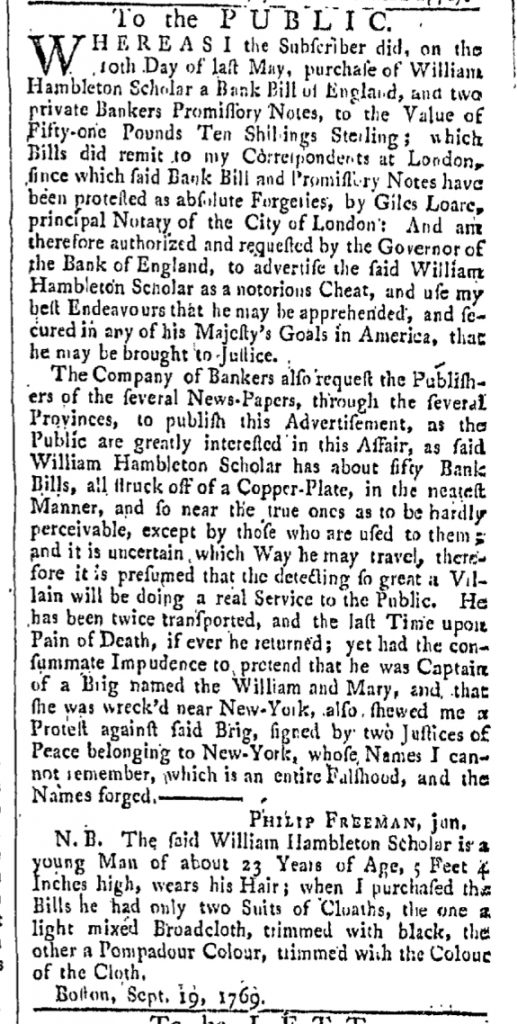
Advertisement or news article? An item that appeared in the September 30, 2019, edition of the Providence Gazette raises interesting questions about its purpose. Extending half a column, it detailed the activities of William Hambleton Scholar, a confidence man who had defrauded Philip Freeman, Jr., of “Fifty-one Pounds Ten Shillings Sterling” through the sale of “a Bank Bill of England, and two private Bankers Promissory Notes.” All three financial devices were forgeries. It took Freeman some time to learn that was the case. He had purchased the bank bill and promissory notes in May and remitted them to associates in London, only to learn several months later that Giles Loare, “principal Notary of the City of London” declared them “absolute Forgeries.”

In response, officials from the Bank of England “authorized and requested” that Freeman “advertise the said William Hambleton Scholar as a notorious cheat.” They instructed Freeman to act on their behalf to encourage the apprehension of the confidence man. To that end, “[t]he Company of Bankers also request the Publishers of the several News-Papers, through the several Provinces, to publish this Advertisement.” Freeman asserted that the public was “greatly interested in this Affair,” but also warned that Scholar had another fifty bank bills “all struck off of a Copper-Plate, in the neatest Manner, and so near the true ones as to be hardly perceivable.” The narrative of misdeeds concluded with a description of the confidence man, intended to help the public more easily recognize him since “it is uncertain which Way he may travel.”

Was this item a paid notice or a news article? Freeman referred to it as an “Advertisement,” but “advertisement” sometimes meant announcement in the eighteenth-century British Atlantic world. It did not necessarily connote that someone paid to have an item inserted in the public prints. The story of Scholar and the forged bank bills appeared almost immediately after news items from New England, though the printer’s advertisement for a journeyman printer appeared between news from Providence and the chronicle of the confidence man’s deception. No paid notices separated the account from the news, yet a paid notice did appear immediately after it. This made it unclear at what point the content of the issue shifted from news to paid notices. The following page featured more news and then about half a dozen paid notices. Perhaps the printer had no expectation of collecting fees for inserting the item in his newspaper, running it as a service to the public. It informed, but also potentially entertained readers who had not been victims of Scholar’s duplicity. That the “Advertisement” interested readers may have been sufficient remuneration for printing it in the Providence Gazette.