September 28

What was advertised in a revolutionary American newspaper 250 years ago today?

New-York Journal (September 28, 1775).

“The Words of Command used in the Manual Exercise, and an accurate Plan of Boston.”

Almost simultaneously with Hugh Gaine announcing in the New-York Gazette and Weekly Mercury that he had “Just PUBLISHED … HUTCHIN’s Improv’d; BEING AN ALMANACK … For the Year of our LORD 1776,” Frederick Shober and Samuel Loudon inserted an advertisement in the New-York Journal to alert the public that they had “Just published … The NEW-YORK and COUNTRY ALMANACK, For the Year of our Lord 1776.”  It included “all the necessary Articles usual in an Almanac, with the Addition of many curious Anecdotes, Receipts [or Recipes], [and] poetical Pieces.”  Unlike Gaine, Shober and Loudon did not provide an extensive list of the contents.  As printer of the New-York Gazette and Weekly Mercury, Gaine had access to as much space as he wished to devote to promoting an almanac he published.  Shober and Loudon, on the other hand, paid to run their advertisement in the New-York Journal.

The partners did, however, specify two items that they wanted prospective customers to know they would find in the New-York and Country Almanack: “the Words of Command used in the Manual Exercise, and an accurate Plan of Boston with the different Situations of the Provincials, and the Ministerial Armies.”  Both reflected current events.  The “REFERENCES TO THE PLAN” (or legend for the map of Boston) in the almanac highlighted the “Battle of Lexington, 19th of April,” and the “Battle of Bunker’s-Hill, 17th of June.”  For readers beyond Massachusetts who did not directly experience those battles, that helped solidify in their minds the dates that they occurred.  By the time that Shober and Loudon took their almanac to press, maps of Boston had circulated widely in the July issue of the Pennsylvania Magazine (and Loudon had been among the booksellers to advertise them).  Nicholas Brooks and Bernard Romans also collaborated on a map that they likely distributed by the end of summer.  Those may have served as models for the “Plan of Boston” that Sober and Loudon commissioned for their almanac.  Gaine also directed attention to the “beautiful Plan of Boston, and the Provincial Camp” in his almanac.  The “whole Process of making SALT PETRE, recommended by the Hon. the Continental Congress” and a “Method of making Gun-Powder” accompanied their map.  In Shober and Loudon’s almanac, the “Words of Command,” taken from the widely published Manual Exercise, supplemented the map.  In both cases, the events of the Revolutionary War inspired the contents of the almanacs and became selling points in marketing them.
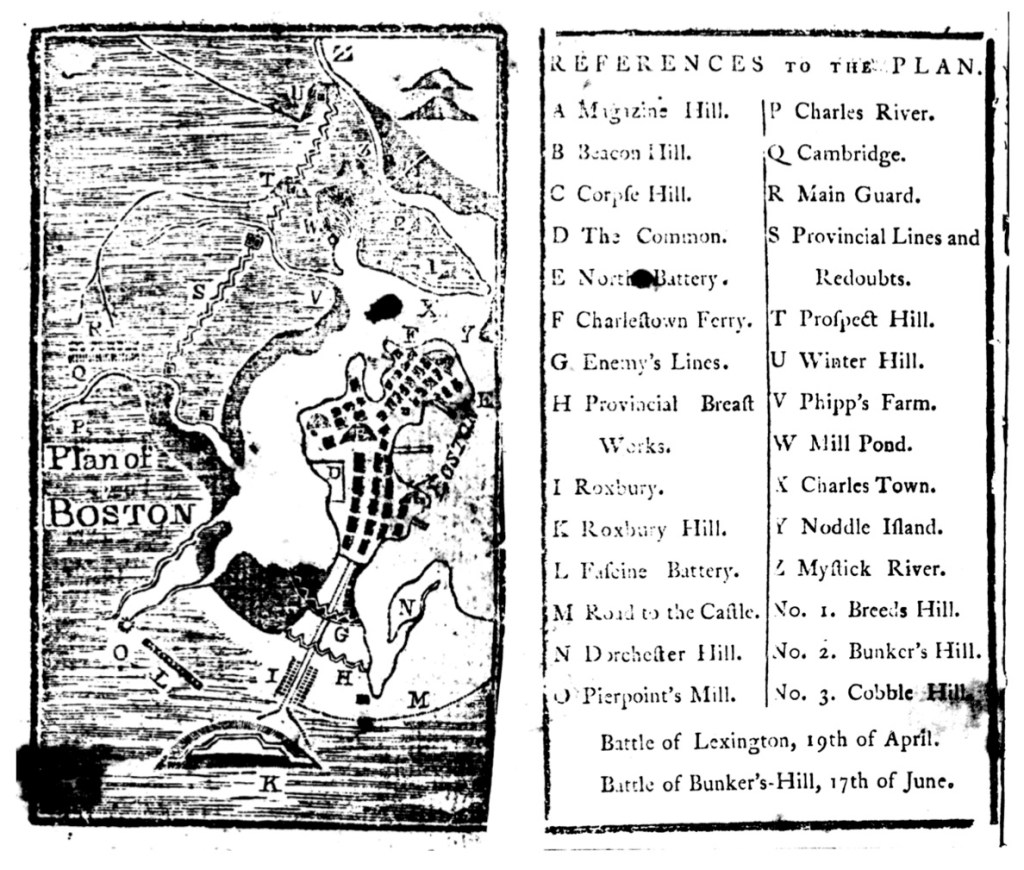
“Plan of Boston” [left] and “References to the Plan” [right], in The New-York and Country Almanack for the Year of Our Lord 1776 (New York: Shober and Loudon, 1775). Courtesy American Antiquarian Society.

November 8

What was advertised in a colonial American newspaper 250 years ago this week?

Maryland Gazette (November 5, 1772).

“Intend shortly to exhibit Proposals for publishing a NEWS-PAPER.”

Robert Hodge and Frederick Shober took to the pages of the Maryland Gazette, published in Annapolis, in the fall of 1772 to advise prospective customers that they did “PRINTING In all it’s DIFFERENT BRANCHES … with the greatest neatness, accuracy and dispatch” at their “NEW PRINTING-OFFICE” in Baltimore.  At the time, the Maryland Gazette was the only newspaper published in the colony, so it served Baltimore as well as Annapolis.

Hodge and Shober, however, had plans for establishing their own newspaper in Baltimore.  They declared that they “intend shortly to exhibit Proposals for publishing a NEWS-PAPER, which shall be justly entitled to the Attention and Encouragement of this FLOURISHING TOWN and PROVINCE, both for ENTERTAINMENT and ELEGANCE.”  They were not the only entrepreneurs to decide that Baltimore seemed ready for its first newspaper.  A week earlier, the Maryland Gazette carried an extensive subscription proposal in which William Goddard announced his plans to publish “THE MARYLAND JOURNAL, AND BALTIMORE ADVERTISER … as soon therefore as I shall obtain a sufficient Number of Subscribers barely to defray the Expence of the Work.”  In a market that did not yet have one newspaper, Hodge and Shober competed with Goddard in their efforts to launch two newspapers simultaneously.

Neither met with immediate success.  Goddard, who was already printing the Pennsylvania Chronicle at the time he published his subscription proposal, did not manage to take the Maryland Journal to press until August 20, 1773, ten months after he announced his plans for the newspaper.  Hodge and Shober never published a newspaper.  In his monumental History of Printing in America (1810), Isaiah Thomas notes that the partners purchased “printing materials” in 1772 and “began business in Baltimore, where they intended to have published a newspaper; but, not meeting with the encouragement they expected, before the end of the year they left Baltimore, and settled in New York.”[1]  A variety of factors likely contributed to their decision to relocate.  Competing with Goddard for subscribers to Baltimore’s first newspaper probably did not help their prospects in the city.

After Goddard commenced publication of the Maryland Journal, Baltimore did gain a second newspaper less than two years later.  John Dunlap, printer of the Pennsylvania Packet, established Dunlap’s Maryland Gazette; or the Baltimore General Advertiser on May 2, 1775.  James Hayes, Jr., seems to have operated the publication on Dunlap’s behalf for three years before acquiring it for himself and changing the name to the Maryland Gazette, and Baltimore General Advertiser on September 15, 1778.  Hodge and Shober were just a few years too early in their efforts, though the war almost certainly played a role in inciting interest to establish more than one newspaper in Baltimore.  Under those difficult circumstances, however, Hayes removed to Annapolis just four months later.  Baltimore did not have a second newspaper of any longevity until after the war.[2]

**********

[1] Isaiah Thomas, The History of Printing in America: With a Biography of Printers & an Account of Newspapers (1810; New York: Weathervane Books, 1970), 480.

[2] See entries in Clarence Brigham S. Brigham, History and Bibliography of American Newspapers, 1690-1820 (Worcester, Massachusetts: American Antiquarian Society, 1947) and Edward Connery Lathem, Chronological Tables of American Newspapers, 1690-1820 (Barre, Massachusetts: American Antiquarian Society and Barre Publishers, 1972).