April 11

What was advertised in a revolutionary American newspaper 250 years ago today?
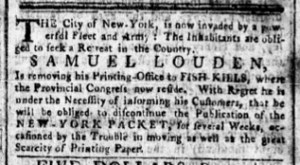
New-York Packet (April 11, 1776).

Just Published … by SAMUEL LOUDON.”

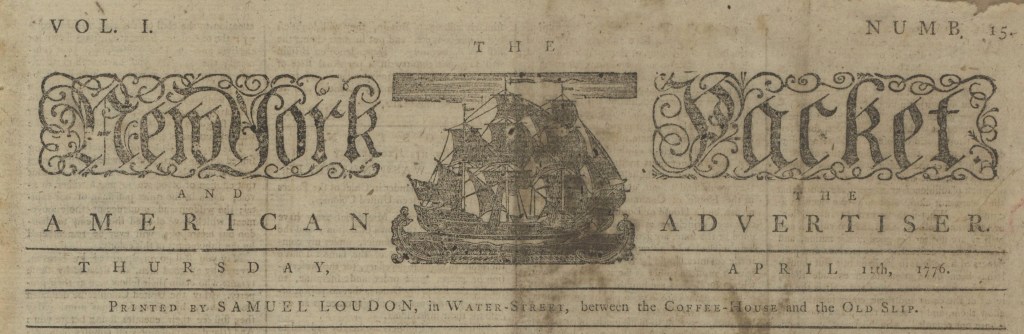
Samuel Loudon launched a new newspaper, the New York Packet, on January 4, 1776.  It lasted for about eight months before closing down just before the British occupation of New York.  The Adverts 250 Project featured subscription proposals for the newspaper that ran in the Connecticut Journal and the Pennsylvania Gazette on December 27, 1775, and an announcement that Loudon “published the first Number of his News Paper” that ran in the New-York Journal on January 11, 1776.  In that latter entry, I stated that “surviving issues have not been digitized for greater access, so advertisements and other content from the New-York Packet will not appear in the Adverts 250 Project.”  I have since learned that the New York Packet has indeed been digitized and made available via the Library of Congress’s Chronicling America: Historic American Newspapers.  When I discovered it there, I also learned that advertisements referred to the newspaper as the New-York Packet (hyphenating “New-York” like other newspapers published during the era of the American Revolution) yet the elaborate script in the masthead presented it as the New York Packet (without the hyphen).

New-York Packet (April 11, 1776).

Throughout the decade I have been producing the Adverts 250 Project, I have relied on four databases of digitized eighteenth-century American newspapers.  Archives of Maryland Online, sponsored by the Maryland State Archives, provides access to issues of the Maryland Gazette published in Annapolis between 1728 and 1839.  Colonial Williamsburg provides access to three newspapers, each named the Virginia Gazette, published in Williamsburg between 1736 and 1780.  In the 1760s and 1770s, two and sometimes three operated simultaneously.  Accessible Archives, now part of History Commons, provides access to several newspapers published in Charleston, including the South-Carolina Gazette, the South-Carolina Gazette and Country Journal, and the South-Carolina and American General Gazette.  Readex/Newsbank’s America’s Historical Newspapers & Periodicals provides the most comprehensive access to early American newspapers, incorporating dozens of newspapers published throughout the colonies and new nation in the eighteenth century.  That collection, however, does not include the New York Packet.  I neglected to consult Chronicling America before declaring that the New York Packet has not been digitized.

Since then, I have acquired digital copies of all the issues of the New York Packet available via Chronicling America, examined them to identify advertisements that belong in the Slavery Adverts 250 Project and special features chronicling advertisements for Thomas Paine’s Common Sense, and made updates and revisions as necessary.  As I continue with the Adverts 250 Project, I will cross reference issues of early American newspapers available via Chronicling America with those in the other databases that have made this project possible.

Cheers to the National Endowment for the Humanities’ National Digital Newspaper Program and the Library of Congress for making early American newspapers even more accessible to scholars, students, and the public!

March 18

What was advertised in a revolutionary American newspaper 250 years ago today?

New-York Gazette and Weekly Mercury (March 18, 1776).

“The Deceiver unmasked … In answer to a Pamphlet, entitled, COMMON SENSE.”

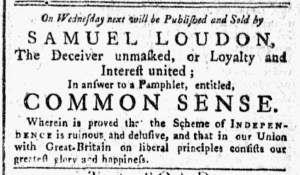
As Robert Bell advertised Plain Truth, a response to Thomas Paine’s Common Sense, in Philadelphia in March 1776, Samuel Loudon, a printer and bookseller in New York, prepared to publish and sell “The Deceiver unmasked, or Loyalty and Interest united; in answer to a Pamphlet, entitled COMMON SENSE.”  On Monday, March 18, he announced that two days later he would make available a new pamphlet “Wherein is proved that the Scheme of INDEPENDENCE is ruinous and delusive, and that in our Union with Great-Britain on liberal principles consists our greatest glory and happiness.”  By the time Loudon placed this advertisement, he may have seen an advertisement for Plain Truth in a newspaper printed in Philadelphia, borrowing the words “ruinous” and “delusive” for his own advertisement.

At first glance, this advertisement seems to contradict Thomas R. Adams’s assertion that only two pamphlets directly responding Common Sense appeared in the colonies in the six months between its publication in January and the Continental Congress declaring independence in July.  Bell published Plain Truth in the middle of March and James Humphreys, Jr., published The True Interest of America Impartially Stated in Certain Strictures on a Pamphlet Intitled Common Sense at the end of May.[1]  What about Loudon’s Deceiver Unmasked?  In a footnote, Adams explains that a “third pamphlet … was printed by Samuel Loudon in New York, but it was never sold because a Committee of Mechanics under Christopher Duyckinck destroyed almost all of the 1,500 copies.”[2]  One of the notes in the American Antiquarian Society’s catalog entry for Deceiver Unmasked provides more information: “The New-York Historical Society copy bears the [manuscript] note: General Duykinck’s Committee went to the House of Mr. Loudon’s and destroyed all these pamphlets just as they were ready to be published. — this Copy was saved.”  That delayed rather than prevented dissemination of Deceiver Unmasked.  The pamphlet eventually came off Humphreys’s press in Philadelphia as The True Interest of America.  Readers intrigued by Loudon’s advertisement for Deceiver Unmasked had to wait months for its publication, not knowing during that time whether Loudon or any other printer would even attempt it.  The first edition met with sufficient success that Humphreys issued a second edition.  While neither Plain Truth nor Deceiver Unmasked/True Interest of America had much impact, the publication and marketing of these responses to Common Sense demonstrates that printers believed a market existed for Loyalist tracts.

**********

[1] Thomas R. Adams, “The Authorship and Printing of Plain Truth by ‘Candidus,’” Papers of the Bibliographical Society of America 49, no. 3 (1955): 230-231.

[2] Adams, “Authorship and Printing,” 230.

January 11

What was advertised in a revolutionary American newspaper 250 years ago today?

New-York Journal (January 11, 1776).

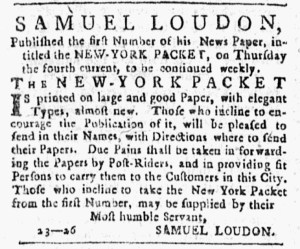
“SAMUEL LOUDON, Published the first Number of his News Paper, intitled the NEW-YORK PACKET.”

After spending several weeks distributing subscription proposals for a new newspaper, the New-York Packet, Samuel Loudon released the first issue on schedule on January 4, 1776.  On that day, Loudon’s notice that he planned to establish the newspaper appeared for the fourth and final time in the New-York Journal.  A week later, a new advertisement promoting the New-York Packet ran in the New-York Journal.  The notation at the end, “23-26” (corresponding to the issue numbers), indicated that Loudon planned for that notice to run for four consecutive weeks as well.

In it, the printer announced that he “Published the first Number of his News Paper … on Thursday the fourth current, to be continued weekly.”  He then provided an abbreviated version of the subscription proposal, stating that the New-York Packet “IS printed on large and good Paper, with elegant Types, almost new.”  For readers who did not subscribe in time to receive that “first Number,” it was not too late to start a subscription that included the first issue and all subsequent issues.  “Those who incline to encourage the Publication of it,” Loudon advised, “will be pleased to send in their Names, with Directions where to send their Papers.”  Loudon had disseminated the subscription proposals widely, including in the Connecticut Journal and the Pennsylvania Gazette.  He hoped to gain subscribers far beyond the city where he printed the New-York Packet.  To that end, he promised that “Due Pains shall be taken in forwarding the Papers by Post-Riders, and in providing fit Persons to carry them to the Customers in this City.”  That was a necessary part of satisfying both subscribers and advertisers.

Despite the fanfare around its founding, the New-York Packet lasted only eight months.  Loudon suspended the newspaper shortly before the British occupation of New York.  Unfortunately, surviving issues have not been digitized for greater access, so advertisements and other content from the New-York Packet will not appear in the Adverts 250 Project, though advertisements about the newspaper inserted in other publications testify to its short run at the beginning of the Revolutionary War.

December 31

What was advertised in a revolutionary American newspaper 250 years ago this week?

Connecticut Journal (December 27, 1775).

“He will publish No. I. of a News-Paper … THE NEW-YORK PACKET; OR THE AMERICAN ADVERTISER.”

The American Revolution resulted in an explosion of print.  The disruptions of the war led to the demise of some newspapers, but others continued, joined by new publications during the war and, especially, even more newspapers after the war ended.  The major port cities had one or more newspapers before the Revolutionary War.  Many minor ports also had a newspaper.  Once the new nation achieved independence, printers commenced publishing newspapers in many more towns.  Thoughtful citizenship depended in part on the widespread dissemination of news.  Samuel Loudon’s New York Packet was part of that story.

In December 1775, Loudon announced that he “will publish No. I. of a News-paper, (To be continued weekly)” on Thursday, January 4.  He initially advertised in other newspapers printed in New York, but by the end of the month others carried his proposals, including the Connecticut Journal, published in New Haven, and the Pennsylvania Gazette, published in Philadelphia.  Newspapers circulated far beyond their places of publication.  Printers wanted them to supply content for their own newspapers.  The proprietors of coffeehouses and taverns acquired them for their patrons.  Merchants used them for updates about both commerce and politics.  Loudon had a reasonable expectation of attracting subscribers beyond New York.  A nota bene at the end of his advertisement in the Connecticut Journal noted that “Subscriptions [were] taken by the Printers, and all the Post Riders,” a network of local agents that assisted in distributing Loudon’s newspaper.

Pennsylvania Gazette (December 27, 1775).

To entice potential subscribers, Loudon explained that he “is encouraged to undertake this arduous work by the advice and promised literary assistance of a numerous circle of warm friends to our (at present much distressed) country.”  That signaled to readers that Loudon supported the American cause.  It also offered assurances that he had the means to acquire sufficient content to publish a weekly newspaper.  To that end, Loudon pledged “to do everything in his power to render it a complete and accurate NEWS-PAPER, that the Public may thereby receive the earliest intelligence of the state of our public affairs, and of the several interesting occurrences which may occasionally happen whether at home or abroad.”  In the spirit of newspaper providing the first draft of history, the printer declared that he “flatters himself that the NEW YORK PACKET, will influence every discerner of real merit, who may encourage the work, to preserve it in volumes, as a faithful Chronicle of our own time.”

In addition to expressing such ideals, Loudon also tended to the business aspects of establishing a newspaper.  He reported that he “already possessed himself of a neat and sizeable set of TYPES … together with every other necessary for carrying on a splendid News Paper.”  Soon enough, “the best of hands shall be procured to perform the mechanical part.”  Subscribers could expect the New York Packet “will be printed … on a large Paper, of a good Quality, and equal in Size to the other News-Papers published in this City.”  Subscriptions cost twelve shillings per year.  Loudon also solicited advertisements, indicating that they “will be inserted at the usual Price of Five Shillings, when of a moderate Length, and continued Four Weeks.”  As was the practice in other printing offices, “longer Advertisements to be charged accordingly.”

Loudon did indeed launch the New York Packet on January 4, 1776.  It lasted only eight months in New York, suspended after the August 29 edition, as Clarence S. Brigham explains, “immediately prior to the entry of the British into New York.  Loudon re-established the paper at Fishkill in January, 1777, and at the close of the War returned to New York.”[1]  Without changing the volume numbering, he continued publishing the New York Packet from November 13, 1783, through January 26, 1792.  By then, Loudon published the newspaper three times a week, part of that explosion of print that occurred during the era of the American Revolution.  Shortly after closing the New York Packet, Loudon and his son, Samuel, established a daily newspaper, The Diary; or Loudon’s Register.  Unfortunately, the issues of the New York Packet published in 1776 have not been digitized for greater access, though the run for 1783 through 1792 is available via Readex’s America’s Historical Newspapers.  That means that advertisements and other content from that newspaper will not be featured in the Adverts 250 Project, its story confined to the subscription proposals that ran in other newspapers.

**********

[1] Clarence S. Brigham, History and Bibliography of American Newspapers, 1690-1820 (Worcester, Massachusetts: American Antiquarian Society, 1947), 675.

September 28

What was advertised in a revolutionary American newspaper 250 years ago today?

New-York Journal (September 28, 1775).

“The Words of Command used in the Manual Exercise, and an accurate Plan of Boston.”

Almost simultaneously with Hugh Gaine announcing in the New-York Gazette and Weekly Mercury that he had “Just PUBLISHED … HUTCHIN’s Improv’d; BEING AN ALMANACK … For the Year of our LORD 1776,” Frederick Shober and Samuel Loudon inserted an advertisement in the New-York Journal to alert the public that they had “Just published … The NEW-YORK and COUNTRY ALMANACK, For the Year of our Lord 1776.”  It included “all the necessary Articles usual in an Almanac, with the Addition of many curious Anecdotes, Receipts [or Recipes], [and] poetical Pieces.”  Unlike Gaine, Shober and Loudon did not provide an extensive list of the contents.  As printer of the New-York Gazette and Weekly Mercury, Gaine had access to as much space as he wished to devote to promoting an almanac he published.  Shober and Loudon, on the other hand, paid to run their advertisement in the New-York Journal.

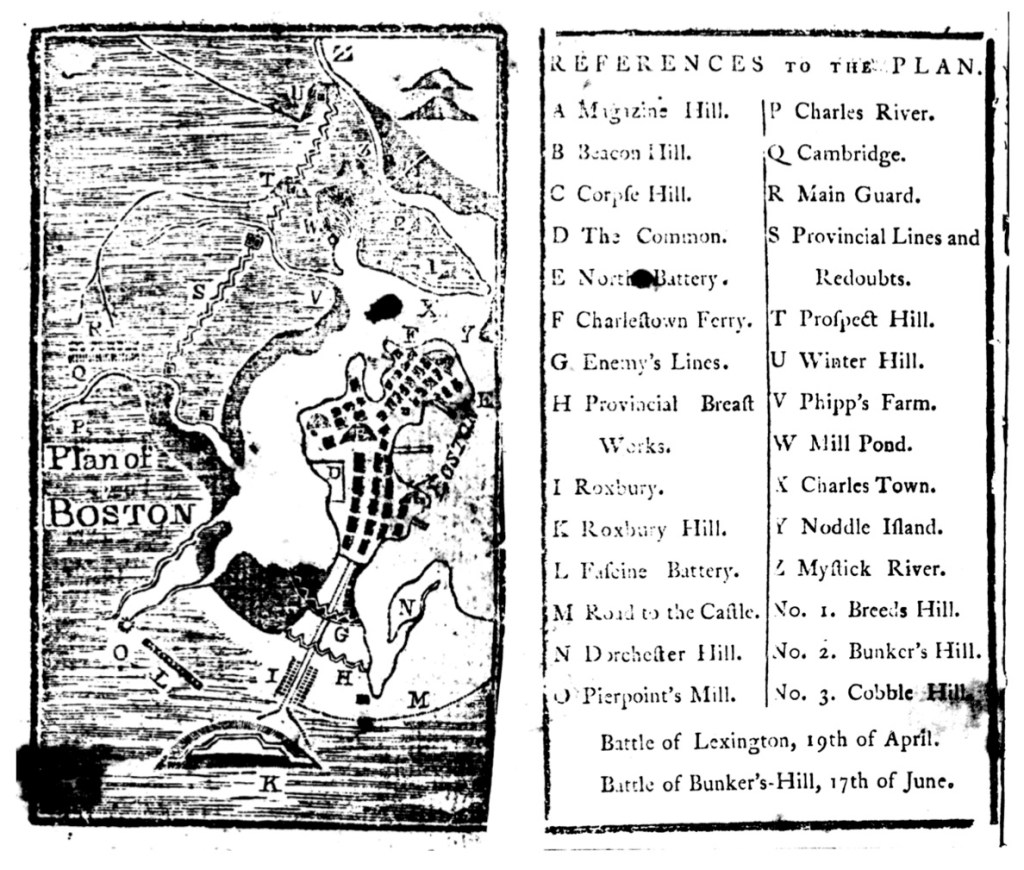
The partners did, however, specify two items that they wanted prospective customers to know they would find in the New-York and Country Almanack: “the Words of Command used in the Manual Exercise, and an accurate Plan of Boston with the different Situations of the Provincials, and the Ministerial Armies.”  Both reflected current events.  The “REFERENCES TO THE PLAN” (or legend for the map of Boston) in the almanac highlighted the “Battle of Lexington, 19th of April,” and the “Battle of Bunker’s-Hill, 17th of June.”  For readers beyond Massachusetts who did not directly experience those battles, that helped solidify in their minds the dates that they occurred.  By the time that Shober and Loudon took their almanac to press, maps of Boston had circulated widely in the July issue of the Pennsylvania Magazine (and Loudon had been among the booksellers to advertise them).  Nicholas Brooks and Bernard Romans also collaborated on a map that they likely distributed by the end of summer.  Those may have served as models for the “Plan of Boston” that Sober and Loudon commissioned for their almanac.  Gaine also directed attention to the “beautiful Plan of Boston, and the Provincial Camp” in his almanac.  The “whole Process of making SALT PETRE, recommended by the Hon. the Continental Congress” and a “Method of making Gun-Powder” accompanied their map.  In Shober and Loudon’s almanac, the “Words of Command,” taken from the widely published Manual Exercise, supplemented the map.  In both cases, the events of the Revolutionary War inspired the contents of the almanacs and became selling points in marketing them.

“Plan of Boston” [left] and “References to the Plan” [right], in The New-York and Country Almanack for the Year of Our Lord 1776 (New York: Shober and Loudon, 1775). Courtesy American Antiquarian Society.

August 21

What was advertised in a revolutionary American newspaper 250 years ago today?

New-York Gazette and Weekly Mercury (August 21, 1775).

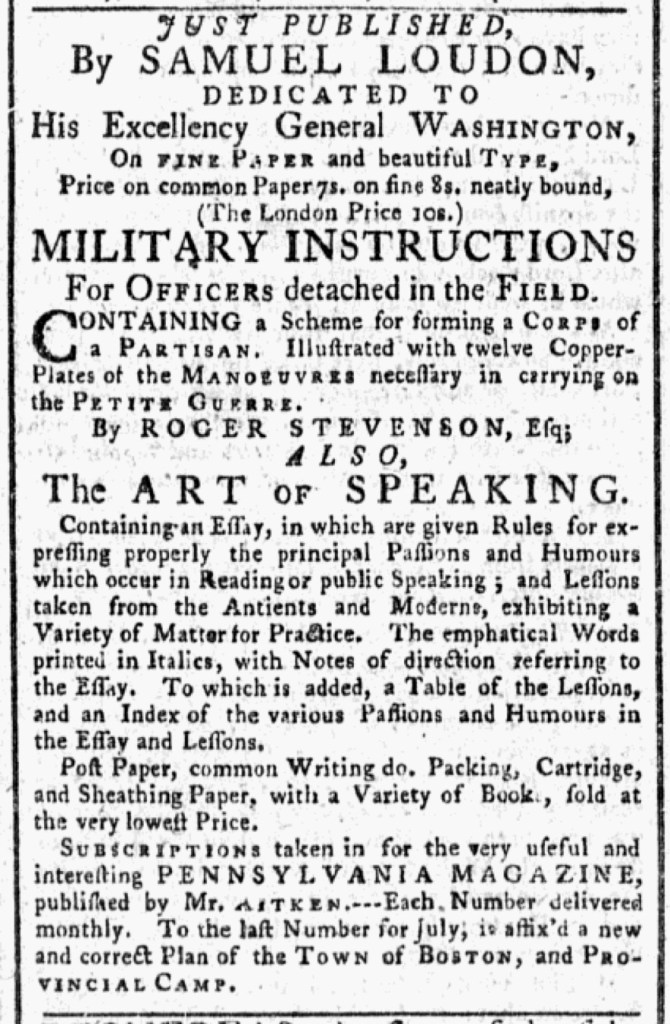
“To the last Number for July, is affix’d a new and correct Plan of the TOWN of BOSTON, and PROVINCIAL CAMP.”

In the summer of 1775, Samuel Loudon, a bookseller in New York, stocked books printed by Robert Aitken in Philadelphia.  He advertised Military Instructions for Officers Detached in the Field, “DEDICATED TO His Excellency General Washington,” and The Art of Speaking in the August 21, 1775, edition of the New-York Gazette and Weekly Mercury.  He also noted that he stocked an assortment of paper and a “Variety of Books” that he “sold at the very lowest Price.”

Loudon concluded his advertisement by promoting another of Aitken’s projects.  The bookseller advised the public that he collected subscriptions “for that very useful and interesting “PENNSYLVANIA MAGAZINE, published by Mr. AITKEN.”  The Pennsylvania Magazine, or, American Monthly Museum commenced publication with its January 1775 issue, briefly overlapping with the Royal American Magazine.  Upon the demise of the latter, it became the only magazine published in the colonies.

To incite interest, Loudon noted that “the last Number for July” featured a “new and correct Plan of the TOWN of BOSTON, and PROVINCIAL CAMP.”  According to the Norman B. Leventhal Map and Education Center at the Boston Public Library, this map “was the earliest printed depiction of Boston after the battle of Bunker Hill, June 17, 1775.”  It includes an inset that “shows the location of the location of the battle, as well as provincial (American) lines in the communities surrounding Boston.”  This demonstrated “the commanding position enjoyed by the Continental Army.”

Getting a free map of Boston following the Battle of Bunker Hill was certainly an incentive to subscribe to the Pennsylvania Magazine!  But was it the first map of Boston created after that battle?  Perhaps, but it might better be described as one of the first depictions of Boston after the Battle of Bunker Hill.  A note in the Leventhal Center’s online catalog states, “This date is inferred,” likely because the map was “Engrav’d for the Pennsylva. Magazine” for July 1775.  Yet the assertion that it was the earliest printed depiction of Boston after the Battle of Bunker Hill may rely on an assumption that colonial printers published magazines at the beginning of the month when they instead issued monthly issues at the end of the month or early in the following month.  Thus, Aitken distributed the July 1775 issue of the Pennsylvania Magazine at the same time that he, Nicholas Brooks, and others advertised Bernard Romans’s map of Boston, a map that also featured an inset showing the “Provincial Lines” during the siege of the city and the site of the Battle of Bunker Hill.  Aitken may have consulted with Romans when preparing a map to accompany the magazine.  For prospective subscribers, it may not have mattered whether they acquired the first map of Boston published after the Battle of Bunker Hill, only that they had access to the map … and at a bargain price since it came as a premium with their subscription to the Pennsylvania Magazine rather than purchasing Romans’s map separately.

“A New and Correct Plan of the Town of Boston, and Provincial Camp” (1775). Courtesy Norman B. Leventhal Map and Education Center at the Boston Public Library.

April 10

What was advertised in a colonial American newspaper 250 years ago today?

New-York Gazette and Weekly Mercury (April 10, 1775).

“Turn them speedily into cash, before the trade opens with Great-Britain.”

In the spring of 1775, Samuel Loudon, a bookseller and stationer, took to the pages of the New-York Gazette and Weekly Mercury to promote his current inventory.  His advertisement included a catalog listing many of the titles currently in stock as well as “a Variety of Religious books too tedious to mention” and “a variety of History and Romance.”  He also carried writing supplies, including “Quills, Writing Paper, Blank Books, Wafers and Sealing Wax.”

Loudon hoped to make a deal with customers “who take a quantity,” whether for themselves or to retail at their own shops, offering to sell the books “nearly at prime cost” or just a small markup.  He stated that he wished to “turn them speedily into cash, before the trade opens with Great-Britain” because he wanted to be in a better position to “lay in a fresh assortment.”  Despite the volume of newspaper advertisements and subscription proposals for books and pamphlets published by American printers, most books purchased and read by colonizers were printed in England and imported to the colonies.  At that moment, however, Americans participated in a nonimportation agreement, the Continental Association, enacted in response to the Coercive Acts.  Loudon acknowledged that he did not currently have access to new books, yet he looked to the future with optimism and planned to place orders as soon as Parliament repealed the offensive legislation and trade returned to normal.

In that regard, his advertisement echoed the one that John Minshull placed for looking glasses and engravings in the New-York Journal a few days earlier, though Minshull, likely a Loyalist, may have adhered to the nonimportation agreement out of necessity rather than enthusiasm.  Loudon “was decidedly a whig,” according to Patriot printer Isaiah Thomas, so his support may the Continental Association could have been more genuine despite any frustration with the disruptions it caused for his business.  Not long after he placed his advertisement in the New-York Gazette and Weekly Mercury, he purchased “printing materials, and opened a printing house.”  He commenced publishing “a newspaper devoted to the cause of the country” in January 1776.[1]  Neither Loudon nor Minshull saw trade resume with Britain in the way they imagined.  They did not know when they submitted their advertisements to the printing offices that resistance would soon become revolution following the battles at Lexington and Concord in Massachusetts.

**********

[1] Isaiah Thomas, The History of Printing in America: With a Biography of Printers and an Account of Newspapers (1810; New York: Weathervane Books, 1970), 482.

June 19

What was advertised in a colonial American newspaper 250 years ago today?

New-York Journal (June 9, 1774).

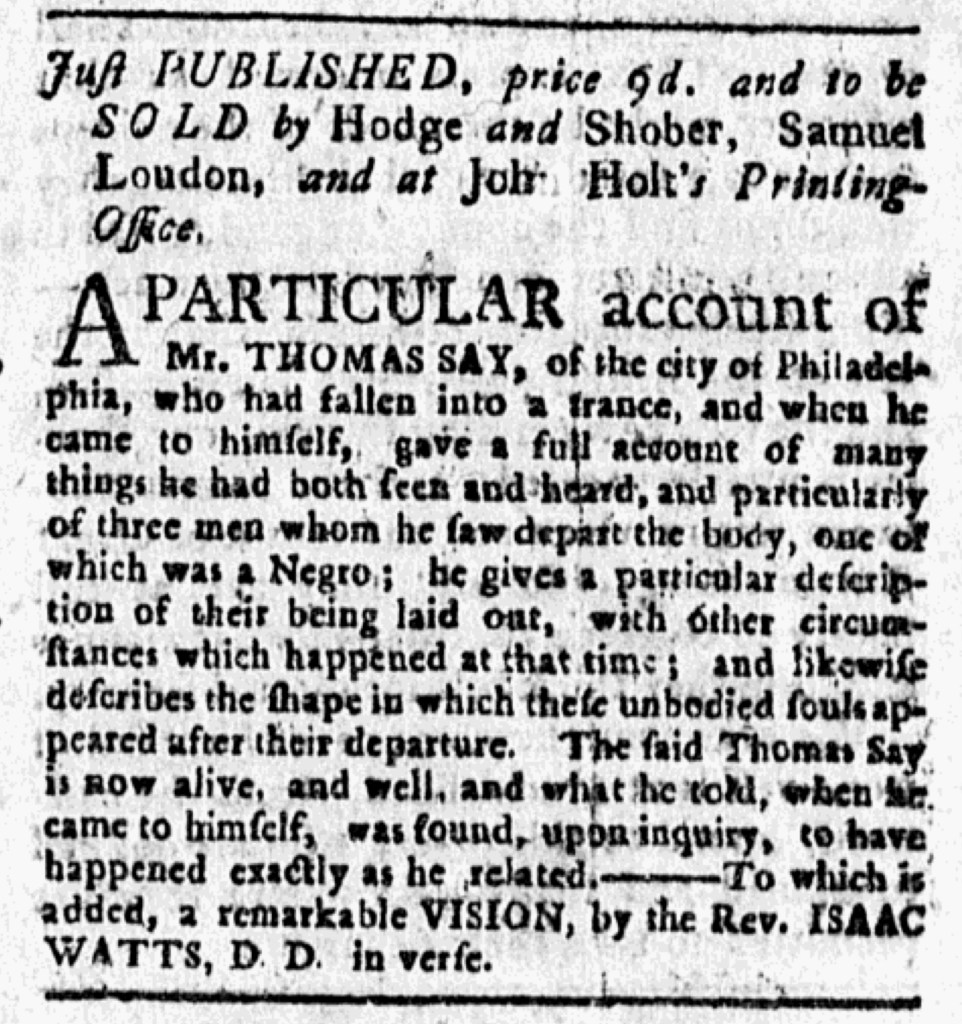
“A PARTICULAR account of Mr. THOMAS SAY … who had fallen into a trance.”

When William Mentz published The Visions of a Certain Thomas Say, of the City of Philadelphia, Which He Saw in a Trance without permission, Say placed an advertisement in the Pennsylvania Gazette to voice his objection.  He described the text as an “incorrect and imperfect” rendition of what he wished to reveal to the public, further asserting that “publishing any Thing in any Man’s Name without his Knowledge or Consent is, in my Opinion, very unjustifiable.”  He concluded with an appeal to “all Printers … not to aid or assist the said Mentz, or anyone else, in such wrong Proceedings.”

Unfortunately for Say, printers and booksellers in New York either did not see that advertisement or, if they did, chose to disregard it in favor of generating revenue by selling the pamphlet.  An advertisement in the June 16, 1774, edition of the New-York Journal described the contents of the work and noted that readers could purchase copies from printers Robert Hodge and Frederick Shober, bookseller Samuel Loudon, and John Holt, printer of the newspaper that carried the advertisement.  Mentz apparently shipped copies of The Visions of a Certain Thomas Say to New York, perhaps exchanging them for titles printed there.  Local agents felt the pamphlet merited a separate advertisement.  Loudon, for instance, simultaneously ran an advertisement for “BOOKS … TO BE SOLD ON THE LOWEST TERMS” that listed dozens of titles but did not mention The Visions of a Certain Thomas Say.  That advertisement also did not promote any books by providing summaries, unlike the advertisement about the pamphlet that Say wished to withdraw from circulation.

In his own advertisement, Say stated that he “never intended what I have wrote … should be published during my Life.”  More than two decades later, Benjamin Say, his son, published A Short Compilation of the Extraordinary Life and Writings of Thomas Say: In Which Is Faithfully Copied, from the Original Manuscript, the Uncommon Vision, Which He Had When a Young Man.  That work, released following Say’s death in 1796, presumably abided by his wishes for disseminating what he recorded of his vision.  During his lifetime, however, a public notice in the Pennsylvania Gazettehad not been enough to prevent the marketing of an unauthorized account.

September 25

What was advertised in a colonial American newspaper 250 years ago today?

New-London Gazette (September 25, 1772).

“Sold … by Samuel Loudon, in New-York.”

In his efforts to attract customers for the “Ship-Chandlery, Books, and Stationary” he stocked at his shop in New York, Samuel Loudon placed advertisements in the New-London Gazette in the fall of 1772.  For each category of merchandise, he provided a short list, concluding each with one or more “&c.” (the abbreviation for et cetera commonly used in the eighteenth century) to indicate even more choices.  He also stated that he carried “a great Variety of other Books, Divinity[, and] History” beyond the titles in his list.

Although Loudon may have welcomed retail customers for his wares, he most likely intended for his advertisement to capture the attention of masters of vessels who needed to outfit their ships and shopkeepers in New London and other towns in Connecticut interested in augmenting their inventory.  In a note near the end of the advertisement, Loudon stated that “Country Stores are supplied at the lowest Prices with Bibles, Testaments, Common Prayer Books, Spelling-Books, Entick’s Dictionary, Primmers, Bed Cords, Trace Rope, Gunpowder, Brimstone, &c.”  Loudon promised bargains to shopkeepers when they bought popular books and other items usually purchased in quantity.

Loudon could have confined his advertising to any of the three newspapers published in New York at the time.  After all, each of those publications enjoyed circulations far beyond the busy port.  Doing so, however, would have kept him in competition with others who also advertised in those newspapers.  Instead, Loudon sought to expand the market in which he operated by placing advertisements in the nearest newspaper published outside New York.  Although circulation of the New-London Gazette and New York’s newspapers overlapped, this strategy introduced him to new prospective customers.  It also gave his advertisements greater prominence.  All of the newspapers published in New York overflowed with advertising.  The New-London Gazette, a more modest publication, featured significantly less advertising.  It contained much less advertising, giving Loudon’s notice greater visibility.  Even if country shopkeepers in Connecticut perused any of the New York newspapers, they were much more likely to spot Loudon’s advertisement in the New-London Gazette.  Loudon apparently decided that advertising in large newspapers in his own city did not offer the only or even the best route to success.  Advertising in a smaller newspaper in a neighboring colony had its own advantages he considered worth the investment.