July 16

What was advertised in a revolutionary American newspaper 250 years ago this week?
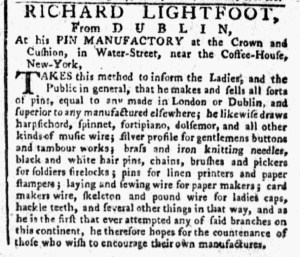
New-York Gazette and Weekly Mercury (July 10, 1775).

“He therefore hopes for the countenance of those who wish to encourage their own manufactures.”

In the summer of 1775, Richard Lightfoot placed a newspaper advertisement to promote his “PIN MANUFACTORY at the Crown and Cushion” in New York.  In addition to “all sorts of pins,” he also produced a variety of other wirework, including “harpsichord, spinnet, fortepiano, dolsemor, and all other kinds of music wire,” “brass and iron knitting needles,” “pins for linen printers and paper stampers,” and “laying and sewing wire for paper makers.”

Lightfoot addressed “the Ladies,” who presumably constituted a significant portion of his customers, yet also directed his advertisement to “the Public in general.”  After all, he had an interest in the entire community knowing about the work undertaken at his “PIN MANUFACTORY” and his contributions to the American cause through his participation in the marketplace.  Lightfoot proclaimed that “he is the first that ever attempted any of said branches,” the production of the various kinds of wirework, “on this continent.”  He did so at a time that colonizers observed the Continental Association, a nonimportation agreement devised by the First Continental Congress in response to the Coercive Acts.  That pact called for encouraging “Industry” and “the Manufactures of this Country” as alternatives to imported goods.  Under those circumstances, Lightfoot hoped “for the countenance of those who wish to encourage their own manufactures.”  That meant that “the Public in general” should support his enterprise by recommending it to “the Ladies” who purchased and used the pins and other items he made.

When they did so, they could depend on the quality of those products.  Lightfoot asserted that his pins were “equal to any made in London or Dublin, and superior to any manufactured elsewhere.”  He was qualified to make that claim, indicating that he was “From DUBLIN” and likely learned and practiced his trade there before migrating to New York.  Claiming that authority, Lightfoot assured prospective customers that they did not sacrifice quality when they applied their political principles to their decisions about which pins to purchase.  It did not matter that the Continental Association prohibited buying imported pins because Lightfoot made and sold pins that were just as good as (or even better than) pins produced elsewhere!
June 11

What was advertised in a colonial American newspaper 250 years ago today?

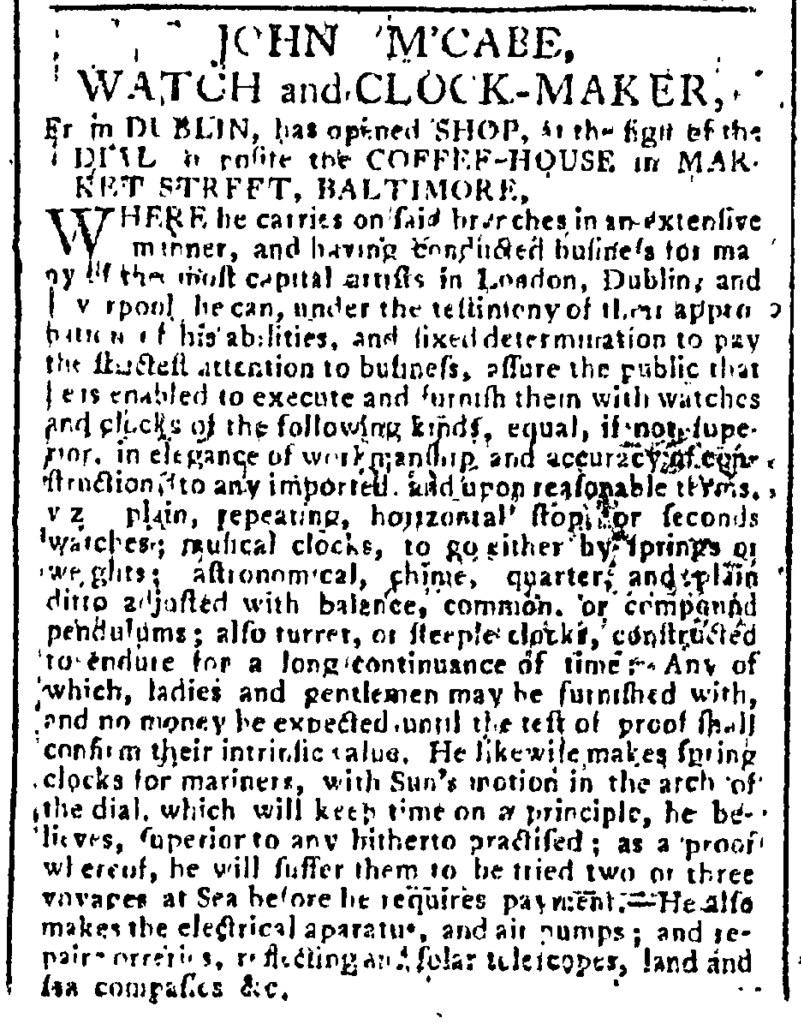
Maryland Journal (June 11, 1774).

“No money be expected until the test of proof shall confirm their intrinsic value.”

When he set up shop “at the sign of the DIAL” in Baltimore, John McCabe, a “WATCH and CLOCK-MAKER, From DUBLIN,” deployed a marketing strategy commonly undertaken by artisans who migrated across the Atlantic to the colonies.  In an advertisement in the June 11, 1774, edition of the Maryland Journal, he sought to establish his reputation in a town that did not have firsthand knowledge of his skill.  Instead, he relied on an overview of his experience, asserting that he had “conducted business for many of the most capital artists in London, Dublin, and Liverpool.”  Having worked in the most exclusive shops in urban centers, especially the cosmopolitan center of the empire, gave the newcomer a certain cachet, enhanced even more by the “testimony of their approbation of his abilities” that he claimed he could produce.

Yet McCabe did not rest on such laurels that were not immediately apparent to readers.  Instead, he simultaneously declared that his “fixed determination to pay the strictest attention to business.”  Underscoring his industriousness also came from the playbook developed by other artisans, a familiar refrain in their advertisements.  Prospective customers who might have been skeptical of McCabe’s credentials could judge for themselves whether he made clocks and watches “equal, if not superior, in elegance of workmanship and accuracy of construction to any imported.”  They could acquire such timepieces “upon reasonable terms,” getting the same style and quality as watches and clocks from London without paying exorbitant prices.

Even though the initial portions of his advertisement resembled notices placed by other artisans, McCabe, he did include an offer not made nearly as often: allowing a trial period for customers to decide if they wished to purchase or return watches and clocks from his shop.  The enterprising artisan declared that “ladies and gentlemen may be furnished” with any of the variety of clocks and watches listed in his advertisement and “no money be expected until the test of proof shall confirm their intrinsic value.”  McCabe did not explicitly state that customers could return items they found lacking, so confident was he that they would indeed be satisfied with his wares during the trial.  He extended a similar offer for “spring clocks for mariners … which keep time on a principle, he believes, superior to any hitherto practised.”  Customers could make that determination for themselves: “he will suffer them to be tried two or three voyages at Sea before he requires payment.”  Such arrangements would have required some negotiation about the amount of time and the length of those voyages, but allowing for such trials before collecting money from customers did not put McCabe at a disadvantage in the eighteenth-century commercial culture of extending extensive credit to consumers.  Prospective customers likely expected credit, so McCabe gained by transforming the time that would elapse between purchase and payment into a trial, giving those customers the impression that they received an additional benefit from doing business with him.  For some, that may have been the more effective marketing strategy than any claims about his experience working in the best shops in London, Dublin, and Liverpool.

December 18

What was advertised in a colonial American newspaper 250 years ago today?

Dec 18 - 12:18:1769 Boston-Gazette
Boston-Gazette (December 18, 1769).

“Will engage to make any Piece of Work as compleat as can be imported.”

In December 1769, Daniel MacNeill, a “Saddler and Cap-maker from DUBLIN,” turned to the Boston-Gazette to advise residents of Boston and its environs that he operated a shop in King Street. He made and sold a variety of items, including “Neat welted and plain Hunting Saddles,” “Pistol Cases & Holsters,” “Portmanteaus and Saddle Baggs,” and “every Article in the Sadlery Branch.” In addition to offering low prices, he assured prospective customers that he served them “with Fidelity and Dispatch.” He also made appeals to quality and fashion, proclaiming that he constructed these items “in the neatest and genteelest Manner.” MacNeill incorporated many of the most common marketing appeals of the eighteenth century into his advertisement.

As a relative newcomer to the city, MacNeill deployed another strategy that often appeared in newspaper notices placed by artisans who migrated across the Atlantic. He provided an overview of his work history as a means of convincing prospective customers of his competence. MacNeill asserted that he “had the Advantage of many Years Practice in the most principal Shops in Dublin and Towns adjacent.” In so doing, he attempted to transfer the reputation he established in one location to another, asking prospective customers to credit him for his years of experience. Although items he made during that time had not circulated for inspection in Boston, MacNeill hoped that his affiliation with “the most principal Shops” in one of the largest cities in the empire testified to his skill and expertise.

To that end, he pledged that he made saddles and other items “as compleat as can be imported.” Realizing that colonists sometimes had a preference for imported goods with an expectation of higher quality or better craftsmanship, MacNeill promised that his clients did not have to fear that they purchased inferior goods from his workshop. This appeal likely resonated with colonists who adhered to the nonimportation agreements and sought “domestic manufactures,” goods produced in the colonies, as alternatives to those transported across the Atlantic. An article on the first page of the December 18, 1769, edition of the Boston-Gazette proposed bringing artisans and their families to the colonies, suggesting that those migrants were much more welcome than imported goods that Parliament taxed. MacNeill’s advertisement reverberated with political implications, even as he made standard appeals to price, quality, and fashion.