
What was advertised in a colonial American newspaper 250 years ago this week?
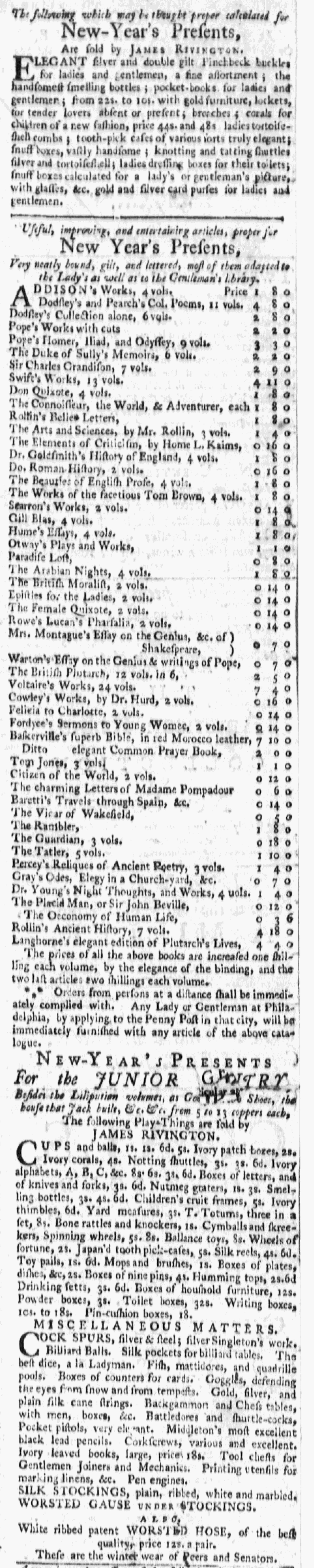
“NEW-YEAR’S PRESENTS.”
Rarely did retailers associate Christmas and consumption in newspaper advertisements they published in the 1760s and 1770s. They were just as likely to identify the new year as a time to give presents, though relatively few adopted that strategy either. James Rivington, a bookseller, stationer, and printer of Rivington’s New-York Gazetteer, was among those who suggested to consumers that they should purchase presents to commemorate the occasion. His advertisements filled an entire column in the December 30, 1773, edition of his newspaper.
As the first day of the new year approached, Rivington advised that he stocked “[t]he following which may be thought proper calculated for New-Year’s Presents.” He listed a variety of items, including “ELEGANT silver and double gilt Pinchbeck buckles for ladies and gentlemen, a fine assortment,” “snuff boxes, vastly handsome,” “ladies dressing boxes for their toilets,” and “pocket-books for ladies and gentlemen.” Rivington made clear that both women and men could be recipients of these “New-Year’s Presents,” even though editorials and other commentary often depicted women as the perpetrators of conspicuous, frivolous, or unnecessary consumption.
Rivington also presented a catalog of books as “Useful, improving, and entertaining articles, proper for New Year’s Presents,” most of them suitable for recipients of either sex. He described the books as “very neatly bound, gilt, and lettered, most of them adapted to the Lady’s as well as to the Gentleman’s Library.” They included “Pope’s Works with cuts” (or illustrations), “Dr. Goldsmith’s History of England,” “Paradise Lost,” “Mrs. Montague’s Essay on the Genius, &c. of Shakespeare,” “The charming Letters of Madame Pompadour,” and “Gray’s Odes, Elegy in a Church-yard.” Unlike most book catalogs published as newspaper advertisements, this one included the prices for each volume. Those contemplating giving them as gifts could take into account their budget and their relationship to the recipient when considering their purchases. Rivington also encouraged readers living beyond New York to give books as gifts for the new year, declaring that “Orders from persons at a distance shall be immediately complied with.” Those in Philadelphia, he directed, could “immediately” acquire any of the books “by applying to the Penny Post in that city.”
In addition to gifts for adults, Rivington also marketed “NEW-YEAR’S PRESENTS For the JUNIOR GENTRY.” He sold books for children, “Liliputian volumes,” as well as “Play-Things.” The toys included “CUPS and balls,” “Ivory alphabets, A, B, C,” “Bones rattles and knockers,” “Humming tops,” and “Toy pails.” Once again, he listed prices so prospective customers could assess how much they wished to spend on gifts.
Rivington concluded that advertisement with a list of “MISCELLEANOUS MATTERS” that he apparently did not consider as appropriate for giving as presents. In a final advertisement in that column, he promoted a “new and corrected edition” of “Rivington’s Gentleman and Ladys Pocket Almanack.” Although he did not suggest giving the almanac as a gift, the printer considered it “Necessary to every one, in and out of Business, and useful in every Colony upon the Continent.” A couple of days before the new year was the perfect time to purchase an almanac and, according to Rivington, items that customers might not otherwise have purchased but would give as gifts.

