
What was advertised in a revolutionary American newspaper 250 years ago today?
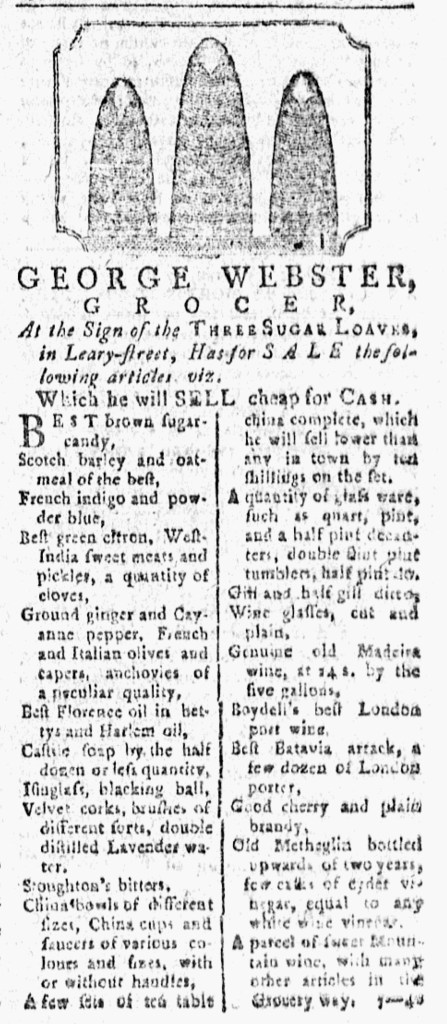
“The Sign of the THREE SUGAR LOAVES.”
George Webster, a grocer, kept shop “At the Sign of the THREE SUGAR LOAVES, in Leary-street,” in New York during the era of the American Revolution. In an advertisement in the April 18, 1776, edition of the New-York Journal, he listed a variety of items, including “Best green citron, West-India sweet meats and pickles, a quantity of cloves, Ground ginger and Cayanne pepper, French and Italian olives and capers, [and] anchovies of a peculiar quality.” He also stocked some housewares, such as “China bowls of different sizes, Chinas cups and saucers of various colours and sizes, with or without handles, [and] A few sets of tea table china complete, which he will sell lower than any in town by ten shillings on the set.” That was a bargain for a tea seat, though colonizers were supposedly abstaining from drinking tea in protest of the Intolerable Acts.
The “Sign of the THREE SUGAR LOAVES” must have been a familiar sight for many residents of New York. It had marked Webster’s location on Leary Street for several years. In addition, the grocer commissioned a woodcut that depicted his sign to adorn some of his newspaper advertisements. It featured a taller sugar loaf in the center, flanked by two shorter sugar loaves, all enclosed in a thin border with scalloped corners. It may have replicated the sign that marked Webster’s location, creating a visual identity or brand through the consistency. Webster used the woodcut in his advertisements in the fall of 1772 and then discontinued it for a few years before using it again in his advertisements in the spring of 1776. Perhaps he retrieved it from the printing office and tucked it away at his shop, though he could have left it in the care of the printer during that time. After all, the image was so tied to his business that it would not have been of much use to other advertisers. Unlike some entrepreneurs who commissioned woodcuts and advertised in multiple newspapers, Webster did not collect his woodcut from one printing office and deliver it to another. His advertisements in Rivington’s New-York Gazetteer in the fall of 1773 featured a decorative border and gave his location as “the THREE SUGAR LOAVES, In LEARY-STREET,” but did not include the woodcut. When he revived the image, it helped distinguish his advertisement from others in the New-York Journal. In the April 18 edition for instance, only one other advertisement included a woodcut. A stock image of a horse, a fraction of the size of Webster’s woodcut, appeared in an advertisement offering the stud services of True Briton. The “Sign of the THREE SUGAR LOAVES” at the top of Webster’s advertisement no doubt helped draw attention to it.
