November 16

GUEST CURATOR: Mary Williams

What was advertised in a colonial American newspaper 250 years ago this week?

nov-16-11161766-providence-gazette
Providence Gazette (November 16, 1766).

Opened my House … for the Reception of such Gentlemen and Ladies who may travel this Way.”

In this advertisement from the Providence Gazette, Abijah Hunt wrote that he had just opened up his house to the public. He promised “every Thing suitable for their Accommodation” to any gentlemen and ladies who might stop by.

When I first read through this advertisement I was confused about what exactly Hunt was advertising to readers: an inn or a tavern. He promised to accommodate travelers, but he also mentioned entertainment. On the Colonial Williamsburg webpage, Ed Crews writes that taverns were also called “inns, ordinaries, and public houses” in colonial America. Traveling performers often provided the entertainment in these inns. A wide variety of performers put on acts at these inns, such as magicians, actors, and musicians. Some acts included the use of animals, such as trained pigs. The most common instruments musicians used in their performances were violins, flutes, and trumpets. On nights when there was no provided entertainment, customers often sang together in groups.

Hunt wrote that some of the public taverns in Providence were “not so agreeable as those (to be found in most other large Towns).” Taverns and inns could vary greatly in their atmospheres. Crews describes many inns as “male-domains” where men drank too much and used foul language. Furthermore, “Felons planned crimes, fenced goods, and passed counterfeit money in inns. Fights and murders were common.” Refined women avoided taverns, but prostitutes visited often. In this advertisement, Hunt offered an alternative place of shelter and entertainment for those colonists who wanted a more safe and refined experience.

**********

ADDITIONAL COMMENTARY: Carl Robert Keyes

Mary paints a vivid picture of some of the activities that took place in taverns in the eighteenth century. In addition to being places of entertainment where colonists socialized, Mary also indicates that taverns provided a venue for participating in consumer culture in various ways, including fencing stolen goods and passing counterfeit money.

Such activities were part of what Serena R. Zabin has described as the “informal economy” in colonial America. Not all colonists had the means to purchase new goods directly from merchants and shopkeepers, but that did not prevent them seeking out other ways to obtain the “English, India, and West-India GOODS” that Samuel Nightingale, Jr., marketed on the page after Abijah Hunt’s advertisement appeared. Zabin and others have demonstrated that a vibrant secondhand economy operated in eighteenth-century America; colonists bought and sold used clothing and other goods. Yet others turned to more nefarious means to get their hands on the goods they desired, either stealing or purchasing stolen items. In today’s advertisement Abijah Hunt announced that he opened a house of entertainment to be a place of refuge for visitors “to this Town, both on Business and Recreation,” patrons that he believed wished to avoid some of the more unsavory activities (including the exchange of stolen goods) that took place in some taverns.

While newspaper advertisements reveal a lot about the availability of goods during the consumer revolution, they do not tell the entire story. Occasionally shopkeepers and others placed advertisements lamenting thefts and announcing rewards upon the capture and conviction of the perpetrators, but those who stole the goods almost certainly did not turn to newspapers to offer them for sale. Piecing together the informal economy that included fencing stolen goods, as Zabin has done, requires consulting court records. Those documents provide insight into how some colonists – consumers themselves – used and thought about goods, while newspaper advertisements, for the most part, suggest how retailers, producers, and suppliers attempted to shape colonists’ attitudes and behaviors related to consumption.

August 18

What was advertised in a colonial American newspaper 250 years ago today?

Aug 18 - 8:18:1766 Boston-Gazette
Boston-Gazette (August 18, 1766).

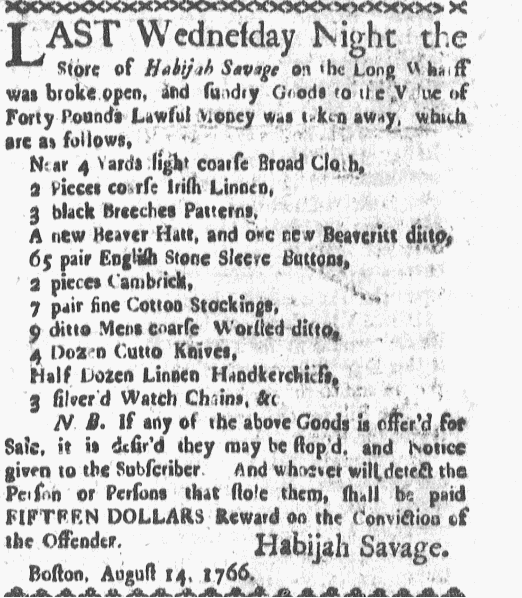
“The Store of Habijah Savage on the Long Wharff was broke open.”

Earlier this week the Adverts 250 Project featured an announcement that Simon Rhodes placed in the New-London Gazette. In late July 1766, a thief or thieves broke into his home in Stonington, Connecticut, and stole two silver watches and a pair of silver buckles. He offered a description of the missing items, warned against anybody purchasing the stolen goods, and offered a reward for their return and the capture of the culprits.

In today’s advertisement, Habijah Savage offered a similar story out of Boston. In this case, however, the thieves “broke open” Savage’s store, rather than his house, and made off with a significant amount of merchandise, amounting to “Forty Pounds Lawful Money.” This was a quite a loss for Savage’s business. Indeed, his list of stolen merchandise was as extensive as those that frequently appeared in advertisements placed by merchants and shopkeepers seeking to sell new goods and auctioneers sponsoring vendue sales.

Despite Savage’s announcement about the theft in the public prints, it seems unlikely that he would have been able to recover all (or any) of the stolen goods. For the most part, they were fairly common items that would have been easily absorbed into an underground economy that paralleled the more legitimate means of acquiring goods. In a fascinating chapter on “The Informal Economy” in Dangerous Economies: Status and Commerce in Imperial New York, Serena R. Zabin has traced how many marginalized colonists – the poor, slaves and free blacks, women – participated in the consumer revolution of the eighteenth century through alternative means that worried authorities and elites. This was an economy that incorporated crime and threatened to disrupt traditional social and economic hierarchies.

The goods stolen from Habijah Savage’s store likely became part of that informal economy. Who might have ended up wearing that “new Beaver Hatt” or making clothes from the “English Stone Sleeve Buttons” and assorted textiles?

August 15

What was advertised in a colonial American newspaper 250 years ago today?

Aug 15 - 8:15:1766 New-London Gazette
New-London Gazette (August 15, 1766).

“STOLEN out of the Subscriber’s House in the Night … Two silver Watches.”

As a general rule, most advertisements featured on the Adverts 250 Project promoted consumer goods and services. As its primary purpose, the project explores how eighteenth-century advertising incited consumer demand and convinced colonists to purchase an expanding array of goods and services.

Today’s advertisement, however, demonstrates that buying new goods from shopkeepers and merchants was not the only way that colonists could participate in the consumer economy. Some purchased used goods (which were sometimes advertised, but also changed hands in an informal economy that did not rely on public commercial notices), but others resorted to theft to obtain the items they desired or intended to sell for their own gain.

In Simon Rhodes’ case, a thief made off with “Two Silver Watches” and “a pair of Silver wrought Buckles with Steel Chapes and Tongues.”

Rhodes wanted his watches and buckles back, so much so that he paid to insert this advertisement in the New-London Gazette at least three times. (It appeared on August 15, 22, and 29. It may have appeared in earlier issues, but they are no longer extant.) He also offered a reward of five dollars to anybody who captured “the Thief or Thieves, so that the above things may be had, and he or they brought to Justice.” At the very least, Rhodes wanted to make it difficult for the thief or thieves to benefit from the crime. He requested that if any readers noticed his stolen property “offered for Sale” that “they may be stopped.” In addition, his descriptions of the stolen goods, including their flaws and repairs, were designed to make it more difficult to sell them.

February 14

GUEST CURATOR:  Elizabeth Curley

What was advertised in a colonial newspaper 250 years ago today?

Feb 14 - 2:14:1766 New-Hampshire gazette
New- Hampshire Gazette (February 14, 1766).

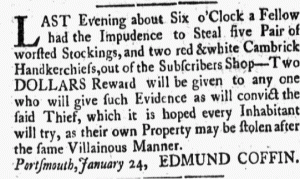
“A Fellow had the Impudence to Steal five Pair of worsted Stockings.”

I could not imagine having my stockings and handkerchiefs stolen from within my own home or shop. Clearly this person from New Hampshire could not either until it happened to him, and he was upset enough to place a whole two dollar reward for information on thief. That would have been a lot of money for five pairs of stockings and two red and white handkerchiefs. This makes me wonder if it was more about revenge on the thief.

This advertisement was placed in Portsmouth, which was one of the biggest cities in New Hampshire, and had different types of people living in the area: robbers and other questionable characters, shopkeepers, merchants, and the genteel class. Edmund Coffin went on to say that “every inhabitant” should watch out and report such behavior or it could happen to them.

This advertisement really grabbed my attention. It was a little different from some of the other advertisements that I had seen, because it was not a service or goods begin sold or bought. Especially in today’s society socks and handkerchiefs are so easily attainable that I would never even think twice if two of my socks disappeared.

**********

ADDITIONAL COMMENTARY:  Carl Robert Keyes

The Adverts 250 Project focuses primarily on marketing consumer goods and services in eighteenth-century America, but then (as now) not all advertisements were placed for that purpose. The guest curators from my Public History class and I have reached an agreement: each may select one advertisement not intended to sell goods or services during his or her week.

Elizabeth is beginning her week as guest curator with her “exception(al)” advertisement, but it is an extremely good choice because it tells us a lot about consumption in eighteenth-century America. Purchasing goods was not the only way to participate in the consumer revolution taking place in the colonies and Britain. Sometimes people came into possession of goods in more nefarious ways via an underground economy that included stolen items. Serena Zabin devotes an entire chapter to this “Informal Economy” in Dangerous Economies: Status and Commerce in Imperial New York. In addition to stolen items, secondhand goods were often exchanged via the informal economy. As Elizabeth notes, people of various backgrounds – from the lower sorts to the elite – resided in colonial cities and towns. Not all of them purchased new goods, but a great many found alternate ways to participate in the marketplace. This advertisement demonstrates one way they did so, much to the chagrin of poor Edmund Coffin who was the victim of an eighteenth-century shoplifter.