August 1

What was advertised in a revolutionary American newspaper 250 years ago today?

Pennsylvania Evening Post (August 1, 1776).

“The managers hope for public assistance in detecting the villain.”

Reports of burglaries and robberies frequently appeared among the advertisements in early American newspapers, but this notice with a headline that proclaimed, “ROBBERY,” was different than most.  Rather than a house or shop that had been targeted, this time “the Cellar of the Public Manufactory at the corner of Market and Ninth streets” in Philadelphia “was broke open” sometime during the night of July 29, 1776.  The culprits absconded with “two pieces of goods cut out of the looms,” approximately “twenty yards of Cotton, Barragon, or Fustian” and approximately “fifty yards of narrow striped Corded Dimity.”  That was quite a haul, but the managers of the Public Manufactory noted that the fabrics were “rough and unfinished,” making them easy to recognize “if offered for sale, or carried to any of the bleachyards” for processing.

The managers requested “public assistance in detecting the villain” who perpetrated this crime.  They hoped that merchants, shopkeepers, millers, consumers, or anyone else who might spot these stolen textiles would aid them in “detecting the Robber, so that he may be prosecuted to conviction.”  In return, they would receive “FIFTY DOLLARS Reward.”  The size of the reward testified not only to the value of the fabrics but also to patriotic mission of the Public Manufactory.  It had been established to produce textiles that local consumers could purchase instead of imported goods.  The managers believed that the Public Manufactory played a vital role in making “domestic manufactures” that supported the local economy and reduced reliance on imports.  This enterprise played a symbolic as well as practical role in the contest with Great Britain.  The managers lamented that “losses of this kind (by discouraging weavers and manufacturers) may prove a fatal injury to America.”  Less than a month after the Continental Congress declared independence, the managers of the Public Manufactory envisioned high stakes for this “ROBBERY.”  The “villain” did not merely deprive them of several years of unfinished fabric; instead, he demoralized weavers who contributed to the American cause and might have even out the fate of the entire nation in jeopardy.  The managers of the Public Manufactory framed this unfortunate event and the potential reverberations as more than just everyday theft.
August 18

What was advertised in a colonial American newspaper 250 years ago today?

Aug 18 - 8:18:1766 Boston-Gazette
Boston-Gazette (August 18, 1766).

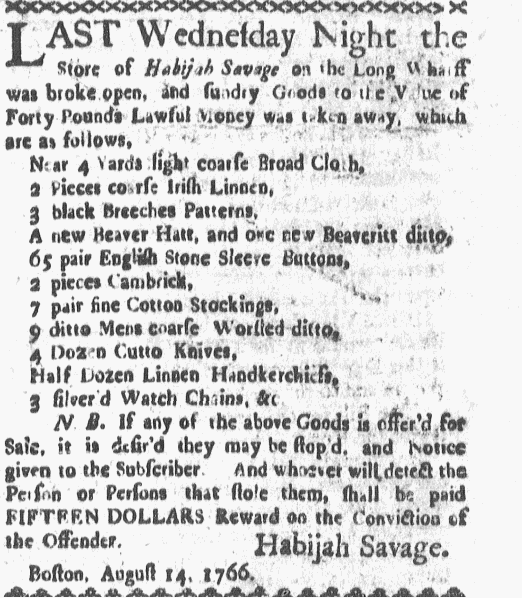
“The Store of Habijah Savage on the Long Wharff was broke open.”

Earlier this week the Adverts 250 Project featured an announcement that Simon Rhodes placed in the New-London Gazette. In late July 1766, a thief or thieves broke into his home in Stonington, Connecticut, and stole two silver watches and a pair of silver buckles. He offered a description of the missing items, warned against anybody purchasing the stolen goods, and offered a reward for their return and the capture of the culprits.

In today’s advertisement, Habijah Savage offered a similar story out of Boston. In this case, however, the thieves “broke open” Savage’s store, rather than his house, and made off with a significant amount of merchandise, amounting to “Forty Pounds Lawful Money.” This was a quite a loss for Savage’s business. Indeed, his list of stolen merchandise was as extensive as those that frequently appeared in advertisements placed by merchants and shopkeepers seeking to sell new goods and auctioneers sponsoring vendue sales.

Despite Savage’s announcement about the theft in the public prints, it seems unlikely that he would have been able to recover all (or any) of the stolen goods. For the most part, they were fairly common items that would have been easily absorbed into an underground economy that paralleled the more legitimate means of acquiring goods. In a fascinating chapter on “The Informal Economy” in Dangerous Economies: Status and Commerce in Imperial New York, Serena R. Zabin has traced how many marginalized colonists – the poor, slaves and free blacks, women – participated in the consumer revolution of the eighteenth century through alternative means that worried authorities and elites. This was an economy that incorporated crime and threatened to disrupt traditional social and economic hierarchies.

The goods stolen from Habijah Savage’s store likely became part of that informal economy. Who might have ended up wearing that “new Beaver Hatt” or making clothes from the “English Stone Sleeve Buttons” and assorted textiles?

August 15

What was advertised in a colonial American newspaper 250 years ago today?

Aug 15 - 8:15:1766 New-London Gazette
New-London Gazette (August 15, 1766).

“STOLEN out of the Subscriber’s House in the Night … Two silver Watches.”

As a general rule, most advertisements featured on the Adverts 250 Project promoted consumer goods and services. As its primary purpose, the project explores how eighteenth-century advertising incited consumer demand and convinced colonists to purchase an expanding array of goods and services.

Today’s advertisement, however, demonstrates that buying new goods from shopkeepers and merchants was not the only way that colonists could participate in the consumer economy. Some purchased used goods (which were sometimes advertised, but also changed hands in an informal economy that did not rely on public commercial notices), but others resorted to theft to obtain the items they desired or intended to sell for their own gain.

In Simon Rhodes’ case, a thief made off with “Two Silver Watches” and “a pair of Silver wrought Buckles with Steel Chapes and Tongues.”

Rhodes wanted his watches and buckles back, so much so that he paid to insert this advertisement in the New-London Gazette at least three times. (It appeared on August 15, 22, and 29. It may have appeared in earlier issues, but they are no longer extant.) He also offered a reward of five dollars to anybody who captured “the Thief or Thieves, so that the above things may be had, and he or they brought to Justice.” At the very least, Rhodes wanted to make it difficult for the thief or thieves to benefit from the crime. He requested that if any readers noticed his stolen property “offered for Sale” that “they may be stopped.” In addition, his descriptions of the stolen goods, including their flaws and repairs, were designed to make it more difficult to sell them.