October 13

What was advertised in a revolutionary American newspaper 250 years ago today?
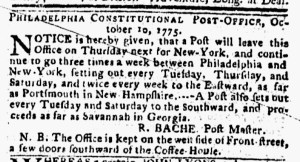
Story and Humphreys’s Pennsylvania Mercury (October 13, 1775).

“PHILADELPHIA CONSTITUTIONAL POST-OFFICE.”

At the same time that Mary Katharine Goddard, postmaster and printer of the Maryland Journal, advertised the Baltimore branch of the Constitutional Post Office in the fall of 1775, Richard Bache ran a notice for the “PHILADELPHIA CONSTITUTONAL POST-OFFICE” in the October 13 edition of Story and Humphreys’s Pennsylvania Mercury. Although Bache was not the printer of that newspaper, his advertisement received a privileged place similar to the one that Goddard’s notice enjoyed in her newspaper.  It appeared first among the advertisements that readers encountered when they perused the newspaper from start to finish, immediately below the “SHIP NEWS” and list of “ARRIVALS” in Philadelphia.  A double line did separate news from advertising, yet this item delivered news relevant to the imperial crisis that had become a war with the battles at Lexington and Concord the previous spring.  Over the summer, the Second Continental Congress established the Constitutional Post Office as an alternative to the imperial post office.  Enoch Story and Daniel Humphreys, the printers of the newspaper that carried Bache’s advertisement, apparently considered it in their best interest to increase the likelihood readers would take note of the information about the Constitutional Post Office by placing the notice right after the news.

Compared to Goddard’s advertisement, Bache’s notice gave readers a much more expansive glimpse of the scope of the enterprise.  Rather than simply stating which days the post arrived and departed, Bache reported that the Constitutional Post carried letters and newspapers “as far as Portsmouth in New-Hampshire” to the north and “as far as Savannah in Georgia” to the south.  The system linked the thirteen colonies.  On Tuesdays, Thursdays, and Saturdays, a rider set out for New York from Philadelphia.  On Tuesdays and Saturdays, another rider headed “to the Southward” to Baltimore, arriving there, according to Goddard’s advertisement, on Mondays and Thursdays.  This new system did more than move mail.  “Establishing a new post office,” Joseph M. Adelman argues, “placed the levers of information circulation in the hands of Americans.  …  Forming a ‘continental’ post office that could properly embody an intercolonial union and its resistance to imperial tyranny was crucial to Patriot mobilization at the height of the imperial crisis.”  Furthermore, “Patriot printers and their radical friends” played an integral role in establishing the new postal system.[1]  No wonder that Story and Humphreys placed Bache’s advertisement about the “PHILADELPHIA CONTSITUTIONAL POST-OFFICE” right after the “SHIP NEWS.”

**********

[1] Joseph M. Adelman, “‘A Constitutional Conveyance of Intelligence, Public and Private’: The Post Office, the Business of Printing, and the American Revolution,” Enterprise and Society 11, no. 4 (December 2010): 747-748.

November 14

What was advertised in a colonial American newspaper 250 years ago this week?

Norwich Packet (November 11, 1773).

“NOAH HIDDEN, has undertaken to ride Post between the town of NORWICH and PROVIDENCE.”

Today the Adverts 250 Project features an advertisement from the Norwich Packet and the Connecticut, Massachusetts, New-Hampshire, and Rhode-Island Weekly Advertiser for the first time.  After circulating subscription proposals during the summer of 1773, Alexander Robertson, James Robertson, and John Trumbull established the newspaper on October 7, “judging from the date of the earliest issue located, that of Nov. 4, 1773, vol. 1, no. 5.”[1]  America’s Historical Newspapers does not include that issue, but instead begins with the November 11 edition.  Noah Hidden, a post rider, placed the final advertisement in that issue, though he may have started advertising as early as the inaugural edition.

Hidden advised the public that he “has undertaken to ride Post between the Town of NORWICH and PROVIDENCE,” a distance of about fifty miles.  He departed from the printing office in Norwich on Thursdays and from Knight Dexter’s house in Providence on Saturdays.  Not by accident, this itinerary matched the publication schedule of the newspapers in both towns.  The Robertsons and Trumbull distributed a new edition of the Norwich Packet on Thursdays.  For many years, John Carter published the Providence Gazette on Saturdays.  Hidden carried “Letters, Papers, Memorandoms, or small Bundles left at either of said Places,” pledging to take good care of them and offering receipts “if required.”  In particular, he noted that he would provide “those who choose to employ him, with this PAPER.”

The post rider presented this enterprise as a valuable service “to the Inhabitants of both towns and the intermediate Country.”  He underscored the “great utility” of disseminating the information in the newspapers and letters he delivered along his route.  Furthermore, Hidden asserted that his contributions to the regional information infrastructure merited the “Encouragement which a faithful Discharge of the Business he has undertaken shall entitle him to.”  His endeavors help to explain how the Robertsons and Trumbull could suggest that a newspaper published in Norwich served each of the colonies in New England.  Like other colonial newspapers, the Norwich Packet circulated far beyond its place of publication.

**********

[1] Clarence S. Brigham, History and Bibliography of American Newspapers, 1690-1820 (Worcester: American Antiquarian Society, 1947), 66.

November 6

What was advertised in a colonial American newspaper 250 years ago today?

Nov 6 - 11:6:1767 New-Hampshire Gazette
New-Hampshire Gazette (November 6, 1767).

“Care will be taken to have all the English and American News Papers, Magazines, and political Pamphlets.”

In the fall of 1767 Robert Calder informed residents of Portsmouth, New Hampshire, and its environs that “he has open’d a COFFEE HOUSE, opposite the South Side of the Reverend Mr. HAVEN’s Meeting House.” He catered to his clients, promising that he served the most popular beverages – coffee, tea, and chocolate – “in the best and most agreeable Manner.” Calder, “LATE FROM LONDON,” paid special attention to cultivating an ambiance of sophistication for his patrons. In his other line of work as a hairdresser for both ladies and gentlemen, he adhered to the “genteelest Fashions.” Those who visited his coffeehouse could expect the same atmosphere as they sipped their drinks and conversed with friends and acquaintances. After all, the proprietor promised that “every other Means [would be] assiduously pursued to give Satisfaction.”

Yet Calder’s coffeehouse was more than just a place to gather for pleasant conversation over a pot of a hot beverage on a brisk fall day. It was also a place where the public could keep themselves informed about events taking place in the colony and, especially, other colonies and other places throughout the Atlantic world and beyond. Calder announced, “Care will be taken to have all the English and American News Papers, Magazines, and political Pamphlets, as early as possible.” Even though the issue of the New-Hampshire Gazette that carried this advertisement included news from Boston, Newport, New York, London, and Algiers, publishers Daniel Fowle and Robert Fowle did not have sufficient space to reprint all the news from faraway places. The variety of newspapers available at Calder’s coffeehouse would allow colonists to keep up to date on current events, a prospect that likely loomed large considering that the Townshend Act was scheduled to go into effect in just two weeks. Realizing that prospective patrons wanted to keep informed, Calder provided magazines and political pamphlets as well. At his coffeehouse the public had access to printed materials that many colonists might not otherwise have had the means or the money to procure on their own.

In eighteenth-century America, coffeehouses were an important counterpart to printing shops that doubled as post offices. Both were places for disseminating and obtaining information via multiple media. Printers published and distributed the news, but coffeehouse proprietors facilitated delivering the news to even broader audiences. They offered an important service that benefited the civic life of their communities.