
What was advertised in a colonial American newspaper 250 years ago today?
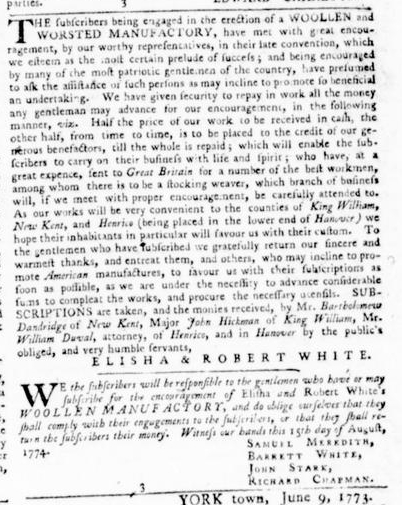
“A WOOLEN and WORSTED MANUFACTORY … American manufactures.”
As John Pinkney published updates from the First Continental Congress in the Virginia Gazette in November 1774, Elisha White and Robert White ran an advertisement to announce that they were “engaged in the erection of a WOOLLEN and WORSTED MANUFACTORY” that they anticipated would meet with great success. They had already been “encouraged by many of the most patriotic gentlemen of the country,” yet sought even greater support for “so beneficial an undertaking” among the public. In other words, they sought investors to defray the costs of this endeavor, addressing those “who may incline to promote American manufactures” as alternatives to goods imported from Britain. The Whites had already gone to some expense, recruiting “a number of the best workmen,” though they still needed to “compleat the works, and procure the necessary utensils.” Their enterprise would have even greater urgency as colonizers learned more about the Continental Association, a nonimportation pact, adopted by the First Continental Congress.
To raise the necessary funds to make their “MANUFACTORY” viable, the Whites established a subscription and designated local agents in several towns who collected the money on their behalf. They also outlined their scheme for repaying these loans: “Half the price of our work to be received in cash, the other half, from time to time, is to be placed to the credit of our generous benefactors, till the whole is repaid.” In case that seemed like too much of a gamble, the Whites appended a note from some of those “most patriotic gentlemen” to offer assurances. Samuel Meredith, Barrett White, John Stark, and Richard Chapman pledged that they “will be responsible to the gentlemen who have or may subscribe for the encouragement of Elisha and Robert White’s WOOLLEN MANUFACTORY.” If the project did not succeed, those four men “shall return the subscribers their money.” That promise reflected their confidence in the Whites’ ability to “carry on their business with life and spirit” while simultaneously underscoring that civic duty called for supporting the “MANUFACTORY” through investing in it and, eventually, purchasing the goods produced there. Political principles guided participation in both production and consumption of “American manufactures” as the imperial crisis intensified in 1774.

