January 6

What was advertised in a colonial American newspaper 250 years ago today?
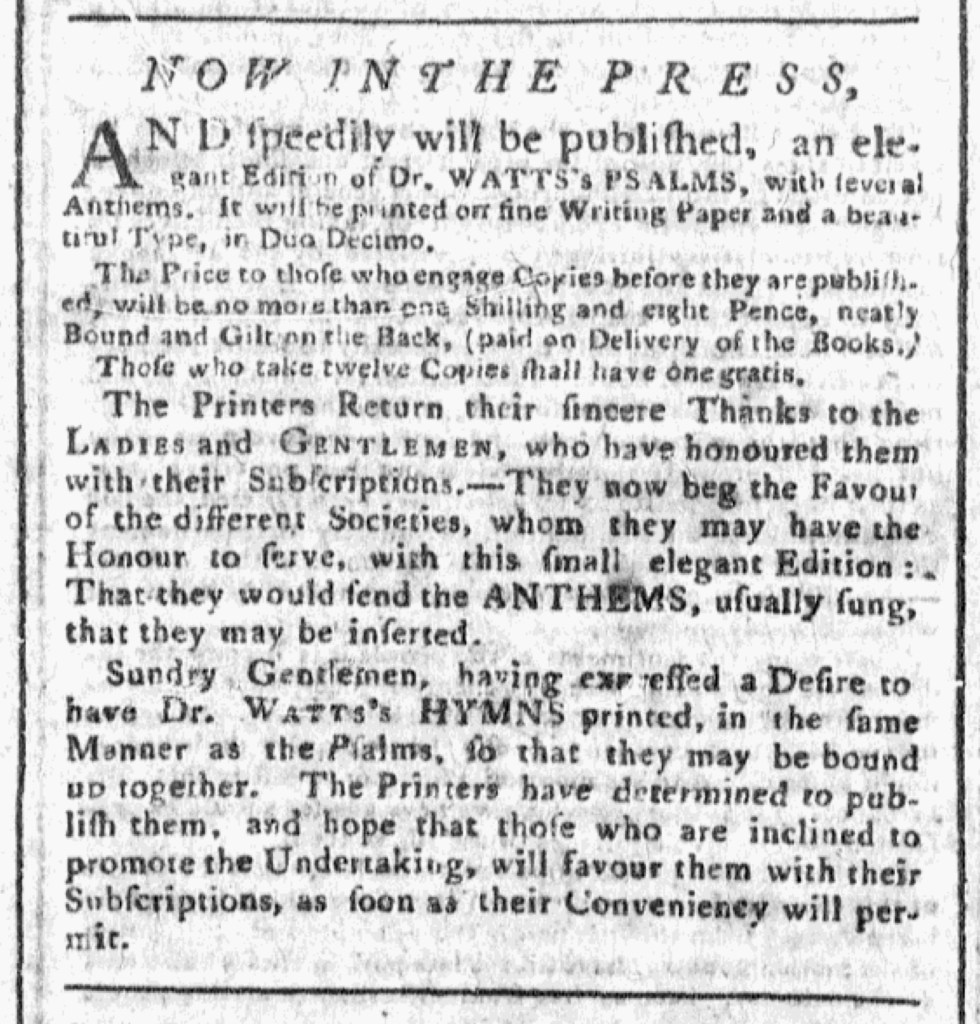
Norwich Packet (January 6, 1774).

“They now beg the Favour of the different Societies … That they would send the ANTHEMS, usually sung, that they may be inserted.”

Alexander Robertson, James Robertson, and John Trumull, the printers of the Norwich Packet, placed a notice in their own newspaper to announce that “an Elegant Edition of DR. WATTS’s PSALMS, with several Anthems,” was “NOW IN THE PRESS.”  It was not too late for customers to qualify for the bargain price, “no more than one Shilling and eight Pence,” as long as they reserved their copies “before they are published” and offered for sale to the general public.  In addition, “Those who take twelve Copies shall have one gratis.”  Printers sometimes offered such discounts to retailers who purchased in volume to sell again, though in this case the Robertsons and Trumbull likely had congregations in mind as well.

They certainly attempted to enlist the aid of congregations in submitting additional material to enhance the project and make their edition of Isaac Watts’s translation of The Psalms of David more attractive to prospective customers.  The Robertsons and Trumbull “now beg the Favour of the different Societies, whom they may have the Honour to serve, with this small elegant Edition: That they would send the ANTHEMS, usually sung, that they may be inserted.”  Such additions would make the books all the more useful to consumers … and marketable for the printers.  Having taken the project to press, they aimed to maximize the return on their investment by producing other items that could be bound in a single volume.  The book ultimately included eleven anthems, some of them likely contributed by members of the “different Societies” that saw the advertisement in the Norwich Packet.

The Robertsons and Trumbull also envisioned a companion to “Dr. WATTS’s PSALMS.”  They reported that “Sundry Gentlemen … expressed a Desire to have Dr. WATTS’s HYMNS printed in the same Manner as the Psalms, so that they may be bound up together.”  That does not seem to have happened, at least not in the copy of Watts’s Psalms held by the Library of Congress and reproduced in America’s Historical Imprints.  The printers likely did not take that project to press, lacking sufficient demand even though they claimed “Sundry Gentleman” suggested the idea to them.  That may have been a ploy to encourage prospective buyers to reserve copies in advance, but when they did not materialize the Robertsons and Trumbull presumably opted not to pursue publishing the hymns.

March 23

GUEST CURATOR: Zachary Dubreuil

What was advertised in a colonial American newspaper 250 years ago today?

Boston Chronicle (March 23, 1769).

“JUST PRINTED … PSALMS of DAVID.”

Religion played an important role in the colonies. This advertisement attempted to sell a book, “PSALMS of DAVID … By the Rev. Dr. WATTS.” Watts (1674-1748) was an English educator who later became a pastor. He wrote a series of essays and poetry on theological topics. According to the Poetry Foundation, “Watts published four volumes of poetry: Horae Lyricae; Hymns and Spiritual Songs (1707); Divine Songs Attempted in Easy Language for the Use of Children (1715); and The Psalms of David Imitated in the Language of the New Testament (1719).” In addition, “several of his Psalms are among the best-known poems in the English-speaking world. ‘Joy to the World’, for example, is Watts’s rendering of the second part of Psalm 98 in common meter.” Watts’s work is still being used today, like it was during colonial times. This advertisement for a religious book shows us how much many colonists valued religion.

**********

ADDITIONAL COMMENTARY: Carl Robert Keyes

John Mein’s advertisement for Isaac Watts’s Psalms of David Imitated in the Language of the New Testament was one of four notices that he inserted in the March 23, 1769, edition of the Boston Chronicle, the newspaper that Mein published with partner John Fleeming. The others included an advertisement for the second edition of Bickerstaff’s Boston Almanack, one for Mein and Fleeming’s Register for New-England and Nova-Scotia, and one in which Mein offered to purchase entire libraries or exchange books. These four advertisements comprised nearly two of the three columns of the final page of the issue.

Guest curator Luke DiCicco and I recently examined the advertisements for the Boston Almanack and the Register. When we published short summaries on Twitter, historian J. L. Bell questioned the number of advertisements placed by Mein and the amount of space that the printer occupied in his own publication. Did the Boston Chronicle lack other advertisers? Or did something else explain the disproportionate advertising related to Mein’s own ventures? After all, other printers regularly placed notices in their own newspapers, but not usually to the same extent.

Three factors likely played a role in the overabundance of advertising by the printer. The Boston Chronicle competed with several other newspapers. It had commenced publication less than a year and a half earlier, while the Boston Evening-Post, the Boston-Gazette, the Boston Post-Boy, and the Boston Weekly News-Letter had been around for years or even decades. From its inception, the Chronicle had fewer advertisements than any of the other newspapers printed in Boston. It took time to build a clientele of readers, subscribers, and advertisers. In 1769, many prospective advertisers likely considered placing their advertisements in other newspapers a better investment. Part of that may have been due to the second factor, Mein’s vocal Tory sentiments. The advertisement for the Register, especially the inclusion of “BRITISH LISTS,” celebrated the colonies’ connection to Britain at a time when many colonists engaged in resistance to abuses by Parliament, including the Townshend Acts. Some prospective advertisers may have been hesitant to hawk their wares in the Chronicle due to the political sympathies expressed by the printers, especially Mein. This hypothesis requires further research. Finally, if Mein still had surplus copies of the Boston Almanack and the Register twelve weeks into 1769 then he desperately needed to sell them. That alone may have justified giving so much space to the advertisements, especially since they promoted reference information good throughout the year, such as lists of colonial officials and the correct dates when the courts would be in session, rather than the astronomical calculations.

Mein’s advertisement for Watts’s Psalms of David was just one several that called attention to his various ventures. As printer of the Boston Chronicle, he exercised his prerogative over the content, filling much of the final page with notices related to his “LONDON BOOK-STORE” on King Street.