March 11

What was advertised in a revolutionary American newspaper 250 years ago today?
Norwich Packet (March 11, 1776).

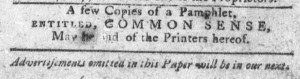
“A few Copies of a Pamphlet, ENTITLED, COMMON SENSE, May be had of the Printers hereof.”

Alexander Robertson, James Robertson, and John Trumbull, the printers of the Norwich Packet, ran out of space for all the content intended for the March 11, 1776, edition of their newspaper.  They inserted a brief notice advising, “Advertisements omitted in this Paper will be in our next.”  They did have just enough space to insert a revised advertisement for Thomas Paine’s Common Sense immediately above that notice: “A few Copies of a Pamphlet, ENTITLED, COMMON SENSE, May be had of the Printers hereof.”

Norwich Packet (March 11, 1776).

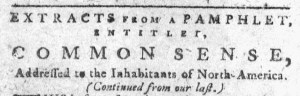
The printers first ran a variation of that advertisement on February 26, but that was not the extent of the notice that Common Sense received in that issue.  Nathanel Patten, a bookbinder and stationer, inserted a separate advertisement that provided an overview of the contents by listing the section headings.  That replicated advertisements for Common Sensethat previously appeared in other newspapers.  In addition, the Robertsons and Trumbull published “EXTRACTS from aPamphlet entitled COMMON SENSE; addressed to the INHABITANTS of AMERICA” on the third page.  In making their selection, they passed over the first section of the pamphlet, “Of the Origin and Design of Government in general, with concise Remarks on the English Constitution,” and went directly to the second section, “Of MONARCHY and hereditary succession.”  The printers devoted half a column to the “EXTRACTS” and promised, “[To be continued.]” They were more generous the following week, allowing nearly two columns for “EXTRACTS FROM A PAMPHLET, ENTITLED, COMMON SENSE.”  In the issue that “omitted” advertisements and promised publication “in our next,” the printers designated two columns for further “EXTRACTS.”  They sacrificed valuable advertising revenue as they disseminated a portion of the popular political pamphlet to readers, though they may have recouped some of that lost revenue by enticing readers to purchase the pamphlet.  The Robertsons and Trumbull continued publishing “EXTRACTS” in another two columns on March 18 and just over two columns on March 25.  On April 1, they gave over the entire first page and another two columns on the last page to continuing the “EXTRACTS.”  On April 8, they concluded the extracted portion of Common Sense, once again featuring it on the first page along with nearly two columns on the last page.  They also promised more material related to the pamphlet, “Additions to the above,” in the next issue.  The Robertsons and Trumbull made it possible for colonizers to engage with Common Sense along multiple trajectories. They could purchase the entire pamphlet and read it for themselves, peruse the extracts in the Norwich Packet, and discuss what they read with others who debated the merits of declaring independence.

November 27

What was advertised in a revolutionary American newspaper 250 years ago today?

Norwich Packet (November 27, 1775).

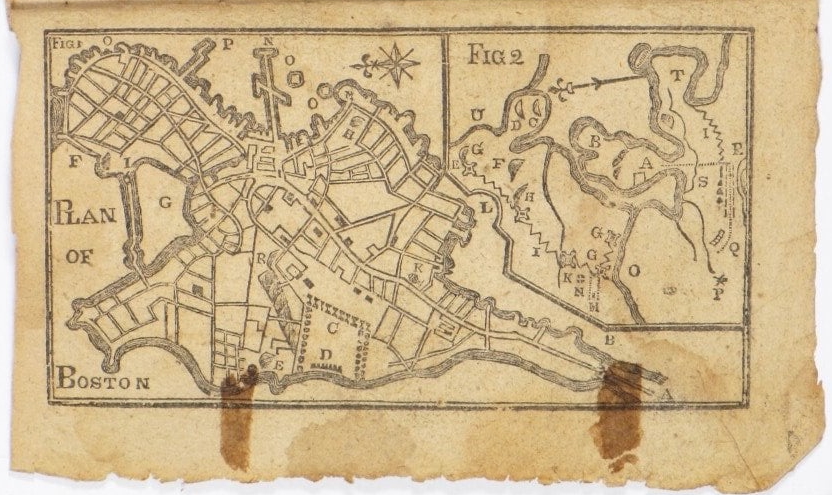
“Illustrated with a beautiful PLAN OF BOSTON, AND THE PROVINCIAL CAMP.”

When Alexander Robertson, James Robertson, and John Trumbull, printers of the Norwich Packet, advertised Bickerstaff’s New-England Almanack, For the Year of Our Lord, 1776, they promoted the “beautiful PLAN OF BOSTON, AND THE PROVINCIAL CAMP” that accompanied the handy reference volume.  Like many other almanacs for 1776 (published in the final months of 1775), this one featured items related to the events that had transpired since the battles at Lexington and Concord on April 19.  In addition to the map of Boston, it also contained the “Method of making Gun-Powder, which at this Juncture may be carried into Execution in a small Way, by almost every Farmer in his own Habitation.”  In a resolution passed in late June, the Second Continental Congress encouraged colonizers to contribute to the American cause by manufacturing gunpowder and saltpeter in small batches.

As a marketing strategy, the printers highlighted the “PLAN OF BOSTON, AND THE PROVINCIAL CAMP” that depicted the ongoing siege of Boston by the American army under the command of George Washington.  Along with the headline in the advertisement, they listed the elements of the “very neat Plan of the Town of Boston, shewing at one View, the Provincial Camp, Boston Neck, Fortifications, Commons, Battery, Magazine, … Liberty Tree, … Bunker’s Hill, … Provincial Lines, … Roxbury Hill Lines, Ministerial Army’s Lines,” and many other significant sites in the area.  The Robertsons and Trumbull declared that this map was “Equally accurate with that sold in the southern Colonies at one Spanish Dollar.”  Consumers did indeed have other options for purchasing similar maps, either separately or inserted in the Pennsylvania Magazine or inserted in another almanac.  Indeed, the map that accompanied Bickerstaff’s New-England Almanack looked almost identical to the one that illustrated “HUTCHIN’s Improv’d,” printed and sold by Hugh Gaine in New York.  Maps of Boston proliferated in 1775 as printers sought to generate revenues while keeping the public informed about current events and consumers sought materials beyond news reports to help them envision and understand what occurred in Massachusetts as resistance became revolution.

“Plan of Boston,” in Bickerstaff’s New-England Almanack, for the Year of Our Lord, 1776 (Norwich, Connecticut: Robertsons and Trumbull, 1775). Courtesy Boston Rare Maps.

January 6

What was advertised in a colonial American newspaper 250 years ago today?

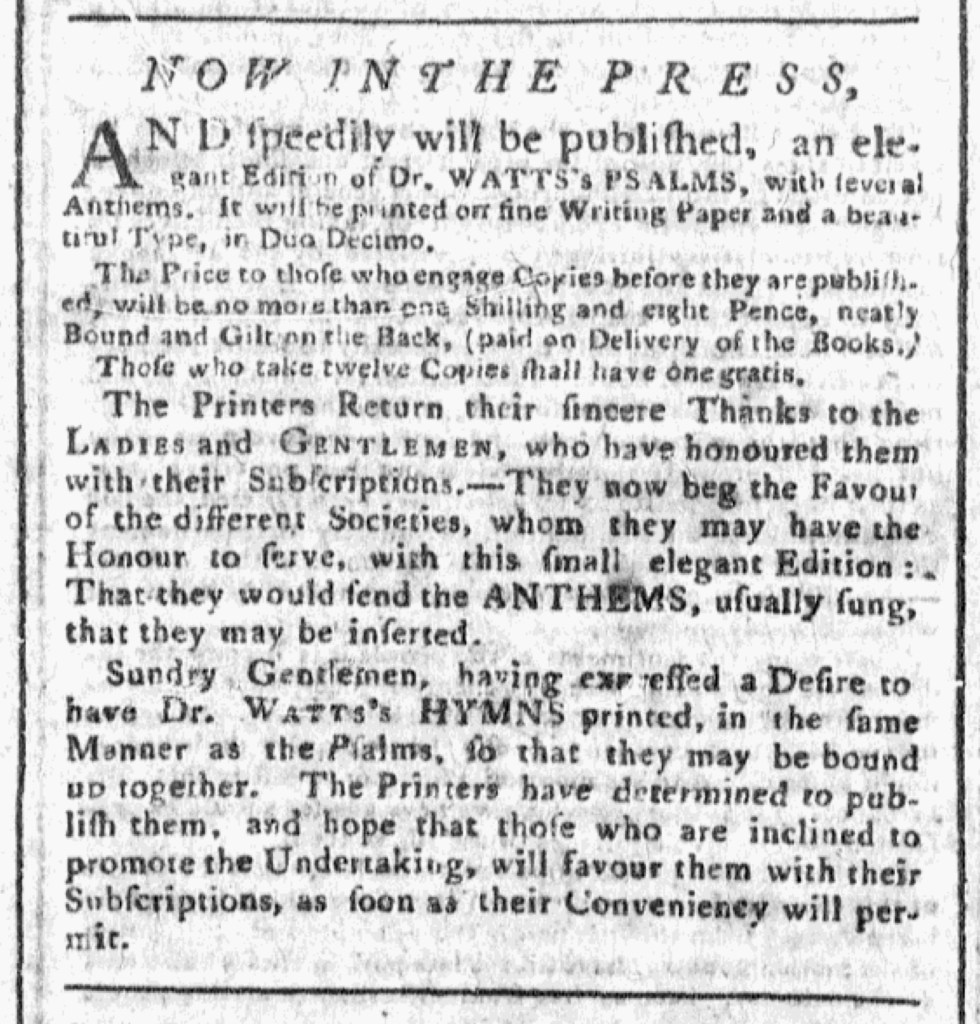
Norwich Packet (January 6, 1774).

“They now beg the Favour of the different Societies … That they would send the ANTHEMS, usually sung, that they may be inserted.”

Alexander Robertson, James Robertson, and John Trumull, the printers of the Norwich Packet, placed a notice in their own newspaper to announce that “an Elegant Edition of DR. WATTS’s PSALMS, with several Anthems,” was “NOW IN THE PRESS.”  It was not too late for customers to qualify for the bargain price, “no more than one Shilling and eight Pence,” as long as they reserved their copies “before they are published” and offered for sale to the general public.  In addition, “Those who take twelve Copies shall have one gratis.”  Printers sometimes offered such discounts to retailers who purchased in volume to sell again, though in this case the Robertsons and Trumbull likely had congregations in mind as well.

They certainly attempted to enlist the aid of congregations in submitting additional material to enhance the project and make their edition of Isaac Watts’s translation of The Psalms of David more attractive to prospective customers.  The Robertsons and Trumbull “now beg the Favour of the different Societies, whom they may have the Honour to serve, with this small elegant Edition: That they would send the ANTHEMS, usually sung, that they may be inserted.”  Such additions would make the books all the more useful to consumers … and marketable for the printers.  Having taken the project to press, they aimed to maximize the return on their investment by producing other items that could be bound in a single volume.  The book ultimately included eleven anthems, some of them likely contributed by members of the “different Societies” that saw the advertisement in the Norwich Packet.

The Robertsons and Trumbull also envisioned a companion to “Dr. WATTS’s PSALMS.”  They reported that “Sundry Gentlemen … expressed a Desire to have Dr. WATTS’s HYMNS printed in the same Manner as the Psalms, so that they may be bound up together.”  That does not seem to have happened, at least not in the copy of Watts’s Psalms held by the Library of Congress and reproduced in America’s Historical Imprints.  The printers likely did not take that project to press, lacking sufficient demand even though they claimed “Sundry Gentleman” suggested the idea to them.  That may have been a ploy to encourage prospective buyers to reserve copies in advance, but when they did not materialize the Robertsons and Trumbull presumably opted not to pursue publishing the hymns.

June 22

What was advertised in a colonial American newspaper 250 years ago today?

Connecticut Courant (June 22, 1773).

“PROPOSALS, For PUBLISHING, upon a PLAN entirely new, a Periodical PAPER.”

For several years, three newspapers served residents of Connecticut, the New-London Gazette (established as the Connecticut Gazette in November 1763), the Connecticut Courant (established October 1764), published in Hartford, and the Connecticut Journal and New-Haven Post-Boy (founded October 1767).  In addition, the Newport Mercury, the Providence Gazette, and several newspapers published in New York circulated in Connecticut.  In 1773, Alexander Robertson, James Robertson, and John Trumbull made plans to launch a fourth newspaper in the colony.  To that end, they distributed subscription proposals for the “NORWICH PACKET, OR THE CONNECTICUT, MASSACHUSETTS, NEW-HAMPSHIRE, AND RHODE-ISLAND INTELLIGENCER, AND WEEKLY ADVERTISER.”  They intended for their newspaper to serve a region that extended far beyond the town where they published it.

As was the case with the Maryland Journal (published in Baltimore) and Rivington’s New-York Gazetteer, it took some time for the printers to amass a sufficient number of subscribers to commence publication.  The Robertsons and Trumbull stated that the “first Paper will be published as soon as a competent Number of Subscribers are procured.”  They printed the first issue in October 1773, the Norwich Packet became the third new newspaper in the colonies that year.  That brought the total to thirty-three newspapers throughout the colonies, most of them in English along with two in German published in Pennsylvania.  By the end of the year, the New-York Gazette or Weekly Post-Boy folded, while Isaiah Thomas and Henry-Walter Tinges established the Essex Journal in Newburyport, Massachusetts.  Even as a few newspapers, such as the Boston Chronicle, went out of business in the early 1770s, colonizers gained access to a greater variety of newspapers in the years just before the American Revolution.  Overall, the total number rose from twenty-six in 1765 to thirty-one in 1770 to forty-three in 1775.  During the Revolutionary War, several of those newspapers ceased or paused publication.  Printers founded others to supply colonizers with information about the war, commerce, and other news.

The Norwich Packet continued publication throughout most of the war, though suspended from late September 1782 through late October 1783.  The Robertsons and Trumbull, however, parted ways.  In May 1776, Trumbull became the sole publisher when the Robertsons, who were Loyalists, relocated to New York.  In their subscription proposals, the three printers asserted that they planned to publish a “succinct detail of the Proceedings of the Parliament of Great-Britain, especially such as relate to America, and the political Manoeuvres of the Statesmen in and out of Administration.”  How to interpret and respond to those “Proceedings” and “Manoeuvres” eventually resulted in such deep fissures that some colonizers declared and fought for independence while others remained loyal to Britain.  When the Robertsons and Trumbull established the Norwich Packet, the updates and editorials in the newspaper helped shape public discourse about the relationship between the colonies and Parliament.  Within just a couple of years, the Norwich Packet related and recorded many of the events of the Revolutionary War.  In order to publish “the most recent Advices of every remarkable Event,” however, the printers first had to convince “THE PUBLIC” to subscribe.