November 21

What was advertised in a revolutionary American newspaper 250 years ago today?
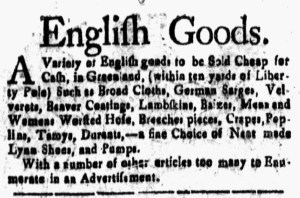
New-Hampshire Gazette (November 21, 1775).

“English Goods … within ten yards of Liberty Pole.”

An anonymous advertiser hawked “A Variety of English goods” in the November 21, 1775, edition of the New-Hampshire Gazette.  The notice included a short list of imported items, mostly textiles, such as “Broad Cloths, … Velverets, … Poplins, Tamys, [and] Durants,” as well as “Mens and Womens Worsted Hose [and] Breeches pieces.”  That list apparently did not cover everything available for sale; the advertisement concluded with a note about “a number of other articles too many to Enumerate in an Advertisement.”

That may have been the advertiser’s choice since some merchants and shopkeepers did occasionally resort to similar language, though it may have been a decision influenced by the printer, Daniel Fowle.  That issue of the New-Hampshire Gazette consisted of only two pages instead of the usual four.  It was the first issue of the New-Hampshire Gazette since November 8.  The printer did not produce and circulate an issue the previous week.  The Adverts 250 Project has tracked apparent disruptions in the supply of paper that had an impact on the New-Hampshire Gazette, yet that was not the only difficulty the printer faced.  In the monumental History and Bibliography of American Newspapers, 1690-1820, Clarence S. Brigham notes that Fowle announced that he printed the November 2 edition “‘with great difficulty’ because of the threatened British attack on Portsmouth” and that the printer “stated that the press ‘is removed to Greenland, about six miles from Portsmouth.”[1]  Those circumstances may have played a role in the decision to publish an abbreviated advertisement that promised a greater selection of goods than appeared in print.

The advertisement presents other questions about consumer culture during the era of the American Revolution.  The Continental Association, a nonimportation and nonconsumption agreement devised by the First Continental Congress, was in effect, yet the unnamed advertiser boldly marketed imported goods.  The headline, “English Goods,” appeared in a larger font than anything else in that issue except for the title of the newspaper in the masthead.  The advertiser conveniently did not mention when the goods had arrived in the colonies, whether they had been transported and delivered before the boycott went into effect.  Yet the advertiser did acknowledge current events when giving the location to purchase the imported goods: “within ten yards of [the] Liberty Pole” in Greenland.  In his recent book on the consumption and politics of tea during the era of the American Revolution, James R. Fichter argues that many tea retailers did not face repercussions while tea importers certainly did.  He further contends that advertisements revealed the reality of local commerce compared to the propaganda that appeared in news articles and editorials about tea.[2]  Perhaps something similar occurred with these “English Goods” in Greenland in the late fall of 1775.

**********

[1] Clarence S. Brigham, History and Bibliography of American Newspapers, 1690-1820 (American Antiquarian Society, 1947), 471.

[2] James Fichter, “Truth in Advertising,” in Tea: Consumption, Politics, and Revolution, 1773-1776 (Cornell University Press, 2023), 132-157.
December 14

What was advertised in a colonial American newspaper 250 years ago today?

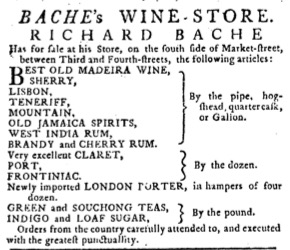
Pennsylvania Journal (December 14, 1774).

“GREEN and SOUCHONG TEAS.”

A year after the Boston Tea Party, advertisements for tea continued to appear in newspapers throughout the colonies.  They even continued to run after the Continental Association, a nonimportation agreement adopted by the First Continental Congress, went into effect on December 1, 1774.  The December 14, 1774, edition of the Pennsylvania Journal, for instance, carried two advertisements, side by side at the top of the final page, that included tea among the commodities offered for sale.  “BACHE’s WINE-STORE” stocked more than just wine and spirits.  Richard Bache also promoted “GREEN and SOUCHONG TEAS … By the pound.”  Similarly, “JOHN MITCHELL’s Wine, Spirit, Rum and Sugar STORES” provided consumers with “Bohea Tea, warranted good, by the chest, half chest or dozen” and “Best Green and Hyson Tea, by the dozen or pound.”  These advertisements apparently did not meet with the sort of ire that resulted in Bache or Mitchell quickly discontinuing them.  Instead, James R. Fichter documents in Tea: Consumption, Politics, and Revolution, 1773-1776, that “between May 1774 and March 1775 their ads appeared most weeks.”[1]

That seems incongruous considering the editorial position of the Pennsylvania Journal and the actions of William Bradford, one of its printers.  Fichter explains that Bradford “hosted in his home the meeting which decided how to oppose the East India Company’s shipment to Philadelphia in 1773.  Furthermore, he published “John Dickinson’s denunciation of the 1773 tea scheme, the broadsides from ‘Committee on Tarring and Feathering,’ which threatened pilots” who brought ships carrying tea up the Delaware River, and the “JOURNAL OF THE PROCEEDINGS” of the First Continental Congress.  On July 27, 1774, the Pennsylvania Journal altered its masthead to include a woodcut depicting a severed snake, each segment labeled to represent one of the colonies, and the motto, “UNITE OR DIE.”  How did advertisements that offered tea for sale find their way into such a newspaper so regularly?  Fichter explains that Bradford “was also a business” as well as a Patriot.  Like other newspaper printers who shared his political principles, he “did not censor tea ads” but instead “ran these ads as long as they were politically permissible.”  Even so late in 1774, “discourse and consumption were only partially politicized,” Fichter asserts, “and advertisements remained separate from but parallel to political debate.”[2]  While that was the case for advertisements about tea, other advertisements did take positions, either implicitly or explicitly, about the politics of consumption, yet Fichter demonstrates the complexity and nuance in how printers, advertisers, and the public approached such issues.  Neither the Boston Tea Party nor the Continental Association resulted in colonizers immediately giving up tea or other imported goods.

**********

[1] James R. Fichter, Tea: Consumption Politics, and Revolution, 1773-1776 (Ithaca: Cornell University Press, 2023), 143.

[2] Fichter, Tea, 143.

March 8

What was advertised in a colonial American newspaper 250 years ago today?

Connecticut Courant (March 8, 1774).

Best Bohea TEA, Such as Fishes never drink!!”

Nearly three months after the destruction of tea now known as the Boston Tea Party, William Beadle of Wethersfield, Connecticut, published an advertisement that alluded to the event.  “Best Bohea TEA, Such as Fishes never drink!!” he proclaimed in a notice in the March 8, 1774, edition of the Connecticut Courant.  Two manicules, one at each end, directed readers to the phrase “Such as Fishes never drink!!”  The double exclamation points gave the comment even more exuberance, especially considering that exclamation points rarely appeared in eighteenth-century newspaper notices.  Beadle’s advertisement certainly differed from those placed by merchants and shopkeepers who assured prospective customers and the public that they did not stock tea and, by extension, opposed Parliament’s attempts to impose duties on the colonies.

What message did Beadle intend for readers of the Connecticut Courant?  What kind of commentary did he offer about consumer politics?  James R. Fichter examines Beadle’s advertisement in his recently published Tea: Consumption, Politics, and Revolution, 1773-1776.  Fichter indicates that Beadle’s neighbors “knew him as a man … who dabbled in dark and ambiguous humor.”  Some of that humor was on display in his previous advertisements.  Perhaps Beadle made a joke “at the expense of the Boston tea partiers or the drinkers deprived of their tea.”  After all, humor about the destruction of the tea already spread.  As Fichter recounts, Peter Oliver, a noted loyalist, reported that “some Bostonians abstained from eating local fish ‘because they had drank of the East India Tea.’”  Was Beadle taking a political position and mocking the excesses of patriots in Boston and other cities and towns who stopped selling tea?  Fichter also suggests that Beadle could have been “drawing attention to Connecticut not having a tea boycott” or he might have meant that he carried Dutch tea smuggled into the colonies.  Consumers could purchase and drink such tea with a clear conscience since it had not been subject to Parliament’s duties.  Yet Beadle may not have been making a political argument at all.  Perhaps he just wanted to publish the boldest advertisement, gain the most attention, and garner the most customers among merchants and shopkeepers who continued to advertise and sell tea in Connecticut.  According to Fichter, “Tea advertising remained common in Connecticut, and Beadle bore little burden for his cheek: he placed generic advertisements for tea throughput the spring and summer of 1774 and early 1775.”[1]

**********

[1] James R. Fichter, Tea: Consumption, Politics, and Revolution, 1773-1776 (Cornell University Press, 2023).