September 24

What was advertised in a colonial American newspaper 250 years ago today?

sep-24-9241766-georgia-gazette
Georgia Gazette (September 24, 1766).

“May be had at the Printing-Office … A SERMON.”

James Johnston, the printer of the Georgia Gazette, advertised the second edition of “A SERMON Preached in the Meeting at Savannah in Georgia, June 25th, 1766.” Although he did not specify the topic of this sermon, the four lines from Galatians that concluded the advertisement suggested that it addressed the uneasy relationship between the colonies and Great Britain that had been occasioned by Parliament’s attempts to regulate commerce within the empire, especially within its North American colonies. “Brethren, ye have been called unto liberty,” the biblical verses began, but concluded with a warning to “take heed that ye not be consumed one of another.” Johnston apparently presumed that potential customers/readers were so familiar recent political events, in general, and this sermon, in particular, that he did not need to state explicitly that it addressed the Stamp Act.

Johnston was certainly advertising John Joachim Zubly’s “The Stamp Act Repealed: A Sermon.” The title page of the second edition of that thirty-page duodecimo pamphlet included the same verses and other information that also appeared in the advertisement, including the assertion that it had been “First published at the Request and Expence of the Hearers.” The second edition was simultaneously published in Charleston by Peter Timothy and in Philadelphia by Heinrich Miller.

sep-24-pamphlet-cover
John Joachim Zubly, The Stamp-Act Repealed:  A Sermon (Savannah, GA:  James Johnston, 1766).  American Antiquarian Society.

In an introduction to the “Sermon,” Randall M. Miller notes that Zubly “captured the feelings of other prominent Georgians in 1766 who had recoiled from the strong words and threats of the Stamp Act crisis but also who had resented Parliament’s encroachment on American rights.” The sermon “stressed obedience to law and the reciprocal obligations of both Christian rulers and subjects to honor law and order.”[1]

By the time the second edition was published, colonists had known for several months that the Stamp Act had been repealed (which had led to Zubly preaching this sermon for a day of thanksgiving). One crisis had been averted, but colonists continued to grapple with their relationship to Britain, especially in the wake of the Declaratory Act. Still, few colonists were prepared at that time to sever ties with Britain. Johnston marketed a sermon that might assist readers in maintaining their identity as Britons while acknowledging that they had been slighted by Parliament. “We seemed like people that had been apprehensive of being shipwrecked and happily made a harbour,” Zubly proclaimed.[2] In publishing, marketing, and selling a second edition of the sermon, Johnston and his counterparts in Charleston and Philadelphia amplified that message to greater numbers of colonists.

**********

[1] Randall M. Miller, “A Warm & Zealous Spirit”: John J. Zubly and the American Revolution, A Selection of His Writings (Macon, GA: Mercer University Press, 1982), 31.

[2] John Joachim Zubly, The Stamp-Act Repealed: A Sermon (Savannah, GA: James Jonhnson, 1766), 28.
August 27

What was advertised in a colonial American newspaper 250 years ago today?

Aug 27 - 8:27:1766 Georgia Gazette
Georgia Gazette (August 27, 1766).

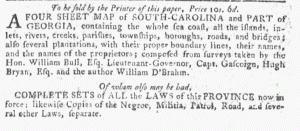
“A FOUR SHEET MAP of SOUTH-CAROLINA and PART of GEORGIA.”

James Johnston, the printer of the Georgia Gazette, advertised a “FOUR SHEET MAP of SOUTH-CAROLINA and PART of GEORGIA,” a resource that would have been particularly valuable to readers of his newspaper. Although Johnston likely printed the “COMPLETE SETS of ALL the LAWS of this PROVINCE” promoted elsewhere in his advertisement, the map most certainly had been imported from England.

In fact, the map had been produced in London nearly a decade earlier by mapmaker William Gerard de Brahm and engraver Thomas Jefferys. Historians of cartography have described the 1757 map as the most important map of South Carolina and Georgia created during the colonial period. In The Southeast in Early Maps (1958), William P. Cumming noted, “For the first time, for any large area of the southern colonies, a map possesses topographical accuracy based on scientific surveys.”

Aug 27 - Map
William Gerard de Brahm, Map of South-Carolina and Part of Georgia, engraved by Thomas Jeffreys (London: 1757).  Barry Lawrence Ruderman Antique Maps.

The advertisement made clear that the map had been carefully constructed by collating surveys conducted by William Bull, Captain Gascoign, Hugh Bryan, and William de Brahm (though it did not indicate that de Brahm had been appointed surveyor general of Georgia in 1754). The map accurately included the variety of features listed in the advertisement (“the whole sea coast, all the islands, islets, rivers, creeks, parishes, townships, boroughs, roads, and bridges” as well as the boundary lines of several plantations), making it a vast improvement over previous maps.

Johnston cannot be credit with composing copy that promoted the most useful and important features of the map. The entire description in the advertisement came directly from the title printed on the map itself. De Brahm had already embedded the necessary marketing text on the product itself!

August 13

What was advertised in a colonial American newspaper 250 years ago today?

Aug 13 - 8:13:1766 Georgia Gazette
Georgia Gazette (August 13, 1766).

“BLank bonds, bills of sale, mortgages, powers of attorney, bonds of arbitration, indentures, bills of lading …”

Like other colonial newspapers, the Georgia Gazette consistently ended with a colophon that gave the particulars concerning publication: it was printed “by JAMES JOHNSTON, at the Printing-Office in Broughton-Street” in Savannah. Also like other colonial newspapers, the colophon announced a variety of printed goods for sale. Johnston solicited advertisements and subscriptions for the Georgia Gazette, but he supplemented that revenue with job printing: “Hand-Bills, Advertisements, &c. printed at the shortest Notice.”

Regular readers may have grown accustomed to seeing the colophon and largely ignored its contents. It would have been harder to skip over this advertisement, strategically positioned as the final item in the final column on the final page (and immediately above the colophon). Whether reading the advertisements intensively or merely skimming over them, this one would have left a lasting impression among most readers thanks to its placement on the page.

The “&c.” (an eighteenth-century abbreviation for et cetera) in the colophon covered an array of printed items, but Johnston elaborated on them in this advertisement. In total, he listed a dozen kinds of printed blanks, forms intended to streamline a variety of economic transactions and legal interactions. Even this extensive list, however, ended with another “&c.” Blank forms, whether printed or online, are part of everyday life in the twenty-first century, but this advertisement suggests that colonial Americans were not strangers to filling out, handling, and reading forms themselves. It also indicates that the work done by printers facilitated diverse commercial and legal activities as their printed blanks passed from person to person within and beyond their communities.

July 23

What was advertised in a colonial newspaper 250 years ago today?

Jul 23 - 7:23:1766 Georgia Gazette
Georgia Gazette (July 23, 1766).

“Most Kinds of BLANKS to be sold at the Printing-Office.”

Eighteenth-century printers often inserted advertisements for their own wares and services in the newspapers they published. They hoped to generate additional revenues, but they may have also strategically placed their own advertisements as a means of generating content that would fill space. Unlike other advertisers who usually purchased “squares” of advertising, thus paying by the length of the advertisement, printers who promoted their own enterprises did not have to factor the length of their advertisements into their calculations. That sometimes resulted in lengthy advertisements or multiple notices in a single issue.

In this case, however, printer James Johnston inserted a very brief advertisement, a single line announcing, “Most Kinds of BLANKS to be sold at the Printing-Office.” (By blanks, Johnston meant a variety of forms, including indentures.) The advertisement appeared at the bottom of the second and final column on the last page of the newspaper, nestled right above the colophon. Johnston needed one more line of text to complete the column. This one had the added benefit of drawing attention to one of the services he provided.

Jul 23 - 7:23:1766 Colophon Georgia Gazette
Georgia Gazette (July 23, 1766).

Like many other eighteenth-century printers, Johnston also used the colophon (the space devoted to publication information, including printer and location, at the end of the newspaper) to promote both the newspaper and other parts of his business. In addition to noting that the Georgia Gazette was “Printed by JAMES JOHNSTON, at the Printing-Office in Broughton-Street” in Savannah, it also announced that he sold subscriptions and advertisements. Furthermore, he did job printing (like the blanks) “at the shortest Notice,” including handbills and other forms of advertising (such as broadsides, trade cards, or circular letters).

Throughout the eighteenth century, Johnston and other printers creatively shaped newspaper colophons to do more than provide basic publication information. They use them to promote other services available in their printing shops.
