October 13

What was advertised in a colonial American newspaper 250 years ago today?
Rivington’s New-York Gazetteer (October 13, 1774).

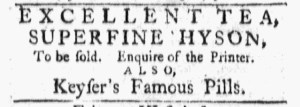
“EXCELLENT TEA, SUPERFINE HYSON.”

Advertisements for tea did not disappear from American newspapers immediately following the Boston Tea Party, nor did they disappear in anticipation of nonimportation agreements enacted in protest of the Coercive Acts that Parliament passed in response.  In Tea: Consumption, Politics, and Revolution, 1773-1776, James R. Fichter notes, “Printers Isaiah Thomas (Patriot) and James Rivington (Loyalist) used their newspapers to advertise their own tea.”[1]  Rivington did so in the October 13, 1774, edition of Rivington’s New-York Gazetteer, offering both “EXCELLENT TEA, SUPERFINE HYSON,” and “Keyser’s Famous Pills,” one of the most famous patent medicines of the era.

Yet that was not only advertisement for tea in that issue.  In the next column, Abraham Duryee provided an extensive list of imported merchandise that concluded with a familiar list: “sugar, tea, coffee, corks, &c. &c. &c.”  On the next page, tavernkeeper Edward Bardin once again inserted his advertisement that promoted “TEA and COFFEE every afternoon” among the amenities available at his establishment.  In the two-page supplement, filled entirely with advertisements, William Parsons included “Green Tea” among the wares in stock at his store.  Peter Elting sold “best Hyson and Bohea tea” along with other groceries.  Fichter reports that Rivington’s New-York Gazetteer “carried tea ads until early 1775, reaching colonies where local tea advertising had already ended.”[2]  Colonial newspapers tended to circulate across regions, including Rivington’s New-York Gazetteer; or, the Connecticut, Hudson’s Rivers, New-Jersey, and Quebec Weekly Advertiser.

Rivington’s editorial stance as well as the advertisements for tea in his newspaper caught the attention of Patriots in New York and beyond.  They often burned Rivington’s New-York Gazetteer, both along with tea and separately.  Furthermore, Fichter identifies “[c]ommittees in at least twenty communities from Rhode Island to South Carolina called for boycotts of his Gazetteer” and “also pressed Rivington’s advertisers” by “urg[ing] ‘Friends of America’ to avoid Rivington and his advertisers.”[3]  Even as tea became the subject of news coverage and editorials and advertisements for tea no longer appeared in some colonial newspapers, other continued to publish advertisements for tea for more than a year after the Boston Tea Party.  The commodity was hotly contested, even as Patriots attempted to impose a boycott of the problematic beverage.

**********

[1] James R. Fichter, Tea: Consumption, Politics, and Revolution, 1773-1776 (Ithaca: Cornell University Press, 2023), 144.

[2] Fichter, Tea, 154.

[3] Fichter, Tea, 208.
July 28

What was advertised in a colonial American newspaper 250 years ago today?

Rivington’s New-York Gazetteer (July 28, 1774).

“Excellent Tea.”

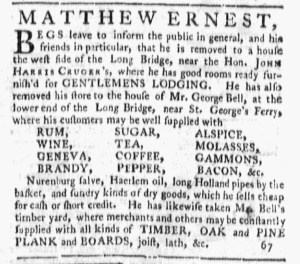
Despite the complicated politics of tea in the wake of the Boston Tea Party and the Boston Port Act that closed and blockaded the harbor as punishment, some merchants and shopkeepers continued to sell tea and printers continued to publish their advertisements in the summer of 1774.  At the same time that many advertisers quietly dropped tea from the lists of merchandise in their newspaper notices, others refused to do so.  In New York, for instance, Matthew Ernest enumerated a dozen commodities that customers could acquire at his store.  In capital letters in three columns, making each item easy for readers to spot, Ernest listed “RUM, WINE, GENEVA, BRANDY, SUGAR, TEA, COFFEE, PEPPER, ALSPICE, MOLASSES, GAMMONS, [and] BACON.”  The merchant supplied tea to consumers willing to purchase it.

Rivington’s New-York Gazetteer (July 28, 1774).

One printer, James Rivington, even sold tea himself or acted as a broker for a customer who did wish for their name to appear in print.  For many weeks, Rivington’s New-York Gazetteer ran an advertisement that announced “Excellent Tea” in a font much larger than almost anything else that appeared among news or advertisements.  It further clarified, “SUPERFINE HYSON, To be sold.  Enquire of the Printer.”  Colonial printers often stocked books, stationery, patent medicines, and other goods, so perhaps Rivington sought to supplement revenues with tea.  On the other hand, an advertisement on the same page as the “Excellent Tea” notice in the July 28 edition promoted “Middleton’s incomparible Pencils, Red and black Lead, Sold by James Rivington.”  Whether or not he was the purveyor of the tea or merely a broker, the printer disseminated the advertisement and sought to earn money through trucking in tea.

In Tea: Consumption, Politics, and Revolution, 1773-1776, James R. Fichter argues that most colonizers who continued to advertise tea did not face significant repercussions, quite a different interpretation than the traditional narrative.  “If we only look at people who got in trouble over tea,” Fichter states, “we will think tea was troublesome.  But if we note the hundreds of people who did not get in trouble over tea, we see a very different story.”[1]  Even as the imperial crisis intensified, there was still space in the public marketplace for advertising and selling tea in the summer of 1774.

**********

[1] James R. Fichter, Tea: Consumption, Politics, and Revolution, 1773-1776 (Ithaca: Cornell University Press, 2023), 145.

April 24

What was advertised in a colonial American newspaper 250 years ago this week?

Rivington’s New-York Gazetteer (April 21, 1774).

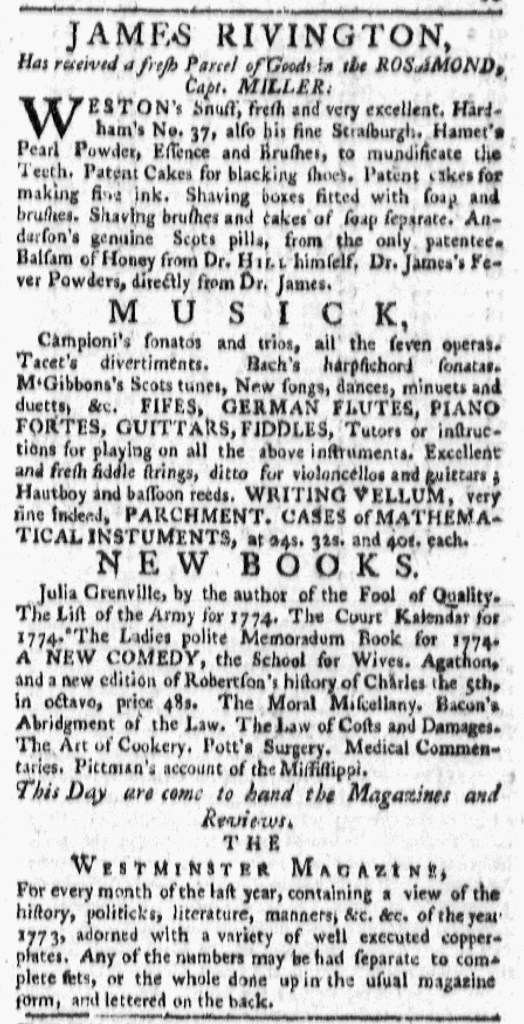
“Any number may be had separate to complete sets, or the whole done up in the usual magazine form.”

James Rivington, the printer of Rivington’s New-York Gazetteer, cultivated alternate revenue streams at his printing office.  Many printers were also booksellers, peddling books they imported from England.  Such was the case with Rivington.  He devoted a portion of his advertisement in the April 21, 1774, edition of his newspaper to “NEW BOOKS,” listing several that he had on hand.  He also promoted other items from among the “fresh Parcel of Goods” he recently received.  Like many other printers, he sold “cakes for making ink” and popular patent medicines, yet he also stocked a more elaborate inventory of other kinds of goods, including “Shaving boxes fitted with soap and brushes,” “CASES of METHEMATICAL INSTRUMENTS,” and “WESTON’s Snuff, fresh and very excellent.”

The printer and bookseller also advised prospective customers that “This Day are come to hand the Magazines and Reviews.”  In particular, he hawked “THE WESTMINSTER MAGAZINE,” proclaiming that he had copies “For every month of the last year.”  An associate on the other side of the Atlantic had assembled the annual run of the magazine and shipped it to Rivington to peddle to colonizers interested in a review of “the history, politicks, literature, manners,” and other cultural touchstones “of the year 1773.”  To further entice readers, the magazine was “adorned with a variety of well executed copperplates” that buyers could leave intact or remove to frame and display in homes, shops, or offices.  For those who had already purchased some editions but not others, Rivington allowed that “Amy of the numbers may be had separate to complete sets.”  He also offered “the whole done up in the usual magazine form, and lettered on the back.”  In other words, a bookbinder would compile all the issues of the Westminster Magazine from 1773 into a single bound volume and label the spine.  That transformed the separate issues from ephemera into an attractive collection that would enhance any library.

Rivington advertised the Westminster Magazine at the same time that Isaiah Thomas continued marketing the Royal American Magazine, the publication that he launched earlier in the year.  The Royal American Magazine was the only magazine published in the colonies at the time.  Only about a dozen American magazines had been published before that, most of them folding in less than a year and none of them lasting longer than three years.  Instead of American magazines, colonizers usually bought imported magazines from booksellers or received them from correspondents.  Rivington’s method of importing, advertising, and disseminating the Westminster Magazine and other magazines was familiar and standard practice, making the Royal American Magazine the novelty in the American marketplace.

January 2

What was advertised in a colonial American newspaper 250 years ago this week?

Rivington’s New-York Gazetteer (December 30, 1773).

“NEW-YEAR’S PRESENTS.”

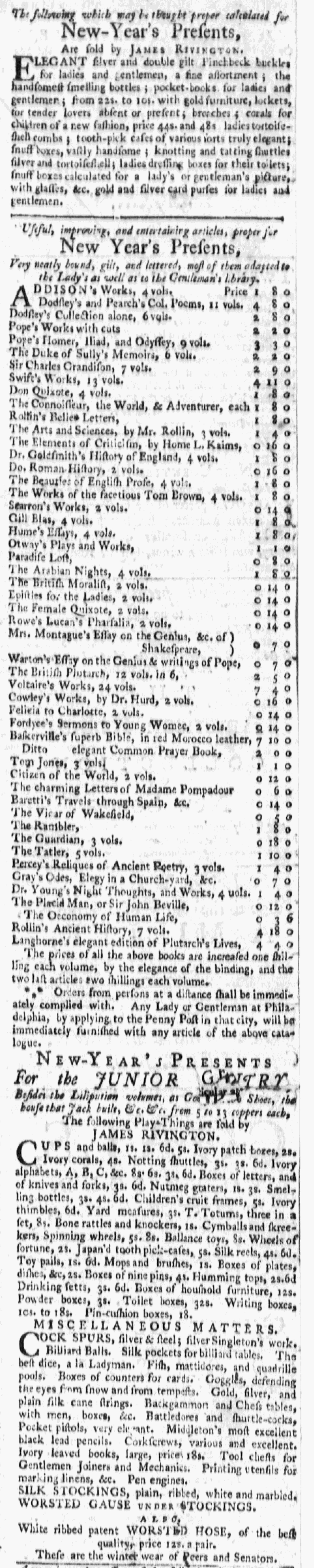
Rarely did retailers associate Christmas and consumption in newspaper advertisements they published in the 1760s and 1770s.  They were just as likely to identify the new year as a time to give presents, though relatively few adopted that strategy either.  James Rivington, a bookseller, stationer, and printer of Rivington’s New-York Gazetteer, was among those who suggested to consumers that they should purchase presents to commemorate the occasion.  His advertisements filled an entire column in the December 30, 1773, edition of his newspaper.

As the first day of the new year approached, Rivington advised that he stocked “[t]he following which may be thought proper calculated for New-Year’s Presents.”  He listed a variety of items, including “ELEGANT silver and double gilt Pinchbeck buckles for ladies and gentlemen, a fine assortment,” “snuff boxes, vastly handsome,” “ladies dressing boxes for their toilets,” and “pocket-books for ladies and gentlemen.”  Rivington made clear that both women and men could be recipients of these “New-Year’s Presents,” even though editorials and other commentary often depicted women as the perpetrators of conspicuous, frivolous, or unnecessary consumption.

Rivington also presented a catalog of books as “Useful, improving, and entertaining articles, proper for New Year’s Presents,” most of them suitable for recipients of either sex.  He described the books as “very neatly bound, gilt, and lettered, most of them adapted to the Lady’s as well as to the Gentleman’s Library.”  They included “Pope’s Works with cuts” (or illustrations), “Dr. Goldsmith’s History of England,” “Paradise Lost,” “Mrs. Montague’s Essay on the Genius, &c. of Shakespeare,” “The charming Letters of Madame Pompadour,” and “Gray’s Odes, Elegy in a Church-yard.”  Unlike most book catalogs published as newspaper advertisements, this one included the prices for each volume.  Those contemplating giving them as gifts could take into account their budget and their relationship to the recipient when considering their purchases.  Rivington also encouraged readers living beyond New York to give books as gifts for the new year, declaring that “Orders from persons at a distance shall be immediately complied with.”  Those in Philadelphia, he directed, could “immediately” acquire any of the books “by applying to the Penny Post in that city.”

In addition to gifts for adults, Rivington also marketed “NEW-YEAR’S PRESENTS For the JUNIOR GENTRY.”  He sold books for children, “Liliputian volumes,” as well as “Play-Things.”  The toys included “CUPS and balls,” “Ivory alphabets, A, B, C,” “Bones rattles and knockers,” “Humming tops,” and “Toy pails.”  Once again, he listed prices so prospective customers could assess how much they wished to spend on gifts.

Rivington concluded that advertisement with a list of “MISCELLEANOUS MATTERS” that he apparently did not consider as appropriate for giving as presents.  In a final advertisement in that column, he promoted a “new and corrected edition” of “Rivington’s Gentleman and Ladys Pocket Almanack.”  Although he did not suggest giving the almanac as a gift, the printer considered it “Necessary to every one, in and out of Business, and useful in every Colony upon the Continent.”  A couple of days before the new year was the perfect time to purchase an almanac and, according to Rivington, items that customers might not otherwise have purchased but would give as gifts.

December 16

What was advertised in a colonial American newspaper 250 years ago today?

Rivington’s New-York Gazetteer (December 16, 1773).

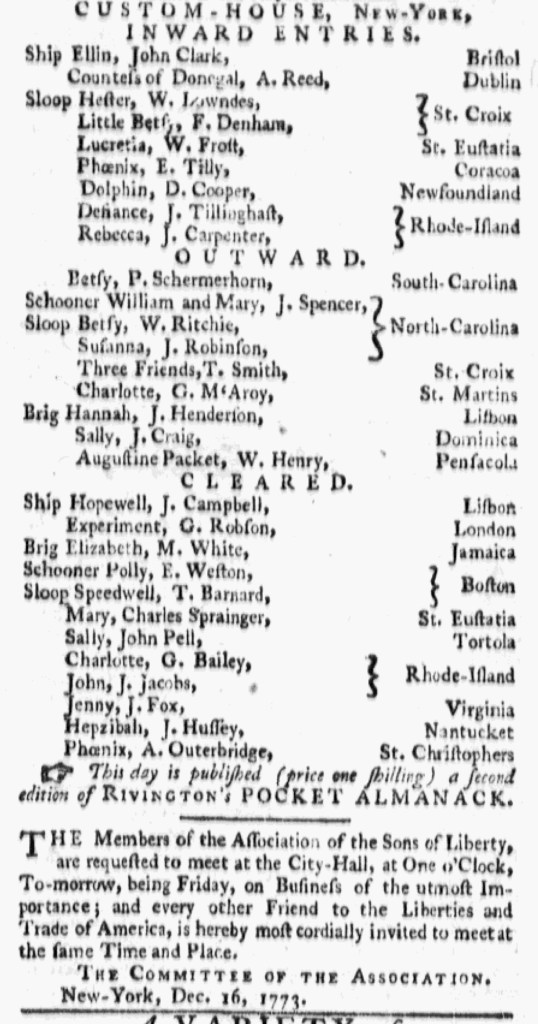
“The Sons of Liberty, are requested to meet at the City-Hall.”

James Rivington, bookseller and printer of Rivington’s New-York Gazetteer, is most often remembered as a Loyalist.  He began publishing his newspaper in April 1773.  According to Isaiah Thomas, a staunch Patriot printer and author of The History of Printing in America (1810), Rivington’s newspaper “was soon devoted to the royal cause,” yet he does not elaborate on what constituted “soon.”[1]  Rivington became so vociferous in expressing Tory sentiments in his newspaper that on November 27, 1775, the Sons of Liberty attacked his printing office and destroyed his press and type.  Rivington departed for England, but later returned to New York during the British occupation during the Revolutionary War.  He brought a new press and type with him, started publishing his newspaper again, and quickly changed the name to Rivington’s New York Loyal Gazette and then the Royal Gazette.  That newspaper continued publication under that title until the end of the war in 1783, then became Rivington’s New-York Gazette.  It ceased publication on the final day of that year.

Despite the positions that Rivington ultimately advocated in his newspapers, Thomas acknowledged in his biographical sketch of the printer that “[i]t is but justice to add, that Rivington, for some time, conducted his Gazette with such moderation and impartiality as did him honor.”[2]  Thomas reiterated that assessment in his overview of Rivington’s New-York Gazetteer, stating that “for some time Rivington conducted his paper with as much impartiality as most of the editors of that period.”[3]  That helps to explain the privileged place that an advertisement placed by the Sons of Liberty occupied in the December 16, 1773, edition of Rivington’s New-York Gazetteer.  That notice called on the “Members of the Association of the Sons of Liberty … to meet at the City-Hall” on the following day to discuss “Business of the utmost Importance.”  The “COMMITTEE OF THE ASSOCIATION” that placed the advertisement invited “every other Friend to the Liberties and Trade of America” to attend the meeting.  Rivington not only published the advertisement, he placed it immediately below the shipping news from the customs house.  Like many other colonial newspapers, Rivington’s New-York Gazetteer followed a particular format that placed news items and editorials first, then the shipping news, and finally advertisements.  The shipping news, a weekly feature, marked the end of news coverage and the beginning of advertisements.  Readers who were not especially interested in perusing the advertisements, many of which repeated from week to week, may have been more likely to take note of the first advertisement that followed the shipping news as they recognized the transition from one type of content to another. That gave the notice from the Sons of Liberty greater visibility than had it appeared embedded among the dozens of advertisements on the next two pages of the newspaper.  The savvy Rivington inserted a two-line notice about a pocket almanac he just published, not even separating it from the shipping news, before the announcement by the Sons of Liberty.  He certainly tended to his own interests, but he also provided impartial space in the public prints for a while after he commenced publishing Rivington’s New-York Gazetteer.

**********

[1] Isaiah Thomas, The History of Printing in America: With a Biography of Printers and an Account of Newspapers (1810; New York: Weathervane Books, 1970), 479.

[2] Thomas, History of Printing in America, 480.

[3] Thomas, History of Printing in America, 511.

November 11

What was advertised in a colonial American newspaper 250 years ago today?

Rivington’s New-York Gazetteer (November 11, 1773).

“Dr. OGDEN’S very successful Method of Cure, which the Printer inserted in the Almanack at the particular request of some of the Inhabitants.”

As the new year approached and printers throughout the colonies advertised almanacs for 1774, James Rivington of New York took to the pages of his own newspaper to advise prospective customers that the “very great Demand for Rivington’s Almanack … HAS occasioned him to print a new Edition.”  Like many other printers who marketed the almanacs they published, Rivington provided an extensive list of the contents as a means of generating interest.  He enumerated twenty items.  They included helpful reference information, such as “Courts in this and the neighbouring Provinces,” “Fairs,” “FRIENDS Meetings,” and “Roads.”  They also included six “Cures for Disorders in Horses” and five “Receipts [or cures] from some of the most eminent Physicians” for a variety of symptoms.  For entertainment, the almanac contained “Pleasant Jests.”  For the edification of readers, it included “A very important Lesson.”  Rivington emphasized that the contents of his almanac “vary in many particulars from others” sold by competitors.  The items he selected for inclusion “have been so well received by the Public, as to occasion a very large Quantity to be sold in a few Days.”  Existing demand served as a recommendation for the new edition.

Before commenting on the reception that the almanac already enjoyed or listing the contents, Rivington opened his advertisement with a note intended to resonate with prospective customers in nearby Connecticut.  “The following Almanack is particularly recommended to the Inhabitants of the Colony of Connecticut,” the printer asserted, “where the ulcerous and malignant Sore Throat, at this Time rages in a very high Degree.”  Rivington reported that he inserted “Dr, OGDEN’S very successful Method of Cure … at the particular Request of some of the Inhabitants.”  Among the contents enumerated in the advertisement, “Dr. JACOB OGDEN’S Method of treating the Malignant Sore Throat Distemper” appeared first.  That item alone, Rivington suggested, justified purchasing this particular almanac.  He implied that he provided an important service, though his altruism had limits.  After all, he could have published the “Method of Cure” in Rivington’s New-York Gazetteer; or the Connecticut, New-Jersey, Hudson’s-River, and Quebec Weekly Advertiser for the benefit of readers throughout the region he distributed his newspaper.  Still, Rivington framed his choice of contents for his almanac as an act of benevolence that took current events in account.  His awareness of the particular needs of prospective customers in Connecticut led him to respond in a manner that he intended would simultaneously contribute to public health and further his own commercial interests.

October 24

What was advertised in a colonial American newspaper 250 years ago this week?

Rivington’s New-York Gazette (October 21, 1773).

“In a short time JAMES RIVINGTON will publish some other particulars of the efficacy of Dr. KEYSER’s PILLS.”

Like many other colonial printers, James Rivington supplemented revenues from the usual operations of his printing office by peddling patent medicines.  In particular, Rivington hawked Dr. Keyser’s Pills, one of the most popular treatments for venereal disease in eighteenth-century America.  This remedy was so popular that often name recognition alone marketed the pills to prospective customers.  For many weeks in the fall of 1773, Rivington ran a short advertisement that proclaimed, “EVERY ONE THEIR OWN PHYSICIAN, BY THE USE OF Dr, KEYSER’s PILLS.”  A border comprised of decorative type enclosed the bold headline and a promise that the medicine would “infallibly cure a DISEASE, not to be mentioned in a News-Paper, without the Knowledge of the most intimate Friends.”  For those still too embarrassed to purchase the pills, Rivington noted that they “are also wonderfully efficacious in curing the RHEUMATISM,” providing a cover story for prospective customers who wished to make use of it.

On occasion, Rivington enhanced that candid advertisement with descriptions of “CURES Performed by KEYSER’s PILLS,” giving examples to readers who still needed more convincing about whether they should invest in the medicine.  In the October 24 edition of Rivington’s New-York Gazetteer, for instance, the printer included three stories of patients who had been cured of “a fashionable disease.”  The most remarkable concerned a pregnant woman whose child “was born with the distemper.”  When the mother’s symptoms “grew very alarming,” she took the pills and recovered.  The infant’s wet nurse also took the pills and “the child, from the effect of the pills taken by the nurse, was perfectly restored to health.”  According to this story, Dr. Keyser’s Pills were so effective that they even cured a baby breastfeeding from a woman directed to take them!  The other two stories told of patients who had long suffered “with the same disease” and the “severest courses prescribed” by physicians, yet “restored” or “relieved” when they resorted to Dr. Keyser’s Pills.  Once again, Rivington avoided associating the pills exclusively with venereal disease.  To that end, he inserted other examples: “In the RHEUMATISM,” “In APOPLEXIES,” “In the ASTHMA,” and “A WHITE SWELLING.”  That swelling almost resulted in “the amputation of an arm,” but the patient experienced “a radical cure” upon taking Dr. Keyser’s Pills.”

That did not exhaust the stories of successful treatments, just the amount of space that Rivington devoted to advertising the pills in that issue of his newspaper.  He concluded his advertisement with a note that “In a short time [he] will publish some other particulars of the efficacy of Dr. KEYSER’s PILLS,” though he did not indicate if he intended to do so with newspaper advertisements, handbills, broadsides, or pamphlets.  The media mattered less than alerting prospective customers that the printer had access to similar stories.  They could wait to examine those or consider that sufficient enough justification to acquire the pills to start down their own road to recovery.

September 16

What was advertised in a colonial American newspaper 250 years ago today?

Rivington’s New-York Gazetteer (September 16, 1773).

“EVERY ONE THEIR OWN PHYSICIAN, BY THE USE OF Dr. KEYSER’s PILLS.”

Dr. Keyser’s Pills may have been the most widely advertised patent medicine in colonial American newspapers.  Apothecaries included the remedy among the lists of patent medicines that they stocked, as did merchants and shopkeepers who did not specialize in drugs and medicines.  Printers also frequently advertised a variety of patent medicines, especially Dr. Keyser’s Pills, in their efforts to supplement revenues earned from job printing, newspaper subscriptions, advertising fees, and selling books and stationery.  In the summer of 1772, printers in Charleston, South Carolina, even engaged in a feud over which of them sold genuine Dr. Keyser’s Pills and accusing the other of peddling counterfeit medicines.

James Rivington, printer of Rivington’s New-York Gazetteer, managed to avoid such controversy in the fall of 1773, though he competed with Hugh Gaine, printer of the New-York Gazette and Weekly Mercury, in selling Dr. Keyser’s Pills.  Neither of them placed the kind of extensive notice, complete with descriptions of the symptoms that the medicine alleviated and testimonials to the effectiveness of the pills, that sometimes appeared in colonial newspapers.  Gaine did briefly note that he “has now by him many Proofs of their Utility in curing Inflamations, Rheumatism, [and] White Swellings,” an invitation to readers to examine testimonials on hand in his printing office.  For his part, Rivington deployed a headline that proclaimed “EVERY ONE THEIR OWN PHYSICIAN” when they used Dr. Keyser’s Pills to treat a “DISEASE, not to be mentioned in a News-Paper.”  Consumers knew that patients afflicted with venereal disease commonly turned to Dr. Keyser’s Pills, not just those who suffered from rheumatism (though Rivington did join Gaine in stating the pills “are also wonderfully efficacious” in alleviating those symptoms).  For prospective customers seeking to protect their privacy and avoid embarrassment by acting as “THEIR OWN PHYSICIAN,” Rivington asserted that Dr. Keyser’s Pills “infallibly cure” the unnamed disease “without the Knowledge of the most intimate Friend” (or perhaps even spouses or other partners).  Like other purveyors, Rivington sold the pills in boxes of different quantities so customers could select how many pills they thought they needed to treat themselves.

In the eighteenth century, Dr. Keyser’s Pills were as widely known to consumers as many over-the-counter brands are to customers today.  Accordingly, advertisers did not always need to publish lengthy advertisements to market the pills.  Instead, Rivington and others believed that short notices with bold proclamations, like “EVERY ONE THEIR OWN PHYSICIAN” effectively marketed the popular patent medicine.

May 6

Who was the subject of an advertisement in a colonial American newspaper 250 years ago today?

Rivington’s New-York Gazetteer (May 6, 1773).

TO BE SOLD, A Very fine Negro Boy.”

Three issues.  That was how long it took James Rivington to become a broker in the slave trade when he launched Rivington’s New-York Gazetteer or the Connecticut, New-Jersey, Hudson’s-River and Quebec Weekly Advertiser in the spring of 1773.  The Adverts 250 Project has examined some of the advertisements that appeared in the first and second issues of that newspaper.  With the third issue, the Slavery Adverts 250 Project begins chronicling advertisements about enslaved men, women, and children that appeared in Rivington’s New-York Gazetteer.

Rivington, like other colonial printers, generated revenues by publishing and disseminating such advertisements, yet their complicity in perpetuating slavery and the slave trade did not end there.  When they published advertisements that provided descriptions of enslaved people who liberated themselves by running away from their enslavers and offered rewards for their capture and return, colonial printers encouraged and facilitated the widespread surveillance of Black men and women, including by colonizers who did not purport to own enslaved people themselves.  When colonial printers instructed readers to “Enquire of the Printer” for more information about enslaved people for sale, they became brokers in the transactions.

Such was the case with an advertisement in the May 6, 1773, edition of Rivington’s New-York Gazetteer.  In just five short lines, Rivington implicated himself in perpetuating slavery and the slave trade: “TO BE SOLD, A Very fine Negro Boy, about seventeen years old, capable of waiting on a gentleman, and in a family extremly useful, he is strong, well built, and remarkably sober, and well worth £. 100.  Enquire of the Printer.”  In his examination of “Enquire of the Printer” advertisements, Jordan E. Taylor notes, “Printers had several reasons to traffic enslaved people.  Many probably viewed this work as a way of encouraging advertisers.  To refuse to perform this service may have led an advertiser to taker his or her business to competitors.”[1]

Rivington’s competitors certainly did not refuse such business.  On the same day that Rivington’s New-York Gazetteer ran its first “Enquire of the Printer” advertisement, an advertisement describing and offering a reward for Cush, an enslaved man who liberated himself from John Foster of Southampton on Long Island, ran in John Holt’s New-York Journal.  Earlier in the week, Hugh Gaine published three advertisements concerning enslaved people in his New-York Gazette and Weekly Mercury, one seeking a “NEGROE man-servant,” another offering an enslaved woman for sale, and the third describing and offering a reward for Sam, an enslaved man who could speak English and Dutch.  Gaine acted as the broker in the first advertisement, instructing anyone willing to hire out an enslaved “NEGROE man-servant” to learn more “by applying to the printer.”

Still, Rivington made a choice about whether to participate in this aspect of the printing business, just as Nathaniel Mills and John Hicks did when they became proprietors of the Massachusetts Gazette and Boston Post-Boy.  Three days before Rivington published his first advertisement concerning an enslaved person, Mills and Hicks published theirs, joining with other printers in Boston who carried the same notice in their newspapers.  The following week, the fourth issue of Rivington’s New-York Gazetteer carried its first advertisement about an enslaved man, Pompey, who liberated himself.  Rivington had made his editorial decision about what he was willing to publish among the advertisements in his newspaper.  He did not seem to hesitate in doing so.

**********

[1] Jordan E. Taylor, “Enquire of the Printer: Newspaper Advertising and the Moral Economy of the North American Slave Trade, 1704-1807,” Early American Studies 18, no. 3 (Summer 2020): 296.

April 22

What was advertised in a colonial American newspaper 250 years ago today?

Rivington’s New-York Gazetteer (April 22, 1773).

“He will endeavour, to discharge himself in his Function, with Faithfulness to all Mankind.”

After several months of promoting the endeavor, including placing subscription proposals in newspapers in New England, New York, and Pennsylvania, James Rivington published the first issue of Rivington’s New-York Gazetteer; or the Connecticut, New-Jersey, Hudson’s River, and Quebec Weekly Advertiser on April 22, 1773.  In addition to subscribers, the printer sought advertisers for his newspaper … and promised “Gentlemen in Business” in neighboring Connecticut that they would have access to advertisements placed by the “Merchants and Traders of New-York” if they subscribed.

Rivington delivered on that promise, filling five of the twelve columns in the first issue with advertisements.  The revenue from those notices complemented what subscribers paid for their newspapers, an important alternate stream of revenue for the printer.  In the colophon at the bottom of the final page, he solicited more advertisements as well as job printing of blanks, broadsides, handbills, and other items.  Rivington’s roster of advertisers included many entrepreneurs who already placed notices in other newspapers.  They hoped to maintain or increase their share of the market by disseminating advertisements via New York’s newest newspaper.  Among those advertisers who supplemented their marketing efforts in other newspapers, Maxwell and Williams, tobacconists from Bristol, advertised a variety of snuff, John Simnet (in an uncharacteristically subdued notice) informed readers that he repaired watches “VERY cheap and VERY well,” John C. Knapp offered his services as an attorney, broker, and conveyancer at his “Scrivener’s Office,” and William Bayley hawked a “neat and general assortment” of merchandise he recently imported.  Bayley even pledged to insert a more extensive advertisement, encouraging prospective customers to look for it.  He planned to catalog his inventory of hardware, “a full Advertisement of which will be published in a future Paper.”   Nesbitt Deane, the hatmaker, retrieved the woodcut that depicted a tricorne hat with his name in a banner beneath it, from another printing office in order to include it in his advertisement in the first issue of Rivington’s New-York Gazetteer.

Rivington’s New-York Gazetteer (April 22, 1773).

Rivington also published notices from advertisers in other towns.  Rensselaer Williams inserted an advertisement for the Royal Oak Inn adjacent to the Trenton Ferry similar to the one he previously published in the Pennsylvania Gazette.  Given the anticipated circulation of Rivington’s New-York Gazetteer, that certainly made sense, a savvy investment by an innkeeper hoping to serve travelers from many colonies as they passed through New Jersey and Pennsylvania.  Edward Pole, who frequently advertised in newspapers printed in Philadelphia, placed a lengthy notice that listed “Fishing Tackle of all sorts.”  In a note at the end, he declared that “All Orders from Town and Country will be thankfully received, duly attended to, and carefully executed as though the Persons were themselves personally present.”  That signaled his eagerness to serve prospective customers in New York who wished to send orders, yet Pole likely believed that prospective customers in Philadelphia and nearby towns would encounter his advertisement in Rivington’s New-York Gazetteer.  After all, the printer ran subscription notices in the Pennsylvania Chronicle, the Pennsylvania Gazette, the Pennsylvania Journal, and the Pennsylvania Packet.  Pole apparently believed that the newspaper achieved sufficient circulation in his area to make it worth placing an advertisement to supplement those that ran in newspapers printed in his own city.

Advertising accounted for a significant portion of the content of the first issue of Rivington’s New-York Gazetteer … and likely accounted for a significant amount of revenue that helped to defray the costs of printing the newspaper. Although Rivington had presented the presence of advertisements as beneficial to some prospective subscribers, especially merchants in Connecticut, his marketing campaign much more extensively highlighted the news, essays, and speeches that he intended to print.  Still, when he published the first issue, advertising comprised nearly half of the content that subscribers received in Rivington’s New-York Gazetteer … and Weekly Advertiser.